How does HPLC work? How labs use it to measure cosmetic actives
A plain-English guide to high-performance liquid chromatography: what happens inside the column, the numbers that matter, a worked niacinamide assay, and how cosmetic labs use HPLC analysis to check label claims, track retinol degradation and decode a benchmark.
By Dr. Premalatha, Ph.D., Life Science, Regulatory Consultant, Cosmetic Science Lab · Reviewed by Shreya Rangarajan
Quick answer
- How does HPLC work? High-performance liquid chromatography pumps a liquid sample through a packed column under high pressure. Each compound sticks to the stationary phase to a different degree, so it leaves at its own retention time [1].
Take-home message for formulators
- Ask for a stability-indicating method, not just an assay, when an active can degrade
- Prove extraction from your base with a spiked placebo before trusting a number
Take-home message for brand owners
- A percentage on pack should be supported by HPLC at release and at end of shelf life
- Set a release specification before testing, so a 96% result has a clear pass or fail
01What is HPLC?
High-performance liquid chromatography is a form of liquid chromatography that separates the ingredients of a mixture so each one can be measured on its own. "High-performance" refers to the fine packing material inside the column, typically silica particles of about 2–5 µm (below 2 µm in newer columns), which gives sharp separations but needs a high-pressure pump to push liquid through [1].
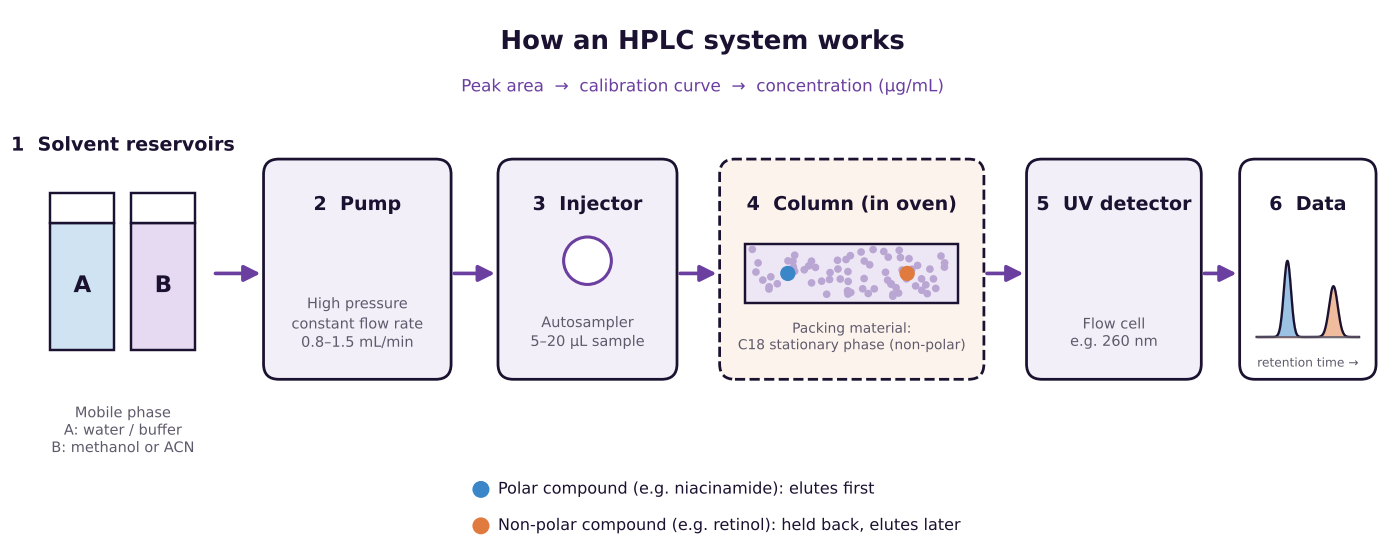
Most cosmetic methods are reversed phase: the stationary phase is non-polar (C18 carbon chains bonded to silica) and the mobile phase is a polar blend of water or buffer with methanol or acetonitrile. Polar molecules such as niacinamide leave early; oily, non-polar molecules such as retinol are held back longer [1].
Why do cosmetic labs rely on it? A serum or cream may hold 30 or more ingredients, and many absorb UV light at similar wavelengths. Measuring the whole product at once would blur them together. HPLC pulls the active away from preservatives, fragrance, emollients and degradation products first, so the number reported belongs to that one compound. That is what makes a result defensible in a stability report or a label-claim file.
02How does HPLC work, step by step
- Prepare the sample.
Weigh the product, dissolve or extract the active, then dilute and filter so no particles reach the column.
- Pump the mobile phase.
The HPLC system draws solvent from reservoirs and the pump delivers it at a constant flow rate, often 0.8–1.5 mL/min.
- Inject.
An autosampler places a fixed volume, typically 5–20 µL, into the flowing stream.
- Separate on the column.
Inside the column, molecules partition between the moving liquid and the stationary phase. Stronger interaction means a longer retention time.
- Detect.
Each band passes through the detector flow cell. A UV detector measures absorbance at a chosen wavelength, for example about 260 nm for niacinamide [2].
- Quantify.
Software integrates each peak, and the peak area is read against the calibration curve.
03The numbers that matter
| Term | What it means | Why it matters in a cosmetic lab |
|---|---|---|
| Retention time (tR) | Time from injection to the top of a peak | Identifies a peak by matching a reference standard |
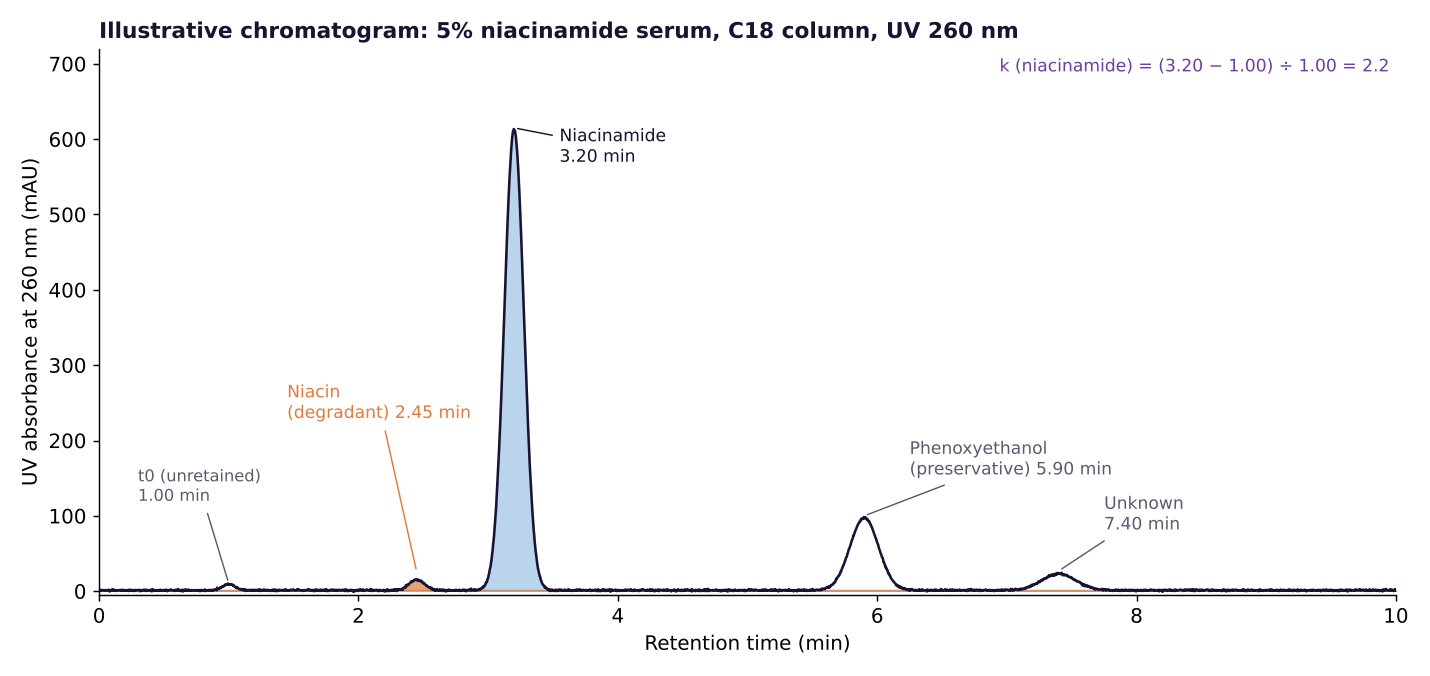
| Retention factor (k) | k = (tR − t0) ÷ t0, where t0 is the time for an unretained compound | Aim for k of about 2–10 (1–20 is acceptable): well retained, but the run stays short [6] |
| Resolution | How cleanly two neighbouring peaks separate | Keeps a degradant from hiding under the active peak |
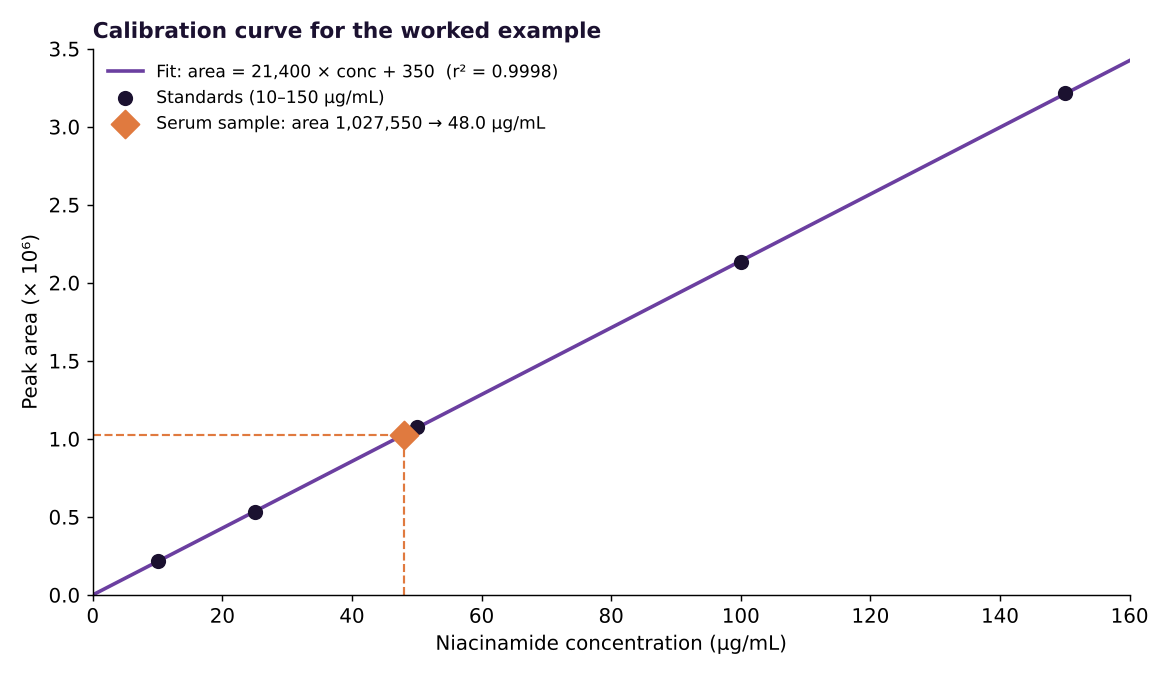
| Calibration curve | Peak area = slope × concentration + intercept | Converts a signal into µg/mL; must bracket the sample [4] |
04Worked example: niacinamide quantification in a 5% serum
A brand wants to confirm a serum labelled "5% niacinamide". The lab runs five standards from 10 to 150 µg/mL on a C18 column with UV detection [2]. The curve is: peak area = 21,400 × concentration + 350, with r² = 0.9998. The figures below are illustrative.
- Sample prep: 0.500 g serum is made up to 100 mL, then diluted 1 in 5.
- Result: sample peak area is 1,027,550, so concentration = (1,027,550 − 350) ÷ 21,400 = 48.0 µg/mL.
- Back-calculate: 48.0 × 5 = 240 µg/mL; × 0.1 L = 24.0 mg in 0.500 g = 4.80% w/w.
- Verdict: 96% of label claim. Whether that passes depends on the release specification the brand has set.
The same run can also look for niacin, a breakdown product that can cause flushing. In a 2025 conference abstract, formulas where niacinamide was added above 45 °C mostly held more than 380 ppm niacin, against under 52 ppm when it was added at 45 °C or below [5]. Read more in our guide to flush-free niacinamide serums.
05How cosmetic labs use HPLC analysis
| Use | What the lab is checking |
|---|---|
| Active assay | Does the batch contain the amount of niacinamide, vitamin C or salicylic acid stated in the formula? [2] |
| Stability-indicating method | Does the active fall over time, and do new peaks appear? A validated method must separate the active from its degradants [4] |
| Retinol degradation | Across 12 commercial products tested by HPLC-UV, retinoid content fell by 0–80% after six months at 25 °C and by 40–100% at 40 °C, and light caused more loss than heat [3]; see retinol |
| Label-claim check | Is the percentage on pack supported at release and at end of shelf life? |
| Benchmarking | Which actives, at what levels, are in a competitor product? |
These measurements feed directly into safety and stability testing, where active content is tracked at every time point rather than only on the day of manufacture.
06Common mistakes
- Treating one peak as one compound. Two ingredients can co-elute. Check specificity with a placebo and, where possible, diode-array peak purity [4].
- Calibrating outside the sample range. If the sample sits above the top standard, dilute it rather than extrapolate.
- Poor extraction from emulsions. Oil-soluble actives can stay trapped in the cream. Spike a placebo and confirm recovery close to 100%.
- Exposing retinol to light and heat during prep. Retinoids degrade faster under light than under heat [3], so use amber glassware and work quickly, or the result reflects the lab, not the product.
- Skipping system suitability. Before each run, inject a standard several times and confirm retention time, peak shape and repeatability are within limits. Drift in flow rate or a worn column shows up here first.
- Using an assay method for stability. Only a method shown to resolve degradants can be called stability-indicating [4].
07For brands and formulators
HPLC is one of the core tools behind deformulation. It tells you which actives are present and at what level, and our team combines it with GC-MS, FTIR and other techniques to rebuild a working formula. See reverse engineering and benchmarking, our hub guide deformulation explained: from INCI list to a working formula, and our overview of analytical methods used in cosmetic formulation.
08Questions readers ask
What is the difference between HPLC and liquid chromatography?
Liquid chromatography is the general technique. HPLC uses fine packing material and high pressure, so separations are faster and sharper.
What does retention time tell you?
It shows when a compound leaves the column. Matching it to a reference standard run under the same conditions helps identify the peak.
Can HPLC identify an unknown ingredient?
Not reliably with UV alone. Identification needs a reference standard or a mass spectrometer coupled to the HPLC (LC-MS).
How accurate is HPLC for cosmetic actives?
A validated method typically shows recovery close to 100% and low relative standard deviation, provided extraction and calibration are sound.
Need an active measured or a benchmark decoded?
We assay actives, run stability-indicating HPLC methods and deformulate benchmark products for brands and manufacturers.
09References
- Snyder LR, Kirkland JJ, Dolan JW. Introduction to Modern Liquid Chromatography. 3rd ed. Hoboken (NJ): Wiley; 2010. doi:10.1002/9780470508183. Wiley
- Jeon JS, Lee MJ, Yoon MH, Park JA, Yi H, Cho HJ, Shin HC. Determination of arbutin, niacinamide, and adenosine in functional cosmetic products by high-performance liquid chromatography. Anal Lett. 2014;47(10):1650–1660. doi:10.1080/00032719.2014.883517. Taylor & Francis
- Temova Rakuša Ž, Škufca P, Kristl A, Roškar R. Retinoid stability and degradation kinetics in commercial cosmetic products. J Cosmet Dermatol. 2021;20(7):2350–2358. doi:10.1111/jocd.13852. PubMed
- International Council for Harmonisation. ICH Q2(R2) Validation of analytical procedures. Step 4, 1 Nov 2023; in effect in the EU from 14 Jun 2024. EMA
- Barré M, Prigent E, Beaube M, Falip A, Berrada Gomez MP, Ferret PJ. P07-01 Niacinamide's impact on cutaneous tolerance of dermo-cosmetic products. Toxicol Lett. 2025;411(Suppl):S99. Conference abstract. doi:10.1016/j.toxlet.2025.07.260. ScienceDirect
- Dolan JW. Count the cost, part 2: increasing resolution by increasing retention. LCGC Europe. 2017;30(4). LCGC
Update log
- Published by Cosmetic Science Lab
This article is general technical information, not legal, regulatory or medical advice. Confirm requirements for your product and market before launch.