Cosmetics Rules, 2020: what they mean for cosmetic formulation in India
The Cosmetics Rules, 2020 decide where a product can be made, which ingredients it can contain, what goes on the label and which claims keep it a cosmetic. Here is how each part shapes formulation, including the 2025 amendment. Part of our product formulation series.
By Dr. Premalatha, Ph.D., Life Science, Regulatory Consultant, Cosmetic Science Lab
The rules behind this article
- Law
- Drugs and Cosmetics Act, 1940 [1]; Cosmetics Rules, 2020 (G.S.R. 763(E)), as amended in 2025 [2][3]
- Scope
- What the Rules mean for formulation, licensing, labelling and records in India
- Key point
- Compliance is a design input: screen ingredients, claims and labels at the brief stage
- Caveat
- Check the current gazette text for your product before launch
Quick answer
- What do the Cosmetics Rules, 2020 require of a formula? Ingredients within the BIS lists and limits, a licensed manufacturing site, a compliant label and claims that stay cosmetic.
- CDSCO registers imported cosmetics; State Licensing Authorities license manufacturing premises [2].
- The 2025 amendment changed date labelling, record-keeping and licence suspension, so check the current text [3].
Take-home message for brand owners
- Decide category and claims before you choose actives.
- Keep one technical file per product, from formula to final label.
Take-home message for formulators
- Screen every raw material against IS 4707 before the first prototype.
- Recheck the label whenever an ingredient or supplier changes.
01Where the Cosmetics Rules, 2020 sit in Indian law
Anyone commissioning cosmetic formulation services in India meets the same question: what do the rules require of the product, the premises and the label? A formula that ignores them can be technically elegant and still impossible to sell.
Cosmetics in India are regulated under the Drugs and Cosmetics Act, 1940 [1]. The Cosmetics Rules, 2020 were notified on 15 December 2020 (G.S.R. 763(E)) and placed the cosmetics provisions in a dedicated rulebook, separate from the Drugs Rules [2]. Authority is shared: the Central Drugs Standard Control Organisation (CDSCO) handles import registration and central oversight, while State Licensing Authorities license manufacturing premises [2]. The Rules were amended by the Cosmetics (Amendment) Rules, 2025 (G.S.R. 513(E), 29 July 2025), which, among other changes, define "use before" and "expiry" dates, set how long batch and raw-material records are kept, and let State Licensing Authorities suspend or cancel licences [3].
02The main requirement areas
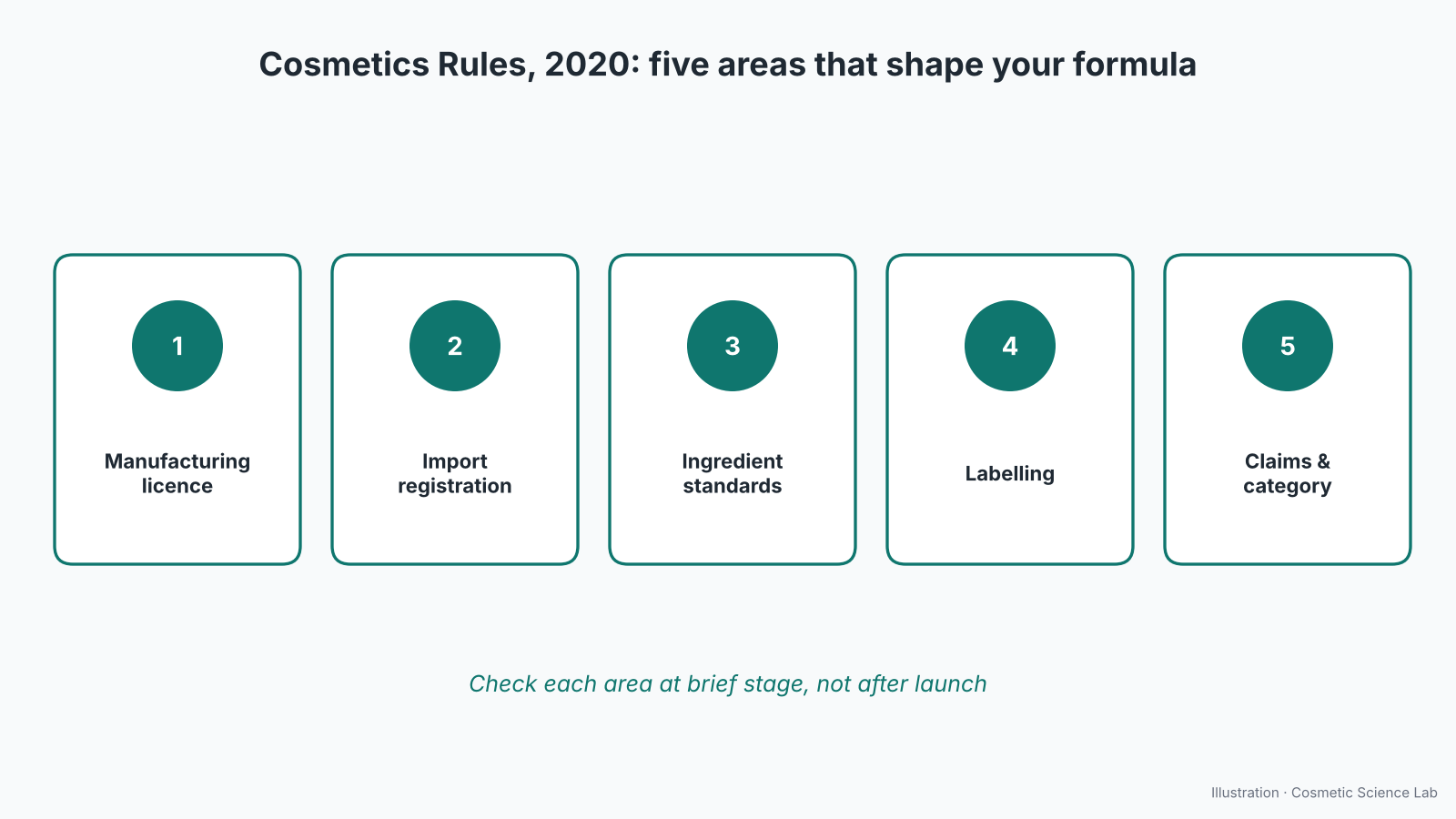
| Area | What it covers | Why it matters to formulation |
|---|---|---|
| Manufacturing licence | Cosmetics are made at premises licensed by the State Licensing Authority, per product category [2] | Your formula needs a licensed site for pilot and commercial batches |
| Import registration | Imported cosmetics need a registration certificate (Form COS-2) from CDSCO; the manufacturer, its authorised agent, its Indian subsidiary or the importer applies in Form COS-1 [2] | Relevant for imported or co-developed products |
| Ingredient standards | Products must conform to the BIS standards listed in the Rules and the IS 4707 ingredient lists (Rule 39) [2][4] | Ingredient choice and level must be screened early |
| Labelling | Product name, manufacturer details, batch and licence numbers, use-before or expiry date, net content, ingredients and warnings (Rule 34) [2]; MRP falls under the Legal Metrology (Packaged Commodities) Rules, 2011 | Pack artwork must be planned with the formula |
| Claims and category | Products making disease or therapeutic claims fall within the drug definition of the Act [1] | Claim wording shapes which actives and strengths are viable |
03How the rules shape formulation decisions
First, the ingredient screen. Each raw material is checked against the IS 4707 lists: colourants (Part 1), prohibited and restricted ingredients (Part 2), preservatives (Part 3) and UV filters (Part 4), each within its permitted limits [4]. Doing this at concept stage avoids the expensive discovery, after stability testing, that a hero ingredient cannot be used at the intended level.
Second, the claims. A moisturiser can support skin hydration; it cannot be positioned as treating a skin disease. The same applies to anti-dandruff, acne or pigmentation language, where wording separates a cosmetic from a drug [1], and Rule 36 bars false or misleading claims [2]. Draft claim language with the formula, not after it.
Third, documentation. Batch manufacturing records, ingredient specifications, supplier certificates and stability data show that the product is made consistently and give you a defensible file if a regulator, retailer or marketplace asks questions. The Rules set the premises and GMP requirements for Indian manufacture, and ISO 22716 is a useful international framework for the record-keeping [5].
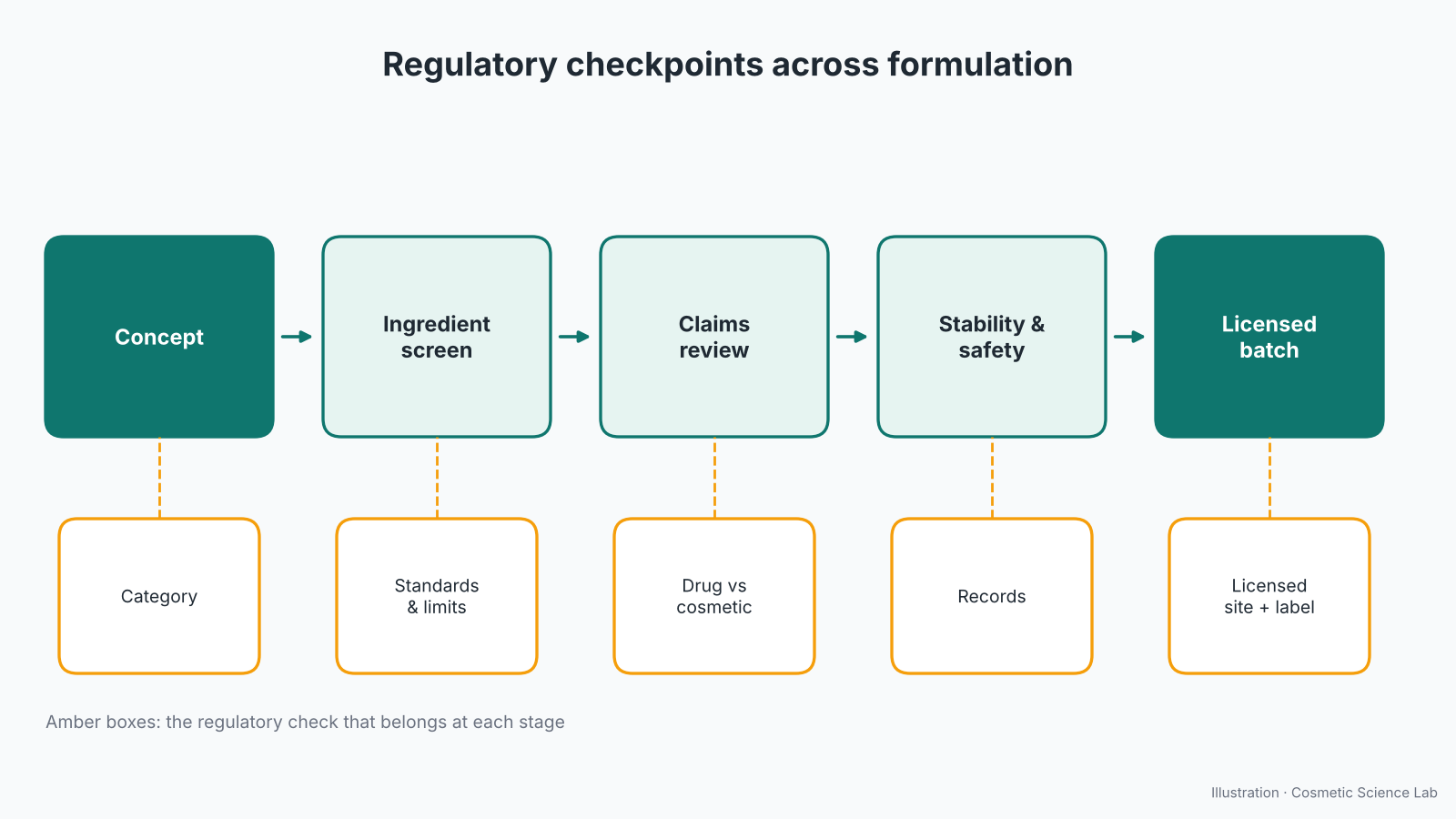
Regulatory review is cheapest at the brief stage and most expensive after launch.
04Licensing and the manufacturing site
A formula only becomes a product at a site holding the right licence. Many founders develop a formula with one partner and manufacture with another, which works as long as the process is documented well enough to transfer. Before approving a pilot batch, confirm that the site's licence covers the product category, ask how batches are recorded, and check how raw materials are received, stored and released. Our supplier qualification guide covers the raw-material side.
05Labelling pitfalls to avoid
Label problems are usually formulation problems in disguise. An ingredient list that does not match the final formula, a claim that outpaces the evidence, or a pack too small for the mandatory particulars can all force a redesign after printing. Agree the label with your formulator while the formula is still changing, recheck it whenever an ingredient or supplier is replaced, and use the 2025 definitions of "use before" and "expiry" when you set the date [3].
06Common mistakes in early-stage brands
- Copying an overseas formula without checking it against the IS 4707 lists.
- Using a colour or preservative that is not permitted for the intended product type.
- Choosing a claim first and looking for evidence later.
- Treating the stability study as optional because the product "looks fine".
- Changing a supplier or ingredient grade without re-testing.
07Documents to keep ready
Whether you work with a development partner or build in-house, keep one technical file per product: the approved formula, ingredient specifications, supplier safety information, stability and preservative challenge reports, batch records and the final label. That file turns a good product into a defensible one, and it is the first thing a serious retailer or regulator will ask to see. Stability data is explained in how an anti-aging cream is built to stay stable.
08Practical steps for brands
- Decide the category and claims first.
Then choose actives that fit them.
- Confirm the site licence.
Check that your manufacturing site holds a valid licence for the product category.
- Ask for a compliance screen.
Your formulation partner should screen ingredients against current Indian standards.
- Plan the label with the formulator.
Align claims, ingredient names and pack size.
- Keep one organised file.
Stability, batch and supplier records belong together.
- Check export rules early.
Markets such as the EU and UK add a Product Information File and Responsible Person.
09Planning for export from day one
Many brands we work with plan to sell abroad within a year or two. Building for the strictest market you expect to enter is usually cheaper than reformulating later, because ingredient lists, preservatives and safety documentation differ between regions. A formula designed with export in mind avoids a second development cycle; see our India market page and regulatory services.
Comparing partners? Our guide to choosing a cosmetic product development company lists the questions worth asking.
Need a compliance-minded formulation partner?
CSL formulation chemists screen ingredients and claims against Indian rules from the brief, so the product that reaches pilot scale is built to be licensed and labelled.
10Questions readers ask
Who regulates cosmetics in India?
CDSCO registers imported cosmetics and oversees the Rules centrally; State Licensing Authorities license manufacturing premises.
Do imported cosmetics need registration in India?
Yes. They need a registration certificate in Form COS-2, applied for in Form COS-1 by the manufacturer, its agent, its subsidiary or the importer.
Which standard lists permitted cosmetic ingredients in India?
BIS IS 4707, with parts covering colourants, prohibited and restricted ingredients, preservatives and UV filters.
Is MRP required under the Cosmetics Rules?
MRP comes from the Legal Metrology (Packaged Commodities) Rules, 2011; the Cosmetics Rules set the other label particulars.
11References
- The Drugs and Cosmetics Act, 1940 (Act No. 23 of 1940), as amended. New Delhi: Government of India. India Code
- Ministry of Health and Family Welfare (India). The Cosmetics Rules, 2020. G.S.R. 763(E). Gazette of India, Extraordinary; 2020 Dec 15. CDSCO (PDF)
- Ministry of Health and Family Welfare (India). The Cosmetics (Amendment) Rules, 2025. G.S.R. 513(E). Gazette of India, Extraordinary; 2025 Jul 29. Notification (PDF)
- Bureau of Indian Standards. IS 4707: Classification of cosmetic raw materials and adjuncts. Part 1, Colourants (2020); Part 2, prohibited and restricted ingredients; Part 3, preservatives; Part 4, UV filters (2022). New Delhi: BIS. BIS (Part 4 record)
- International Organization for Standardization. ISO 22716:2007 Cosmetics — Good Manufacturing Practices (GMP) — Guidelines on Good Manufacturing Practices. Geneva: ISO; 2007. ISO
Update log
- Published by Cosmetic Science Lab
This article is general technical information, not legal, regulatory or medical advice. Confirm requirements for your product and market before launch.