How an anti-aging cream is built to stay stable
An anti-aging cream must carry fragile actives, hold its emulsion together and stay free of microbes for its whole shelf life. Here is how formulators design the emulsion, protect retinoids and vitamin C, preserve the cream and prove stability. Part of our product formulation series.
By Dr. Premalatha, Ph.D., Life Science, Regulatory Consultant, Cosmetic Science Lab
The data behind this article
- Sources
- CTFA and Cosmetics Europe stability guidelines [5]; ISO/TR 18811 [6]; ISO 11930 [7]; retinoid and vitamin C stability studies [1][3][4]
- Scope
- Oil-in-water anti-aging creams carrying sensitive actives
- Design
- Formulation principles and published stability guidance
- Key point
- Stability is designed in through the emulsion, the actives, the preservative and the pack, then proven by testing
- Caveat
- Every protocol is set for the product, pack and target markets
Quick answer
- What keeps an anti-aging cream stable? A well-built emulsion, protected actives, a preservative system that works at the formula's pH, and a pack that keeps out light and air.
- A formula that is stable in a beaker can still fail at batch scale, so key checks are repeated on the pilot batch.
Take-home message for formulators
- Start from the claim and the active, then design the emulsion, preservative and pack around them.
- Repeat key stability checks on the pilot batch, not only on lab samples.
Take-home message for brand owners
- Ask for the stability protocol, checkpoints and pass criteria in writing.
- Set the launch date after the stability data, not before.
01Start with the emulsion
An anti-aging cream has to carry sensitive actives, hold together for its full intended shelf life (often two years or more), stay free of microbes and still feel good on skin. That is the daily work behind custom cosmetic formulation services.
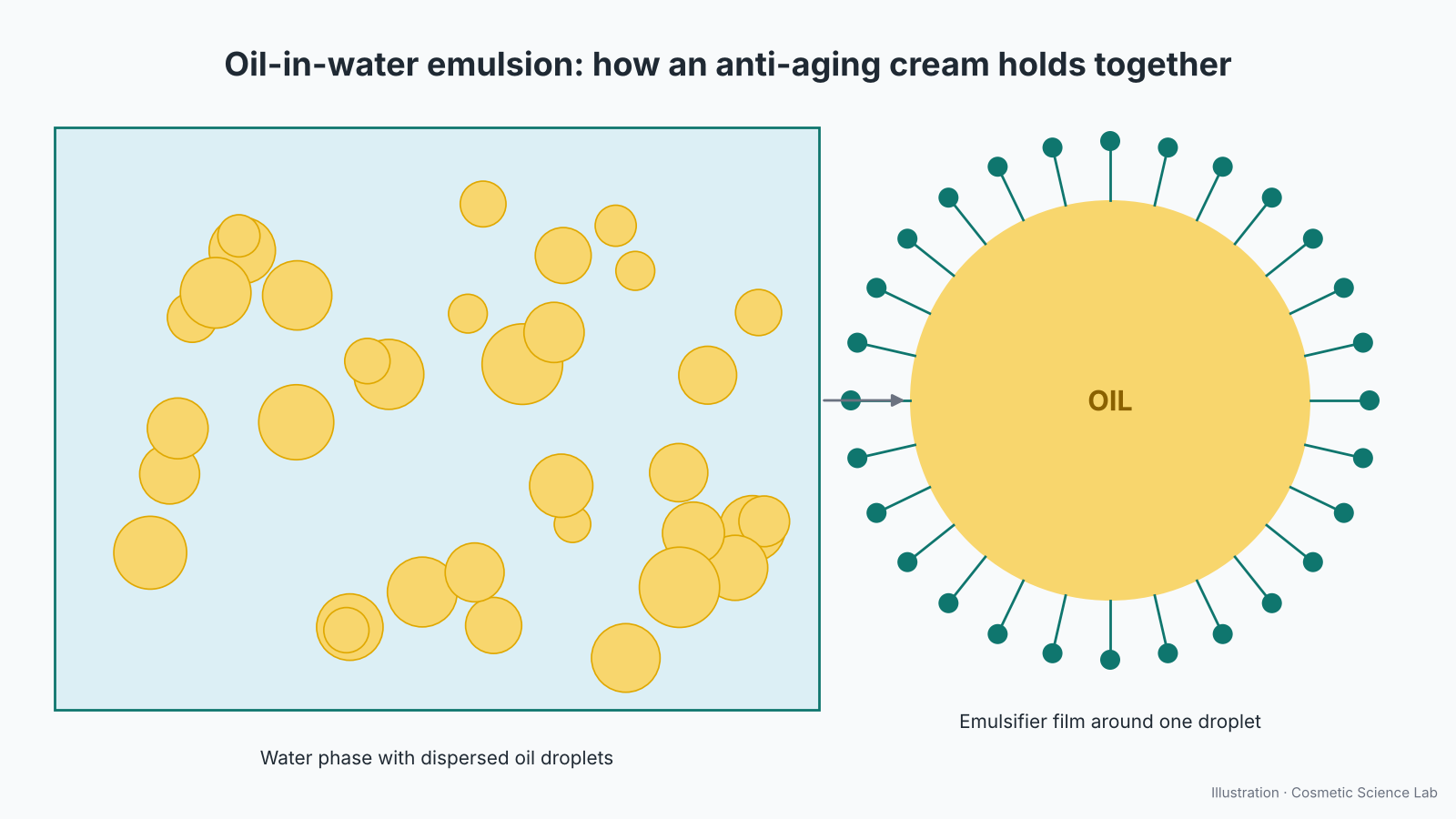
Most anti-aging creams are oil-in-water emulsions: small oil droplets dispersed in water and held there by an emulsifier system. Stability depends on droplet size, the type and amount of emulsifier, the polarity of the oil phase and the thickener network that stops droplets from moving. If any of these is mismatched, the cream may separate, thin out or turn grainy weeks after it looked perfect on the bench.
Processing matters as much as the ingredient list. Heating temperature, mixing speed, cooling rate and the point at which sensitive ingredients go in all change the final structure.
02Protect the actives
Anti-aging claims usually rest on actives that are chemically fragile. Retinoids degrade during storage, and heat and light speed the loss, which a kinetics study in commercial products has measured [1][2]. L-ascorbic acid penetrates skin best when formulated at low pH, below about 3.5 [3], and it oxidises readily, which is why stable vitamin C derivatives or protected systems are often used in creams [4]. Peptides and botanical extracts can be sensitive to pH, ions or enzymes.
- pH control.
Buffer the system where the active is most stable and the skin stays comfortable.
- Antioxidants and chelators.
Tocopherol and similar antioxidants limit oxidation, while chelating agents bind trace metals that speed it up.
- Encapsulation or derivative forms.
These can shield an active or release it more gradually.
- Packaging.
Opaque, airless or tube packs reduce light and oxygen exposure, and can matter as much as the formula. See our packaging compatibility guide.
03Preserve without irritation
Any water-containing cream can support microbial growth. The preservative system must cover bacteria, yeast and mould, work at the formula's pH and avoid irritating skin that may already be sensitised by retinoids or acids. It is verified with a challenge test, such as ISO 11930, in which the product is deliberately inoculated and monitored [7]. Preservative choice is also bounded by regulation, so in India it is screened early against the Cosmetics Rules, 2020 and the BIS ingredient standards they reference, IS 4707 [8].
04Stability you can feel: rheology and sensory
Consumers do not read stability reports. They notice that a cream feels thinner, stickier or heavier than it did last month. Rheology, the study of how a product flows and recovers, links the lab measurement to that experience. A cream needs enough structure to stay put in the jar and on the face, yet enough shear-thinning to spread easily. Tracking viscosity over time shows whether the thickener network is holding.
05Prove it with stability testing
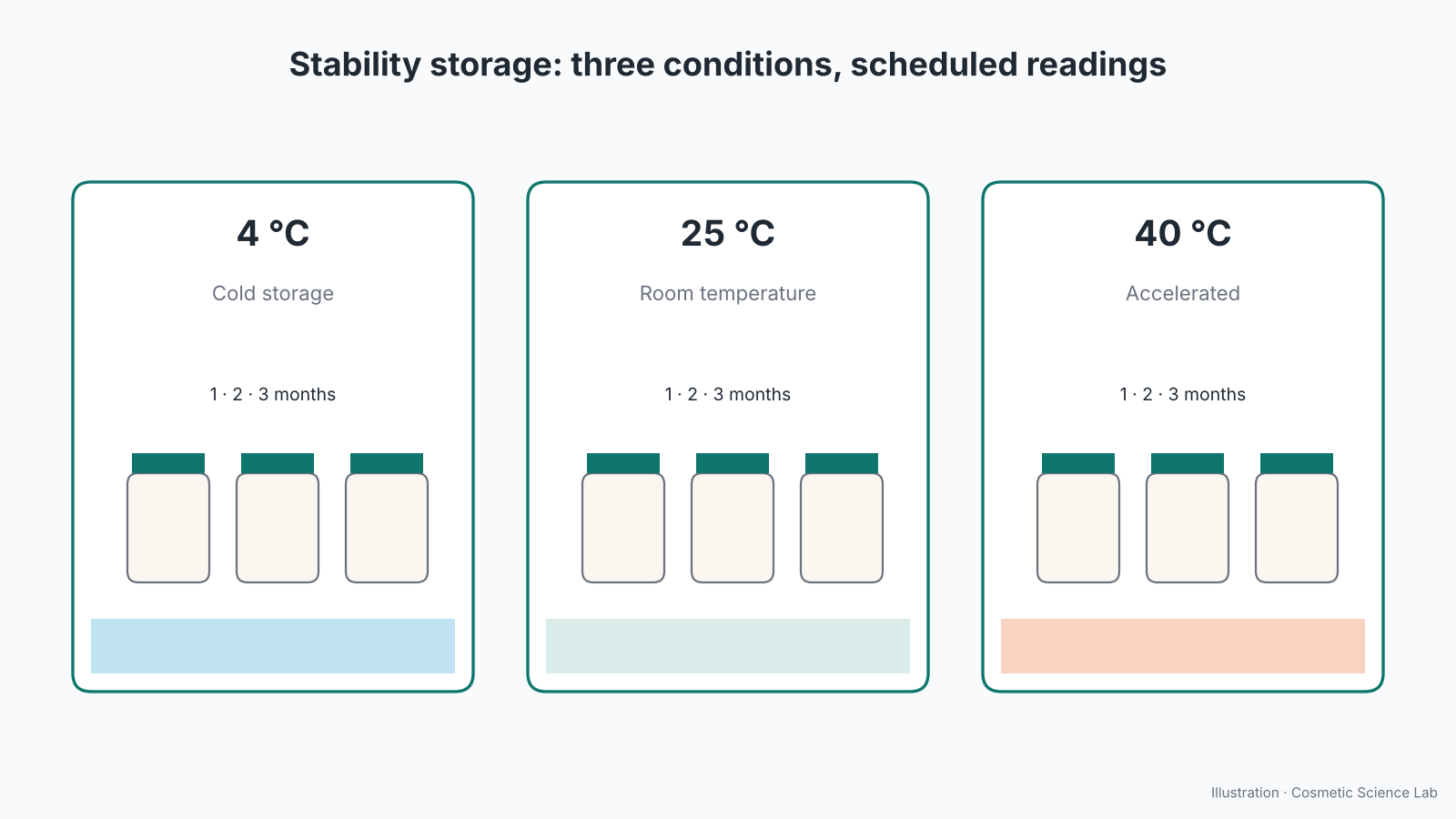
Stability testing turns assumptions into data. Industry guidance recommends storage at room temperature, elevated temperature and cold, with freeze–thaw cycles and light exposure where relevant [5][6]. Samples are checked at set intervals for appearance, colour, odour, pH, viscosity and, where possible, droplet size and active content.
| Test | Typical condition | What it reveals |
|---|---|---|
| Accelerated storage | Elevated temperature, often 37–45 °C (commonly 40 °C), for one to three months or longer [5] | Heat-driven separation, colour or odour change |
| Room temperature | 25 °C, real time through shelf life | Long-term behaviour |
| Cold storage | Around 4 °C | Crystallisation or thickening |
| Freeze–thaw | Repeated cycles between sub-zero and room temperature | Emulsion robustness in transport |
| Light exposure | Daylight or a light chamber, for transparent packs | Colour change and active loss |
| Centrifugation | High-speed spinning of a sample | Early warning of separation |
Conditions vary by project. The protocol is agreed against the product type, the pack and the target markets; ISO/TR 18811 leaves the manufacturer to define and justify it [6]. Do not read three months at 40 °C as proof of a two-year shelf life.
06Common failure modes and how formulators respond
| What you see | Likely cause | Typical response |
|---|---|---|
| Oil layer on top | Weak emulsifier system or droplet coalescence | Rebalance emulsifiers; refine homogenisation |
| Cream thins over weeks | Thickener breakdown or pH drift | Change polymer; buffer the system |
| Yellowing or odour | Oxidation of oils or actives | Add antioxidants and chelators; improve the pack |
| Grainy texture | Waxes or actives crystallising at low temperature | Adjust the wax blend; control cooling rate |
| Microbial growth | Weak preservation or contamination | Redesign the preservative system; review hygiene |
A worked example of the first row is in why a lotion separates at 40 °C.
07Scale-up: where a good formula can still fail
A cream that is stable in a laboratory beaker can behave differently in a 100-litre vessel. Shear, heat transfer and cooling time all change with scale, and so does the way sensitive ingredients are added. The safest route is a defined pilot stage: record every process parameter and repeat the key stability checks on the pilot batch before a commercial run. Our guide to scale-up and tech transfer covers this step.
08Choosing the right base for the claim
The claim decides the architecture. A firming cream built around peptides needs a pH and ionic environment matched to the peptide's stability window, which the supplier should confirm. A retinoid night cream needs low light exposure, antioxidants and a pack that keeps oxygen out. A vitamin C day cream may use a stable derivative or an anhydrous format [4]. Starting from the claim, rather than a favourite base, avoids retrofitting protection once problems appear.
The user matters too. A rich texture may suit mature, dry skin in a cool climate but feel heavy in humid conditions, so test prototypes where the product will be used. See our anti-ageing application page.
09How to evaluate custom cosmetic formulation services
Ask a formulation partner how they will prove stability, not just whether they will. Request the protocol, the checkpoints and the pass or fail criteria. A credible lab will also explain which parts of the formula changed because of test findings. These steps sit inside the wider cosmetic product development process.
Comparing partners? Read how to choose a cosmetic product development company.
Developing an anti-aging cream?
CSL formulation chemists build stability-led anti-aging formulas, from active strategy and prototypes to preservation, stability and the pilot batch.
10Questions readers ask
How long does stability testing of a cream take?
Accelerated storage commonly runs for one to three months or longer, while real-time storage continues through the intended shelf life.
Why does my cream separate after a few weeks?
The usual causes are a weak emulsifier system, droplet coalescence or thickener breakdown, often shown first at elevated temperature.
Is a retinol cream harder to stabilise?
Yes. Retinoids degrade with heat and light, so they need antioxidants, a suitable process and an opaque or airless pack.
What is a challenge test?
A test, such as ISO 11930, in which the product is deliberately inoculated with microbes to check that the preservative system controls them.
11References
- Temova Rakuša Ž, Škufca P, Kristl A, Roškar R. Retinoid stability and degradation kinetics in commercial cosmetic products. J Cosmet Dermatol. 2021;20(7):2350–8. doi:10.1111/jocd.13852
- Mukherjee S, Date A, Patravale V, Korting HC, Roeder A, Weindl G. Retinoids in the treatment of skin aging: an overview of clinical efficacy and safety. Clin Interv Aging. 2006;1(4):327–48. doi:10.2147/ciia.2006.1.4.327
- Pinnell SR, Yang H, Omar M, Monteiro Riviere N, DeBuys HV, Walker LC, et al. Topical L-ascorbic acid: percutaneous absorption studies. Dermatol Surg. 2001;27(2):137–42. doi:10.1046/j.1524-4725.2001.00264.x
- Stamford NPJ. Stability, transdermal penetration, and cutaneous effects of ascorbic acid and its derivatives. J Cosmet Dermatol. 2012;11(4):310–7. doi:10.1111/jocd.12006
- CTFA, Cosmetics Europe (Colipa). Guidelines on stability testing of cosmetic products. Brussels: Colipa; 2004 Mar. Cosmetics Europe (PDF)
- International Organization for Standardization. ISO/TR 18811:2018 Cosmetics — Guidelines on the stability testing of cosmetic products. Geneva: ISO; 2018. ISO
- International Organization for Standardization. ISO 11930:2019 Cosmetics — Microbiology — Evaluation of the antimicrobial protection of a cosmetic product. Geneva: ISO; 2019. ISO
- Ministry of Health and Family Welfare (India). The Cosmetics Rules, 2020. G.S.R. 763(E), 15 Dec 2020, as amended. New Delhi: CDSCO. CDSCO (PDF)
Update log
- Published by Cosmetic Science Lab
This article is general technical information, not legal, regulatory or medical advice. Confirm requirements for your product and market before launch.