How to choose a cosmetic product development company: a founder's guide
Your development partner shapes quality, timeline, cost and who owns the formula. Here are seven criteria, the questions that reveal the real answer, which model fits your stage, the costs to itemise and the red flags. Part of our product formulation series.
By Dr. Premalatha, Ph.D., Life Science, Regulatory Consultant, Cosmetic Science Lab
At a glance
- Who it is for
- Founders and brand teams comparing cosmetic product development partners
- What you get
- Seven criteria, a question scorecard, a stage-to-model map and red flags
- Key point
- Formula ownership, stability proof and itemised costs separate strong partners from weak ones
- Caveat
- Contract terms vary; agree ownership in writing before work starts
Quick answer
- How do you choose a cosmetic product development company? Check who formulates, what lab and pilot capability they have, how they prove stability, and who owns the formula.
- Know the model you are buying: an original custom formula, an adapted stock base, or a ready-made private label product.
- Ask for fees, prototype rounds, stability testing, pilot batches and minimum order quantities as separate line items.
- Send the same brief to every shortlisted partner and compare the written answers, not just the price.
Take-home message for founders
- Get formula ownership and transfer rights in writing before you pay a development fee.
- Set the launch date after the stability protocol, not before.
Take-home message for brand teams
- Score every partner on the same questions and the same brief.
- Ask for a sample of the documents handed over at the end of a project.
01Know what you are buying
Choosing a cosmetic product development company is the first big decision a founder makes, and it quietly shapes quality, timeline, cost and who owns the formula. Companies that call themselves development partners offer very different things. Some are formulation labs that create original formulas. Some are contract manufacturers that adapt stock bases. Others sell ready-made products under your brand. Each model has a place, but they carry different levels of customisation, ownership and risk.
Private label cosmetics development usually starts from an existing base, which shortens timelines and lowers minimums. A custom route starts from your brief and offers more differentiation. Our comparison of private label, white label and custom formulation explains what you own under each.
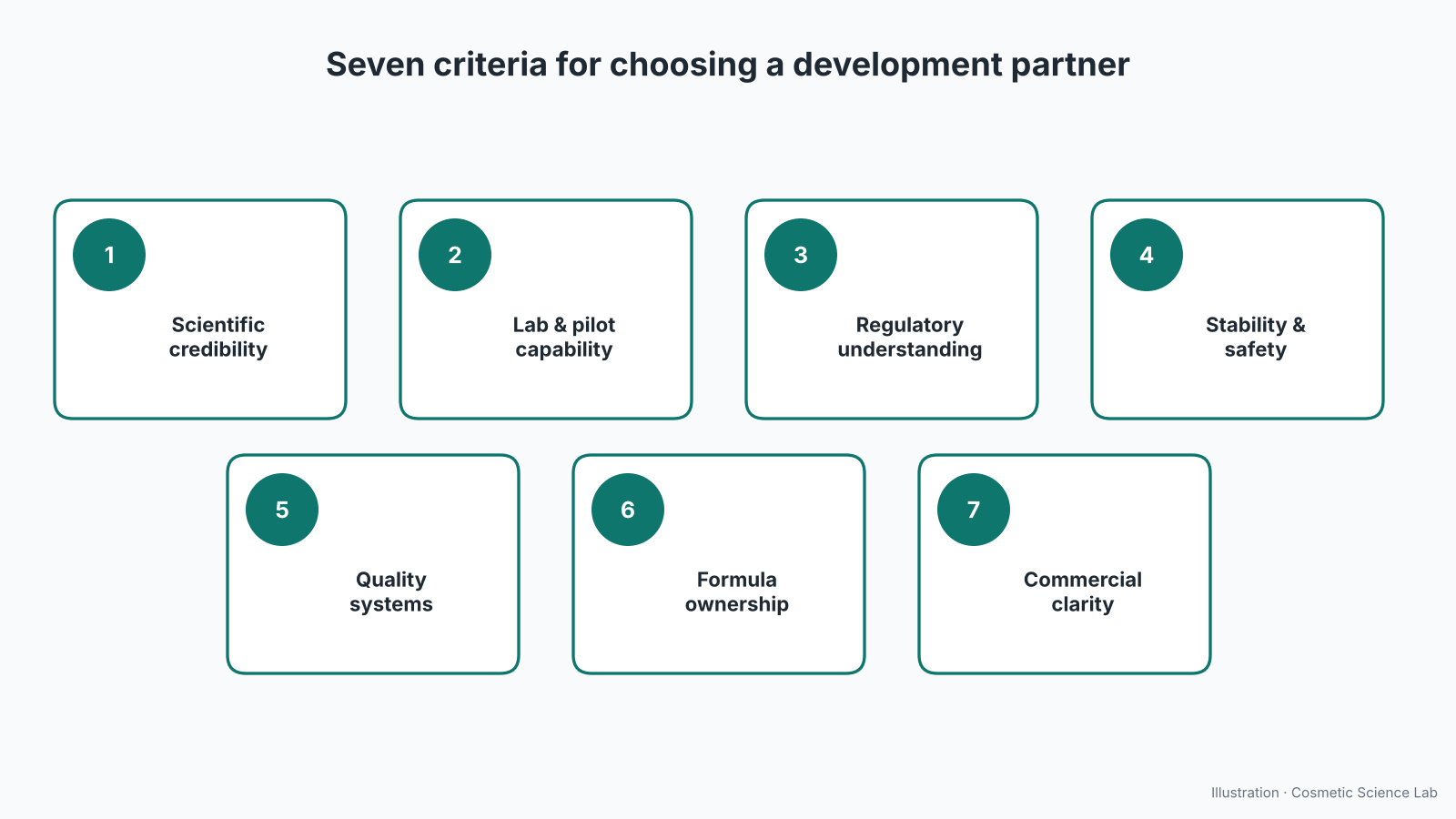
02Seven criteria for choosing a cosmetic product development company
- Scientific credibility.
Who will actually formulate? Look for a named cosmetic chemist with relevant qualifications and experience in your product type.
- Laboratory and pilot capability.
Ask where prototypes are made, how batches are scaled and which instruments are used for pH, viscosity and microscopy.
- Regulatory understanding.
The team should know the Cosmetics Rules, 2020, as amended [1], and the rules of any export market you plan to enter.
- Stability and safety discipline.
Ask for the stability protocol, the preservative challenge approach and how the safety assessment is handled.
- Quality systems.
For manufacture in India, the site must meet the manufacturing and premises requirements of the Cosmetics Rules [1]. Certification to ISO 22716 good manufacturing practice also signals disciplined documentation and traceability [2].
- Formula ownership and confidentiality.
Clarify in writing who owns the final formula, whether it can move to another manufacturer and how your brief is protected.
- Commercial clarity.
Look for transparent fees, defined revision rounds, realistic timelines and sensible minimum order quantities.
03Questions that reveal the real answer
| Question | Strong answer | Warning sign |
|---|---|---|
| Who owns the formula? | You do, after payment, with a written transfer | Ownership is vague or tied to the supplier |
| How many prototype rounds are included? | A stated number, with a clear charge for extra rounds | "As many as needed" with no scope |
| How do you prove stability? | A written protocol with checkpoints and criteria | "We have used this base for years" |
| Can the formula move to another manufacturer? | Yes, with a documented process | The product works only in one facility |
| What if a claim needs evidence? | Testing options and costs are explained | Claims are promised without testing |
04Match the model to your stage
| Stage | Best-fit route | Trade-off |
|---|---|---|
| Testing an idea on a small budget | Private label development from an existing base | Faster and cheaper, but less differentiated |
| Building a signature product | Custom formulation with a development partner | More time and investment, stronger brand story |
| Scaling an existing range | Formula transfer and process optimisation | Needs thorough documentation |
| Entering export markets | Regulatory-led formulation for the destination | Extra safety and file requirements |
05Costs and minimums to discuss early
Development fees, prototype ingredients, stability testing, pilot batches and minimum order quantities are separate line items, so ask for them itemised. A low development fee paired with a very high minimum order can cost more than a higher fee with a flexible first run. Also ask what happens if the formula must change after approval, because revisions are where budgets quietly grow.
06Contracts, confidentiality and ownership
Put the essentials in writing before work starts: a confidentiality agreement, the scope of work, the number of revision rounds, payment milestones, and who owns the final formula and the data behind it. If you may move production later, confirm that the process documentation will be handed over. A trustworthy partner will welcome these questions.
07A realistic development timeline
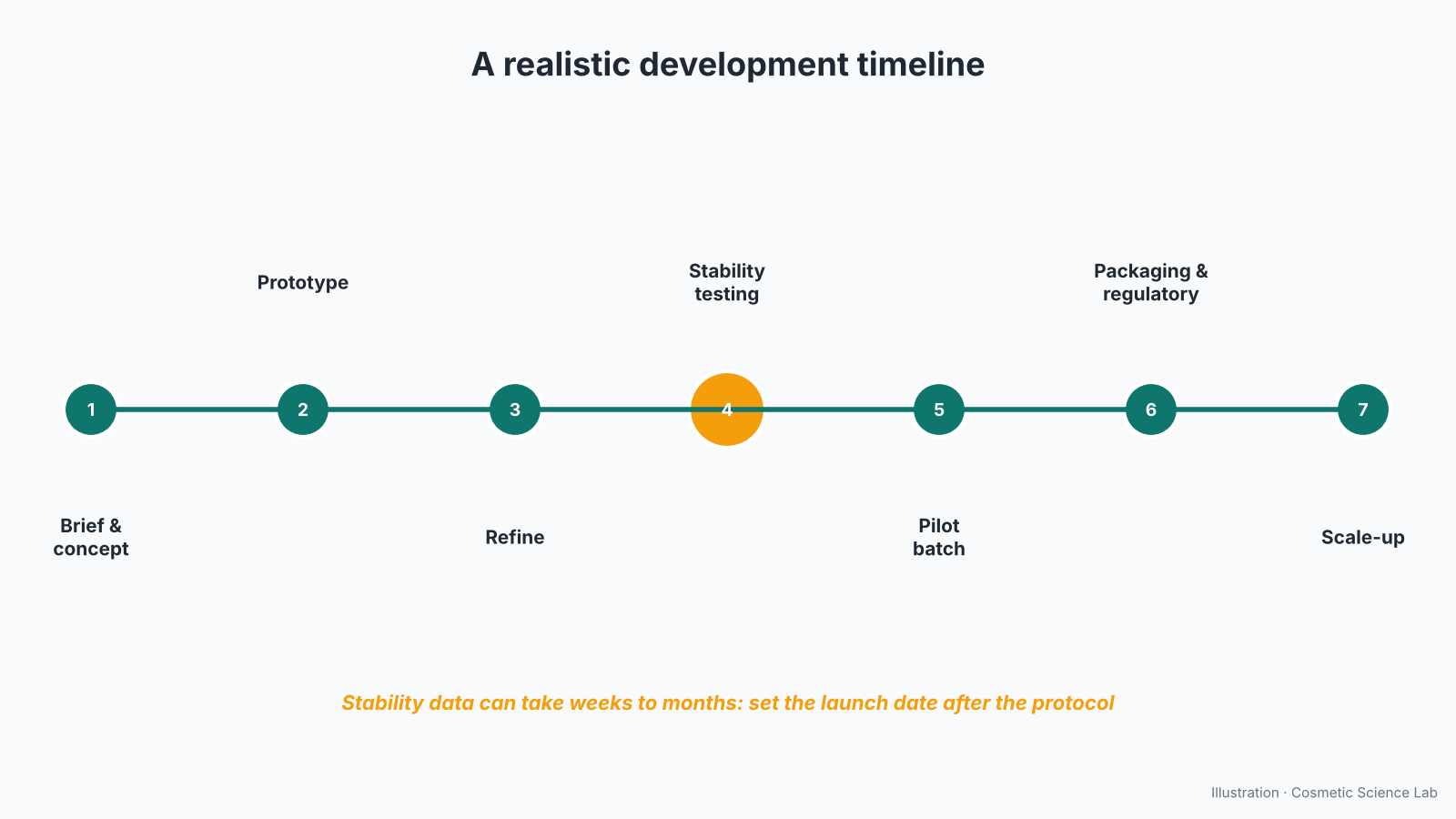
Founders often underestimate time. A new skin care product typically moves through brief and concept, prototypes, refinement, stability testing, a pilot batch, packaging and regulatory preparation, then commercial scale-up. Accelerated stability data alone commonly takes one to three months, with real-time studies continuing after that [3], so set the launch date after the protocol. Our cosmetic product development process guide breaks down each stage.
08Red flags to watch for
- Guaranteed results, or claims with no testing plan.
- No named scientist or technical lead.
- Reluctance to share documentation or process details.
- Pressure to commit to large minimum orders before a prototype is approved.
- A competitor's formula offered as the starting point.
09How to run a fair comparison
Send the same brief to every shortlisted company and ask for a written scope, timeline and cost breakdown. Compare the answers on substance, not price alone; the partner who asks the most useful questions about your customer, claims and budget is often the one who delivers the most reliable product. Ask for references from brands at a similar stage, and for a sample of the documents handed over at the end of a project. If communication is slow or vague during the sales stage, it rarely improves once development begins.
10Prepare before the first call
The best conversations start with a clear brief: the target customer, the format, the claims, the price tier and the launch window. If you are still shaping the idea, read how to start a skincare line first. To see how a brief turns into a pilot batch, read our even-tone serum worked example, and use Table 1 as a scorecard when you compare any partner, including us.
Comparing development partners?
CSL develops custom formulas from brief to pilot batch, documents every stage so the formula can transfer, and you own the formula and its documentation.
11Questions readers ask
What does a cosmetic product development company do?
It turns a brief into a finished formula, with prototypes, stability and safety work, a pilot batch and the documents a manufacturer needs.
Should I choose private label or custom formulation?
Private label is faster and cheaper for testing an idea; custom formulation takes longer but gives a differentiated product you can own.
Who owns the formula after development?
It depends on the contract, so agree in writing before work starts that ownership transfers to you after payment.
How long does it take to develop a cosmetic product?
Several months is common, because stability testing alone often needs one to three months of accelerated data before launch decisions.
12References
- Ministry of Health and Family Welfare (India). The Cosmetics Rules, 2020. G.S.R. 763(E), 15 Dec 2020, as amended. New Delhi: CDSCO. CDSCO (PDF)
- International Organization for Standardization. ISO 22716:2007 Cosmetics — Good Manufacturing Practices (GMP) — Guidelines on Good Manufacturing Practices. Geneva: ISO; 2007. ISO
- CTFA, Cosmetics Europe (Colipa). Guidelines on stability testing of cosmetic products. Brussels: Colipa; 2004 Mar. Cosmetics Europe (PDF)
Update log
- Published by Cosmetic Science Lab
This article is general technical information, not legal, regulatory or medical advice. Confirm requirements for your product and market before launch.