Worked example: an even-tone serum from brief to pilot batch
How a hyperpigmentation and brightening serum project would typically move from brief to an approved pilot batch: claim wording, active strategy, prototypes, tolerance, stability and scale-up. This is an illustrative worked example, not a client project. Part of our product formulation series.
By Dr. Premalatha, Ph.D., Life Science, Regulatory Consultant, Cosmetic Science Lab
Worked example. This page walks through how an even-tone serum project would typically move from a brief to an approved pilot batch, using our standard process. It is illustrative: it does not describe a specific client project, and no measured results are reported.
At a glance
- Product
- A water-based even-tone serum (illustrative)
- Stages
- Brief, ingredient screen, prototypes, evaluation, stability, pilot batch
- Evidence used
- Niacinamide, arbutin and vitamin C studies [3][4][5][6]; Indian cosmetic and drug definitions [1][2]
- Key point
- Claim wording, tolerance and stability decide whether a tone serum survives launch
- Caveat
- Timelines and choices depend on the brief; nothing here is client data
Quick answer
- How is an even-tone serum developed? Brief, ingredient and claim screen, two to four prototypes, sensory and preservative checks, a stability protocol, then a documented pilot batch.
- Most of the elapsed time goes on stability readings, so the launch date should follow the protocol.
Take-home message for formulators
- Screen actives for pH window, compatibility and regulatory status before the first prototype.
- Repeat key stability checks on the pilot batch.
Take-home message for brand owners
- Write the claim and the cost target before choosing actives.
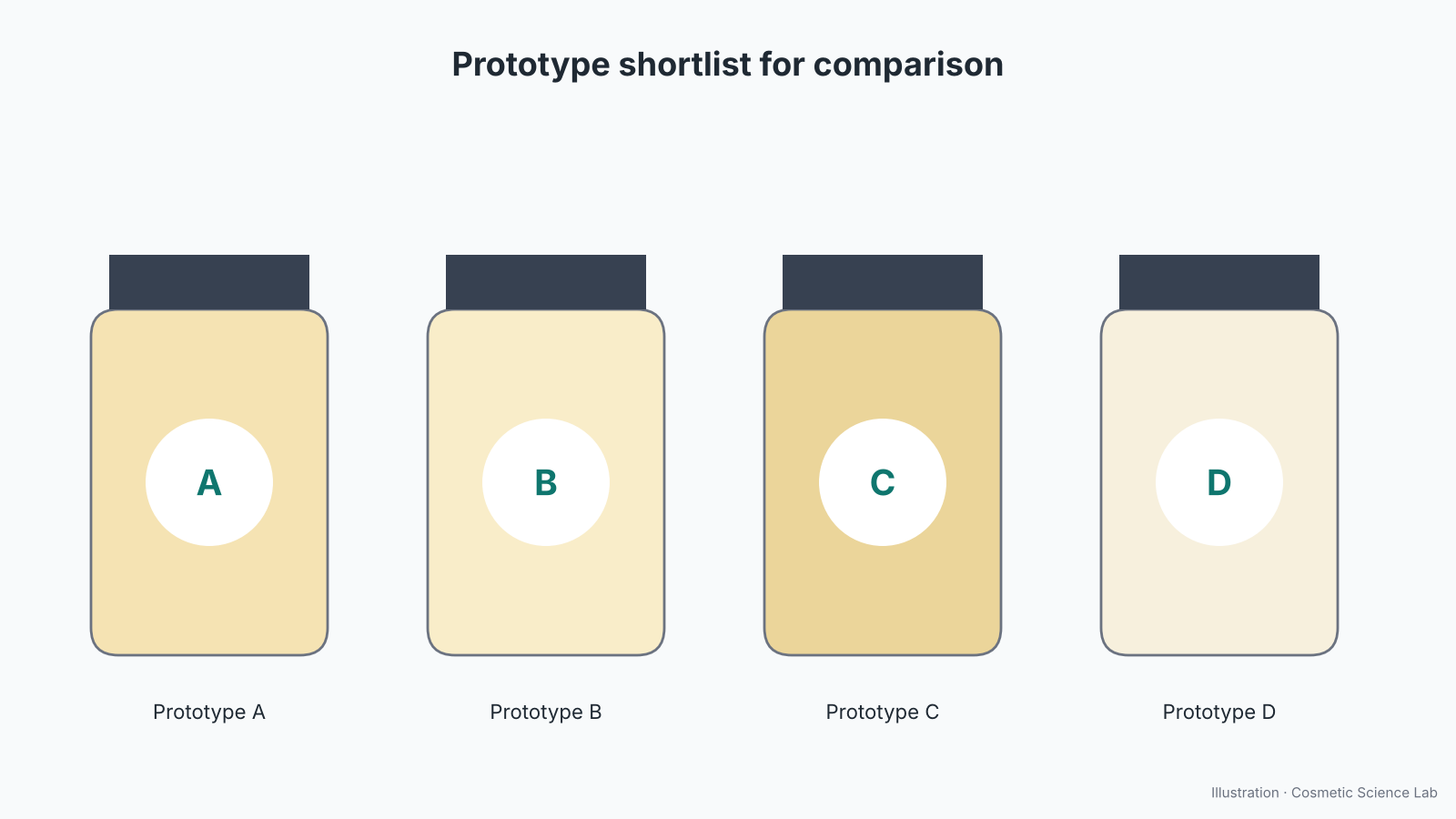
- Compare two or three prototype directions, not one.
01The brief
Uneven tone and post-blemish marks are among the most common concerns brands bring to a formulation lab. A hyperpigmentation or brightening project starts with four decisions: the target user, the format, the claim position and the cost target. Writing them down first means every later choice can be tested against the brief.
For an even-tone serum, the brief says who the product is for, whether the texture is a watery essence or a richer serum, how it will be positioned and which price tier it must meet. A mass-market serum and a premium clinic-channel serum can share hero actives yet need very different ingredient budgets.
02Setting the claim and the evidence plan
Tone language needs careful wording. In India, a product sold as a cosmetic should make appearance claims, such as "helps skin look more even", not claims to treat a pigmentation disorder, which would point to a drug under the Drugs and Cosmetics Act, 1940 [2]. Rule 36 of the Cosmetics Rules, 2020 also prohibits false or misleading claims [1]. So the claim is written around appearance and matched to a testing plan, and every sentence on the pack has evidence behind it. Our claims and clinical testing page covers the options.
03Choosing the active strategy
Several ingredient classes are used for tone-focused products. Niacinamide reduces the transfer of melanosomes to skin cells in laboratory models [3], and a systematic review lists it among topical agents with good clinical support for post-inflammatory hyperpigmentation [4]. Arbutin and its derivatives inhibit tyrosinase, earlier in the melanin pathway [5]. Vitamin C and its more stable derivatives add antioxidant support [6]. Daily sunscreen remains the essential partner, because ultraviolet exposure drives pigmentation.
The shortlist is screened for compatibility, pH window, regulatory status and cost before any prototype is made. For a deeper look at one active, read our niacinamide serum formulation guide.
04From concept to pilot batch
| Stage | Work carried out | Deliverable |
|---|---|---|
| Brief and benchmark | Define user, claim and cost; benchmark comparable products | Approved formulation brief |
| Concept and ingredient screen | Select actives and carriers; check regulatory compliance | Concept formula and ingredient list |
| Prototyping | Build and refine lab prototypes for texture, pH and appearance | Shortlisted prototypes |
| Evaluation | Sensory review with the brand team; preservative challenge and stability set-up | Selected lead prototype |
| Stability | Accelerated, cold, freeze–thaw and light checks with scheduled readings | Stability report |
| Pilot batch | Scale-up, process documentation and batch record | Pilot batch and process file |
05Sensory evaluation
Tone serums are used daily, so feel matters as much as efficacy. Prototypes are compared for spreadability, absorption, residue and finish, usually with the brand team and sometimes with a small user panel. This stage often decides between two technically sound options: a formula that performs on paper but feels tacky is unlikely to earn reorders. See our sensory testing guide.
06Safety and tolerance
Tone actives are often used on skin already sensitised by acne, sun or irritation. Formulators review each ingredient's safety profile, keep concentrations within appropriate levels, leave fragrance out unless essential and check that the pH suits the skin. Supplier safety documents and, where appropriate, tolerance testing go into the project file.
07Solving the stability challenge
Tone serums are often water-based, with actives that prefer a particular pH and can discolour or lose potency over time. Typical responses are tuning the pH window, adding a chelating agent and antioxidant support, and choosing a pack that limits light and air. An opaque airless pump also reduces contamination in use, and compatibility testing confirms the formula does not interact with the pack. Each change is tested against the stability protocol rather than assumed to work; our anti-aging cream stability guide explains the conditions.
08Scaling to a pilot batch
A lab-scale formula is not a production formula. Scale-up reviews mixing speed, order of addition, hold times, filtration and filling temperature. Each parameter goes into a batch record so the result can be reproduced, and key stability checks are repeated on the pilot batch before a commercial run. The handover would include:
- The approved formula and ingredient list.
- Process instructions and the pilot batch record.
- Stability and preservative challenge reports.
- Guidance on label content and claim wording.
- A transfer package for a licensed manufacturer.
09Timeline and lessons
A project like this would usually run for several months from brief to approved pilot batch, with most of the time spent waiting for stability readings rather than formulating. Brands that compress this stage risk finding a problem after the product is on shelf. For a stage-by-stage timeline with overlapping steps, see our brightening serum development timeline.
Testing more than one direction also pays off. Two prototypes that look alike on the bench can diverge in stability and feel. And because pigmentation takes weeks to change visibly, customers judge the serum first by feel, comfort and consistency; formulating for tolerance and stability first gives the claim a fair chance, and pairing the serum with daily sunscreen in the brand's routine supports the result customers want.
Next in this cluster: how we compare products before formulating, in our technical benchmark study.
Planning an even-tone or brightening product?
CSL formulation chemists take tone-focused serums from brief and claim wording through prototypes and stability to a documented pilot batch.
10Questions readers ask
Can a brightening serum claim to treat pigmentation?
Not as a cosmetic in India. It can claim a more even-looking tone; treating a disorder is a drug claim.
Which actives are used in even-tone serums?
Common choices are niacinamide, arbutin and its derivatives, and vitamin C or its derivatives, chosen for pH, compatibility and cost.
How long does it take to develop a brightening serum?
Several months from brief to approved pilot batch is typical, with most of the time spent on stability readings.
Why do brightening serums discolour?
Some actives oxidise or drift out of their pH window; chelators, antioxidants and an opaque airless pack reduce this.
11References
- Ministry of Health and Family Welfare (India). The Cosmetics Rules, 2020. G.S.R. 763(E), 15 Dec 2020, as amended. Rule 36. New Delhi: CDSCO. CDSCO (PDF)
- The Drugs and Cosmetics Act, 1940 (Act No. 23 of 1940), as amended. Section 3. New Delhi: Government of India. India Code
- Hakozaki T, Minwalla L, Zhuang J, Chhoa M, Matsubara A, Miyamoto K, et al. The effect of niacinamide on reducing cutaneous pigmentation and suppression of melanosome transfer. Br J Dermatol. 2002;147(1):20–31. PubMed
- Tan MG, Kim WB, Jo CE, Nabieva K, Kirshen C, Ortiz AE. Topical treatment for postinflammatory hyperpigmentation: a systematic review. J Dermatolog Treat. 2022;33(5):2518–26. doi:10.1080/09546634.2021.1981814
- Boo YC. Arbutin as a skin depigmenting agent with antimelanogenic and antioxidant properties. Antioxidants (Basel). 2021;10(7):1129. doi:10.3390/antiox10071129
- Correia G, Magina S. Efficacy of topical vitamin C in melasma and photoaging: a systematic review. J Cosmet Dermatol. 2023;22(7):1938–45. doi:10.1111/jocd.15748
Update log
- Published by Cosmetic Science Lab
This article is general technical information, not legal, regulatory or medical advice. Confirm requirements for your product and market before launch.