Hair-growth claims: trichogram and phototrichogram explained
How a hair growth clinical study measures hair density, the growth phase and shaft diameter, and which claim wording each result can support. Part of our hair and scalp series.
By Dr. Premalatha, Ph.D., Life Science, Regulatory Consultant, Cosmetic Science Lab

At a glance
Quick answer
- The trichogram needs plucked hairs. The phototrichogram and TrichoScan use a clipped area imaged twice, two to three days apart [1].
Take-home message for brand owners
- Agree the claim wording first, then choose the method that can support it.
- Budget for six months of study time, plus recruitment and reporting.
Take-home message for formulators
- Test the final formula against its own vehicle, not against nothing.
- Freeze the formula before the study starts; a later change can void the evidence.
A hair growth clinical study measures what happens to hairs on a marked area of scalp over time, usually three to six months. The trichogram examines plucked hairs. The phototrichogram and TrichoScan count hairs in growth and rest phases from images of a clipped area, and global photography adds expert-graded pictures of the whole scalp [1][2][3]. The method chosen decides which claim wording the result can support, so it should be picked with the claim in mind.
01Why the hair cycle sets the study length
Each hair follows a cycle of growth (anagen), regression (catagen) and rest (telogen). On the scalp, anagen lasts years, while telogen lasts about two to four months [4]. A change in the balance of the cycle therefore takes months to show. That is why hair growth claim substantiation relies on studies of 90 to 180 days. In a small TrichoScan study of nine men using 5% minoxidil, hair density and cumulative hair thickness had risen significantly at three and at six months [5]. The measurable outcomes are hair density, the share of hairs in anagen and hair shaft diameter.
02The methods compared
A trichogram plucks 60 to 80 hairs and sorts them by their roots [1]. A phototrichogram clips a marked area of about 1 cm² and photographs it twice, 48 hours apart: hairs that have grown are in anagen [1]. TrichoScan automates this with epiluminescence microscopy and image analysis of a clipped, dyed area [1][2][5]. Some users report counting errors, so the output still needs checking [1].
| Method | What it measures | Invasiveness | Claim it can support |
|---|---|---|---|
| Trichogram | Plucked hairs examined under a microscope for the anagen/telogen ratio [1] | Semi-invasive (plucking) | Share of hairs in the growth phase |
| Phototrichogram | A clipped, marked area photographed twice, about 48 hours apart, to identify growing hairs [1] | Non-invasive (clipping only) | Hair density, growth rate, anagen share |
| TrichoScan | Epiluminescence microscopy of a clipped, dyed area with automated image analysis [2][5] | Non-invasive (clipping and dye) | Density, hair shaft diameter, anagen/telogen ratio |
| Global photography | Standardised scalp photographs rated by blinded experts on a fixed scale [3][1] | Non-invasive | Visible change in scalp coverage |
| Consumer self-assessment | Perceived thickness and fullness, by questionnaire | None | Perception wording only |
Global photography fixes head position, lighting and magnification so images can be compared over time [3]. Experts often rate before-and-after pairs on a seven-point scale [1].
03Panel size, controls and ethics
The EU claims guidance asks for well-designed, reliable and reproducible methods, a written protocol, defined evaluation criteria and appropriate statistics [8]. In practice, a power calculation based on the expected effect and its variability should set the panel size, not a round number. Human studies should use the target population, chosen with strict inclusion and exclusion criteria [8]. For hair loss, subjects are usually staged on the Hamilton–Norwood scale for men [9] or the Ludwig scale for women [10].
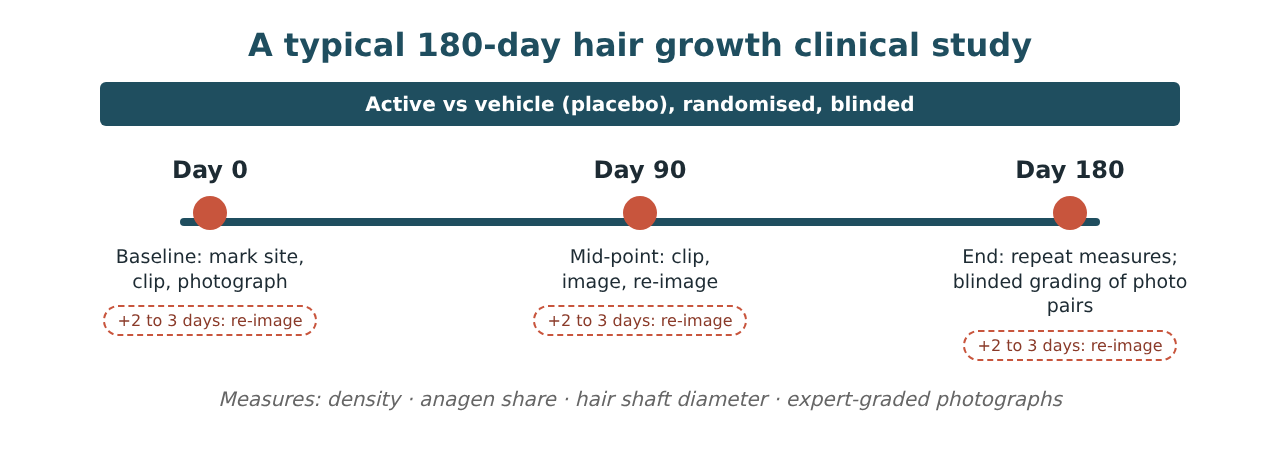
The strongest design compares the product with its own vehicle (a placebo), with randomisation and blinding. The primary endpoint and the success threshold are set before the study starts. Volunteer studies must follow ethical principles, and the product must already be assessed as safe [8]. That means ethics approval and informed consent in line with the Declaration of Helsinki, last revised in 2024 [11].
04How to read a study report
A credible hair growth clinical study report states:
- the primary endpoint and the size of the marked area
- how hairs were clipped, dyed and counted
- whether evaluators were blinded
- how many subjects dropped out
- which statistical test was used
Results are usually given as the change in hairs per cm² against baseline and against the control. The guidance says data handling must not overstate the effect [8]. A report that gives only the active group, or only the best time point, does not support a strong claim.
05An illustrative worked example
This example is illustrative only. It describes no real client, and no values were measured. Suppose a brand tests a scalp serum against its vehicle for 180 days. At day 0 the site would be marked, clipped and photographed, then imaged again two to three days later. The same steps would repeat at day 90 and day 180. A blinded evaluator, or TrichoScan software checked by an evaluator, would count hairs and measure shaft diameter.
If the serum group showed a statistically significant gain in hair density over both baseline and vehicle, the brand would have evidence for an appearance claim such as "hair looks fuller". If the gain were only against baseline, the evidence would be weaker, because the vehicle group may improve as well.
Where the cosmetic and medicine line sits for hair-loss products is set out in Hair-loss products: cosmetic or drug?. For the actives often tested in these studies, see hair growth complexes and caffeine.
06Which wording each result allows
Commission Regulation (EU) No 655/2013 requires every cosmetic claim to meet six common criteria, including truthfulness, evidential support and honesty [12]. The wording must match what was measured, and the product's classification limits it further.
- EU: the Commission's borderline manual decides case by case, on mode of action. It says "promoting hair growth" usually relates to medicinal products, while "reducing hair loss" usually relates to cosmetics and "preventing hair fall" may be cosmetic [6].
- US: any product for external use labelled or promoted as a hair grower or for hair loss prevention is a new drug that needs an approved application [7]. Minoxidil is sold over the counter as an approved drug.
- Safe ground everywhere: appearance wording such as "hair looks thicker", "improves the look of hair density" and "reduces breakage".
A higher anagen share is a physiological finding. Reporting it as "boosts the growth phase" on pack moves the claim towards a medicinal one. Present it as support for an appearance claim. Rules in India and other markets are covered in the cosmetic-or-drug article above.
07Cost and time drivers
Prices depend on scope, so none are given here. The main drivers are:
- panel size and the strictness of the inclusion criteria
- study length and the number of time points
- imaging equipment and trained, blinded evaluators
- whether a vehicle arm is included
- ethics approval time and the statistical analysis
Recruiting subjects at the right stage of hair loss often sets the schedule. The shampoo used during the study matters too, because it should stay the same throughout; our guide to sulfates in shampoo explains the options. The next step is the launch itself, covered in Launching a hair serum.
Planning a hair-growth claim?
CSL can help match the claim wording to a study design and review the evidence before it goes on pack.
08Questions readers ask
What is the difference between a trichogram and a phototrichogram?
A trichogram plucks hairs and examines their roots. A phototrichogram photographs a clipped area twice, a few days apart, and avoids plucking.
How long should a hair growth study last?
Usually 90 to 180 days. Telogen lasts months, so changes in the hair cycle take time to appear.
Can a small study support a claim?
Only a modest one. A small, uncontrolled study can support perception wording from a consumer test, but not a measured change in hair density.
Can a cosmetic say it reduces hair loss?
In the EU, "reducing hair loss" is usually treated as cosmetic, but the product's mode of action is assessed case by case. In the US, a hair loss prevention claim makes the product a drug.
09References
- Dhurat R, Saraogi P. Hair evaluation methods: merits and demerits. Int J Trichology. 2009;1(2):108–19. doi:10.4103/0974-7753.58553. PMC
- Hoffmann R. TrichoScan: a novel tool for the analysis of hair growth in vivo. J Investig Dermatol Symp Proc. 2003;8(1):109–15. doi:10.1046/j.1523-1747.2003.12183.x. DOI
- Canfield D. Photographic documentation of hair growth in androgenetic alopecia. Dermatol Clin. 1996;14(4):713–21. doi:10.1016/S0733-8635(05)70397-1. DOI
- Wolfram LJ. Human hair: a unique physicochemical composite. J Am Acad Dermatol. 2003;48(6 Suppl):S106–14. doi:10.1067/mjd.2003.276. DOI
- Hoffmann R. TrichoScan: what is new? Dermatology. 2005;211(1):54–62. doi:10.1159/000085581. DOI
- Working Group on Cosmetic Products, Sub-Group on Borderline Products. Manual on the scope of application of the Cosmetics Regulation (EC) No 1223/2009 (Art. 2(1)(a)), version 5.5, section 3.3.4: products containing substances stimulating hair growth or reducing hair loss. Brussels: European Commission; June 2025. European Commission
- Drug products containing active ingredients offered over-the-counter (OTC) for external use as hair growers or for hair loss prevention, 21 CFR § 310.527. eCFR
- Sub-Working Group on Claims. Technical document on cosmetic claims, agreed by the Sub-Working Group on Claims (version of 3 July 2017), Annexes I and II. Brussels: European Commission; 2017. European Commission
- Norwood OT. Male pattern baldness: classification and incidence. South Med J. 1975;68(11):1359–65. PubMed
- Ludwig E. Classification of the types of androgenetic alopecia (common baldness) occurring in the female sex. Br J Dermatol. 1977;97(3):247–54. doi:10.1111/j.1365-2133.1977.tb15179.x. DOI
- World Medical Association. World Medical Association Declaration of Helsinki: ethical principles for medical research involving human participants. JAMA. 2025;333(1):71–4. doi:10.1001/jama.2024.21972. DOI
- Commission Regulation (EU) No 655/2013 of 10 July 2013 laying down common criteria for the justification of claims used in relation to cosmetic products. Off J Eur Union. 2013;L190:31–4. EUR-Lex
Update log
- Published by Cosmetic Science Lab
This article is general technical information, not legal, regulatory or medical advice. Confirm requirements for your product and market before launch.