Seborrheic dermatitis shampoo: actives compared
Ketoconazole, zinc pyrithione, selenium sulfide, piroctone olamine, climbazole and ciclopirox compared on mechanism, evidence and legal status in the EU, UK, US and India. Part of our hair and scalp series.
By Dr. Premalatha, Ph.D., Life Science, Regulatory Consultant, Cosmetic Science Lab
At a glance
- Allowed in EU cosmetics
- Piroctone olamine, climbazole, selenium disulphide and salicylic acid, each within its Annex limits [10][9][12]
- Not allowed in EU cosmetics
- Ketoconazole (Annex II since 2019) and zinc pyrithione (Annex II since 1 March 2022) [4][7]
- Best-studied actives
- Ketoconazole and ciclopirox, both medicines [14]
Quick answer
- Trials show antifungal shampoos work, but most ran for about four weeks and the evidence is mostly low quality [14].
Take-home message for brand owners
- Pick the market and the claim first. They decide which actives you can use.
- Keep cosmetic wording about visible flakes, not about treating a disease.
Take-home message for formulators
- Design the base around the active: suspension for particulates, solubility for salts.
- Check every active against the current annex or monograph entry for each market.
A seborrheic dermatitis shampoo works by reducing Malassezia yeast on the scalp, by loosening scale, or both [1][2]. The main actives are ketoconazole, zinc pyrithione, selenium sulfide, piroctone olamine, climbazole, ciclopirox and salicylic acid. They differ in mechanism, evidence and, above all, legal status: some are cosmetic ingredients in one market and banned or prescription-only in another. This guide compares them for brands building a dandruff shampoo.
01Dandruff and seborrheic dermatitis: one spectrum
Dandruff is itchy scalp flaking without visible inflammation. Seborrheic dermatitis adds redness and can affect other oily areas. Many researchers see them as one spectrum [1].
The yeasts Malassezia globosa and M. restricta are linked to both. Their lipases break down sebum triglycerides, and fatty acids such as oleic acid can trigger flaking on susceptible scalps [1][3]. Individual susceptibility matters as much as the yeast [1], so an antifungal helps most people but not every scalp.
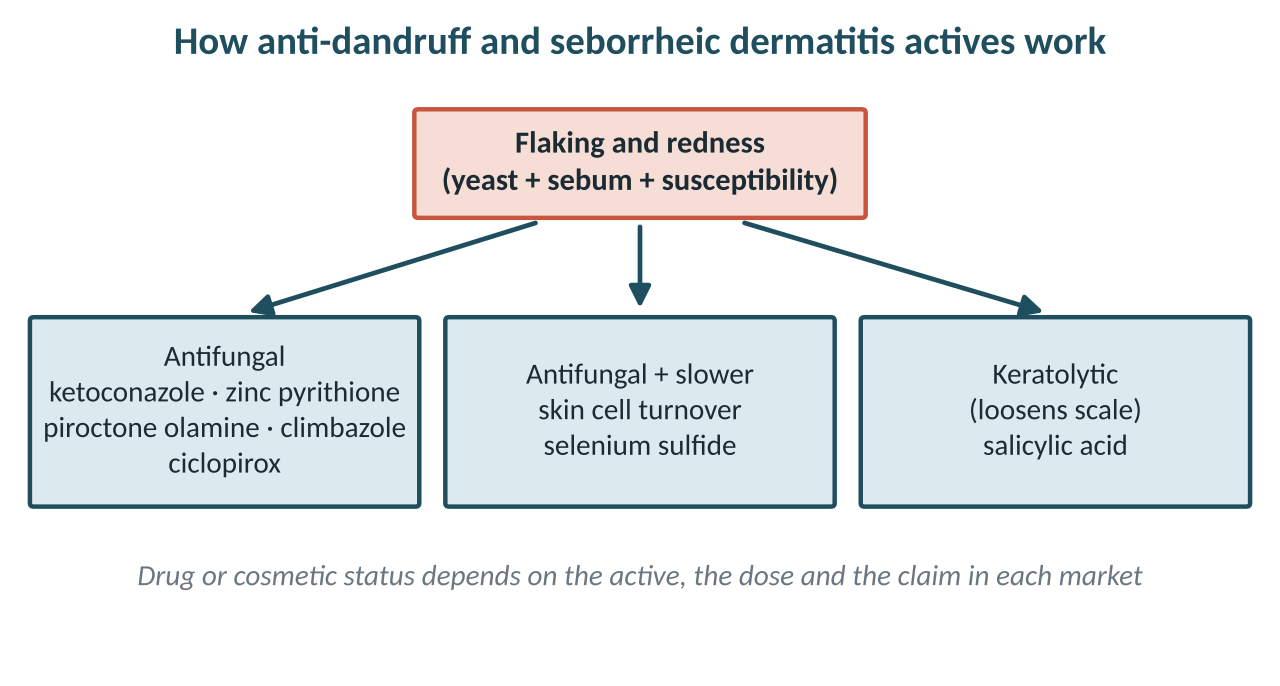
02The actives compared
Most of these actives target the yeast. Salicylic acid is the exception: it is a keratolytic that loosens the bonds between scale cells so they wash away [2]. Table 1 sets out where each active stands.
| Active | Main mechanism | EU cosmetics | United States |
|---|---|---|---|
| Ketoconazole | Azole antifungal; blocks ergosterol synthesis [2] | Prohibited: Annex II, entry 1528 [4] | Drug only: 1% shampoo OTC under an approved application; 2% shampoo prescription [5][6] |
| Zinc pyrithione | Antifungal; helps normalise scalp keratinisation [2] | Prohibited from 1 March 2022: Annex II, entry 1670 [7] | Monograph active: 0.3–2% rinse-off for dandruff, 0.95–2% for seborrheic dermatitis [8] |
| Selenium sulfide | Antifungal; slows cell turnover [2] | Anti-dandruff shampoos up to 1%, with label warnings: Annex III, entry 49 [9] | Monograph active at 1% (0.6% micronised) [8] |
| Piroctone olamine | Hydroxypyridone antifungal | Up to 1.0% rinse-off, 0.5% other products: Annex V, entry 35 [9] | Not a monograph active [8] |
| Climbazole | Azole antifungal | Up to 2.0% in rinse-off anti-dandruff shampoo: Annex III, entry 310 [10] | Not a monograph active [8] |
| Ciclopirox | Hydroxypyridone antifungal [2] | No Annex III or V entry; sold mainly as a medicine | 1% shampoo is prescription-only for scalp seborrheic dermatitis [11] |
| Salicylic acid | Keratolytic; loosens scale [2] | Up to 3.0% in rinse-off hair products: Annex III, entry 98 [12] | Monograph active at 1.8–3% [8] |
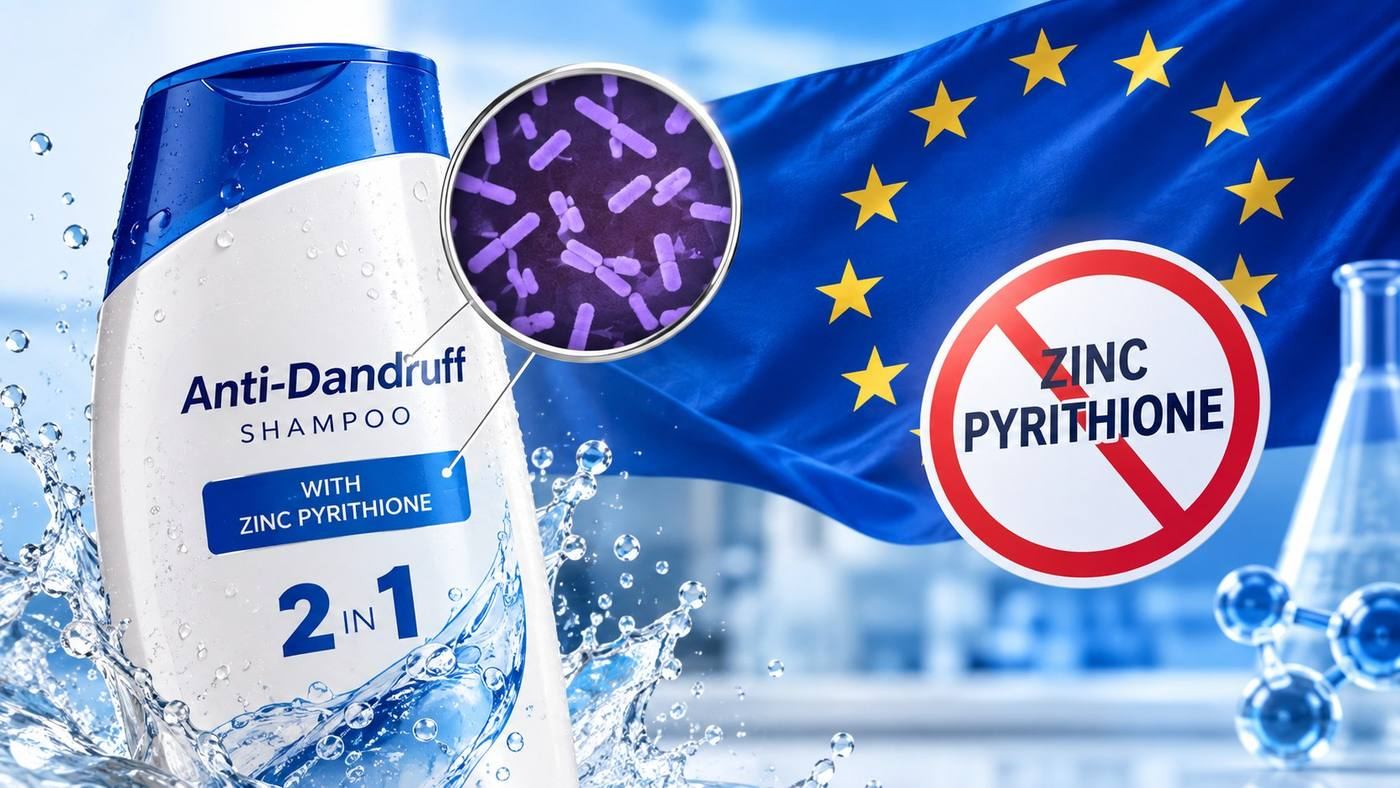
Lists change. Zinc pyrithione became prohibited in the EU in March 2022 and in Great Britain in October 2022 [7][13]. Check the current entry in each market you sell in.
03What the evidence shows
A Cochrane review of 51 trials with 9,052 participants found that ketoconazole reduced the risk of failed clearance at four weeks by 31% compared with placebo. The evidence was rated low quality. Ciclopirox 1% also beat placebo, with moderate-quality evidence. The review found no clear evidence that any one antifungal works better than another, and most trials lasted four weeks or less [14].
Two head-to-head trials are often cited. In 246 people with moderate to severe dandruff, ketoconazole 2% and selenium sulfide 2.5% both beat placebo. Ketoconazole was better only at day 8, and it caused fewer side effects [15]. Note that 2.5% selenium sulfide is above the 1% EU cosmetic limit and the 1% US monograph strength [8][9]. In an open, randomised trial of 331 people with severe dandruff or seborrheic dermatitis, ketoconazole 2% improved total severity scores by 73% after four weeks, against 67% for zinc pyrithione 1%, with fewer relapses afterwards [16].
None of these comparisons tests an active that is legal in EU cosmetics. Evidence for climbazole and piroctone olamine comes mostly from small, industry-funded trials of combinations. Ask suppliers for the study design and funding, and test the finished product.
04Contact time and rinse-off limits
A shampoo sits on the scalp for a few minutes and is then rinsed away, so deposition matters as much as concentration. The US monograph covers shampoos washed off after a brief exposure of a few minutes, used at least twice a week [8]. The prescription ciclopirox shampoo is left on for 3 minutes [11], and the 2% ketoconazole shampoo label asks for 5 minutes [6].
Particulate actives such as selenium sulfide need a suspending system and usually a deposition aid, often a cationic polymer. Soluble actives such as piroctone olamine need a base that keeps them in solution. The surfactant system is part of the performance: see our hub, What are sulfates in shampoo?, and our page on mild surfactants.
05Drug or cosmetic?
Classification depends on the active, the dose and the claim. In the EU, a cosmetic is intended mainly to clean, perfume, protect, change the appearance of or keep in good condition the external parts of the body [9]. Anti-dandruff shampoo can be a cosmetic: the climbazole entry in Annex III is written for "rinse-off anti-dandruff shampoo" [10]. A product presented as treating or preventing a disease is a medicinal product [17], so a claim to treat seborrheic dermatitis takes a shampoo out of the cosmetics rules.
In the US, FDA treats an anti-dandruff shampoo as both a cosmetic, because it cleanses, and a drug, because it treats dandruff [18]. The drug must follow the OTC monograph or have an approved application, as 1% ketoconazole does [8][5]. In India, Rule 39 of the Cosmetics Rules 2020 bars raw materials listed in Annex A of IS 4707 Part 2, so check the current edition [19] and our Cosmetics Rules 2020 guide.
The same drug-or-cosmetic line decides what you can say about hair fall: read Hair-loss products: cosmetic or drug? next. If you are replacing zinc pyrithione in an existing formula, see reformulating after the EU zinc pyrithione ban.
06How to choose an active for your market
For a mass-market dandruff shampoo, regulation decides before chemistry does. Decide in this order:
- Market.
Zinc pyrithione is out in the EU and Great Britain [7][13], and ketoconazole is prohibited in EU cosmetics [4].
- Claim.
An EU cosmetic dandruff shampoo can use piroctone olamine, climbazole or selenium disulphide within their limits, with wording about visible flakes rather than disease [10][9]. A US dandruff claim needs a monograph active at monograph strength [8].
- Active.
A product that claims to treat seborrheic dermatitis belongs with medicines.
- Base.
Then design the surfactant, suspension and deposition system.
A brand selling in the EU and US may need two formulas. See also our dandruff and scalp health page.
07Formulation tips
- Check the active against cationic polymers and the target pH: both change how much reaches the scalp.
- Inflamed scalps tolerate less, so pair the active with a mild surfactant base and keep fragrance low.
- Confirm that particulates stay suspended over shelf life.
- Run an ISO 11930 challenge test on the finished shampoo, especially after removing zinc pyrithione [20].
Building an anti-dandruff shampoo for more than one market?
CSL screens actives against each market's rules and designs the base around them.
08Questions readers ask
Is ketoconazole shampoo a cosmetic?
No. It is prohibited in EU cosmetics, and in the US it is sold only as a drug: 1% over the counter and 2% on prescription.
Can I use zinc pyrithione in the EU?
Not in cosmetics. It has been prohibited there since 1 March 2022. In the US it remains an OTC monograph active.
What is the difference between a dandruff shampoo and a seborrheic dermatitis shampoo?
The actives overlap; the difference is the claim. In the EU, dandruff wording can stay cosmetic, while treating seborrheic dermatitis is a medicinal claim. In the US, both claims make the shampoo an OTC drug.
Which active is best for dandruff?
Ketoconazole has the most trial evidence, but a Cochrane review found no clear proof that one antifungal beats another. The right choice depends on the market and the claim.
09References
- Borda LJ, Wikramanayake TC. Seborrheic dermatitis and dandruff: a comprehensive review. J Clin Investig Dermatol. 2015;3(2). doi:10.13188/2373-1044.1000019. PMC
- Ranganathan S, Mukhopadhyay T. Dandruff: the most commercially exploited skin disease. Indian J Dermatol. 2010;55(2):130–4. doi:10.4103/0019-5154.62734. PMC
- Dessinioti C, Katsambas A. Seborrheic dermatitis: etiology, risk factors, and treatments: facts and controversies. Clin Dermatol. 2013;31(4):343–51. doi:10.1016/j.clindermatol.2013.01.001. DOI
- Commission Regulation (EU) 2019/831 of 22 May 2019 amending Annexes II, III and V to Regulation (EC) No 1223/2009 on cosmetic products (Annex II, entry 1528: ketoconazole). Off J Eur Union. 2019;L137:29. EUR-Lex
- US Food and Drug Administration. Nizoral A-D (ketoconazole) shampoo 1%: approval package, NDA 20-310, approved 10 October 1997. Silver Spring (MD): FDA; 1997. FDA
- Ketoconazole shampoo 2% [prescribing information]. Bethesda (MD): National Library of Medicine, DailyMed; [cited 2026 Nov 18]. DailyMed
- Commission Regulation (EU) 2021/1902 of 29 October 2021 amending Annexes II, III and V to Regulation (EC) No 1223/2009 as regards the use in cosmetic products of certain substances classified as carcinogenic, mutagenic or toxic for reproduction (Annex II, entry 1670: pyrithione zinc). Off J Eur Union. 2021;L387:120. EUR-Lex
- Dandruff, seborrheic dermatitis, and psoriasis drug products for over-the-counter human use, 21 CFR Part 358, Subpart H (§§ 358.701–358.760). eCFR
- Regulation (EC) No 1223/2009 of the European Parliament and of the Council of 30 November 2009 on cosmetic products, Article 2(1)(a), Annex III entry 49 and Annex V entry 35 (consolidated). Off J Eur Union. 2009;L342:59–209. EUR-Lex
- Commission Regulation (EU) 2019/698 of 30 April 2019 amending Annexes III and V to Regulation (EC) No 1223/2009 on cosmetic products (climbazole: Annex III, entry 310; Annex V, entry 32). Off J Eur Union. 2019;L117:5. EUR-Lex
- Ciclopirox shampoo 1% [prescribing information]. Padagis. Bethesda (MD): National Library of Medicine, DailyMed; [cited 2026 Nov 18]. DailyMed
- Commission Regulation (EU) 2019/1966 of 27 November 2019 amending and correcting Annexes II, III and V to Regulation (EC) No 1223/2009 on cosmetic products (salicylic acid: Annex III, entry 98). Off J Eur Union. 2019;L307:15. EUR-Lex
- The Toys and Cosmetic Products (Restriction of Chemical Substances) Regulations 2022, SI 2022/659, regulation 3 and 4. London: The Stationery Office; 2022. legislation.gov.uk
- Okokon EO, Verbeek JH, Ruotsalainen JH, Ojo OA, Bakhoya VN. Topical antifungals for seborrhoeic dermatitis. Cochrane Database Syst Rev. 2015;(5):CD008138. doi:10.1002/14651858.CD008138.pub3. Cochrane
- Danby FW, Maddin WS, Margesson LJ, Rosenthal D. A randomized, double-blind, placebo-controlled trial of ketoconazole 2% shampoo versus selenium sulfide 2.5% shampoo in the treatment of moderate to severe dandruff. J Am Acad Dermatol. 1993;29(6):1008–12. doi:10.1016/0190-9622(93)70282-X. PubMed
- Piérard-Franchimont C, Goffin V, Decroix J, Piérard GE. A multicenter randomized trial of ketoconazole 2% and zinc pyrithione 1% shampoos in severe dandruff and seborrheic dermatitis. Skin Pharmacol Appl Skin Physiol. 2002;15(6):434–41. doi:10.1159/000066452. Karger
- Directive 2001/83/EC of the European Parliament and of the Council of 6 November 2001 on the Community code relating to medicinal products for human use, Article 1(2) (consolidated). Off J Eur Communities. 2001;L311:67–128. EUR-Lex
- US Food and Drug Administration. Is it a cosmetic, a drug, or both? (or is it soap?). Silver Spring (MD): FDA; [cited 2026 Nov 18]. FDA
- Ministry of Health and Family Welfare. Cosmetics Rules, 2020, rule 39. G.S.R. 763(E), 15 December 2020. New Delhi: CDSCO; 2020. CDSCO
- International Organization for Standardization. ISO 11930:2019. Cosmetics – Microbiology – Evaluation of the antimicrobial protection of a cosmetic product (and Amd 1:2022). Geneva: ISO; 2019. ISO
Update log
- Published by Cosmetic Science Lab
This article is general technical information, not legal, regulatory or medical advice. Confirm requirements for your product and market before launch.