Developing a scalp serum: from brief to claim
An illustrative worked example of a caffeine scalp serum, from reframing a hair-regrowth brief through cold-storage crystals and freeze-thaw viscosity loss to a claim the evidence can support. Part of our hair and scalp series.
By Dr. Premalatha, Ph.D., Life Science, Regulatory Consultant, Cosmetic Science Lab
Worked example. This page is built from common patterns in scalp serum development. It does not describe a specific client project, and every value shown is illustrative, not measured.
At a glance
- Product
- Leave-on scalp serum in a dropper bottle, with caffeine and a peptide complex
- Stability problem
- 2% caffeine sits close to its water solubility of about 2.2 g per 100 mL at 25 °C [3]
- Illustrative fix
- Less caffeine, a solubiliser, a sturdier thickener, testing in the final pack [4]
- Claim
- Appearance wording backed by human data, not organ culture results [5]
Quick answer
- A claim to promote hair growth usually points to a medicinal product in the EU, so the brief would be reframed first [1].
Take-home message for brand owners
- Agree the claim before the formula: it decides the legal category.
- Budget for a human study if growth claims may follow.
Take-home message for formulators
- Keep actives below their solubility limit at the coldest storage temperature.
- Run stability in the final dropper pack, not only in glass jars.
A scalp serum project usually goes wrong in the gap between the brief and the claim. This illustrative worked example follows a brand that asks for a scalp serum that would regrow hair. It shows how the project would move from brief to actives, through pilot-scale stability problems, to a claim the evidence could support. The same steps apply to most scalp care products.
01The brief and the first problem
Here the brand wants a leave-on scalp serum in a dropper bottle for adults with thinning hair. The brief names caffeine at 2%, a peptide complex, a launch four months away and a target claim: a hair growth serum that regrows hair.
That claim is the first problem. The EU borderline manual says the claim "promoting hair growth" usually relates to pharmaceutical products, while "reducing hair loss" usually relates to cosmetics, and each product is judged case by case [1]. A cosmetic acts on the external parts of the body mainly to clean, perfume, change appearance, protect, keep them in good condition or correct body odour [8]. In the US, FDA gives claims that a product will restore hair growth as an example of a claim that can make it a drug [2].
The first step would therefore be to rewrite the brief around scalp care and the appearance of fuller hair, which keeps the product cosmetic. The line is explained in Hair-loss products: cosmetic or drug?
02Actives and the stability problem
Caffeine dissolves at about 1 g in 46 mL of water, or roughly 2.2 g per 100 mL at 25 °C, and its solubility rises steeply with temperature [3]. It falls as the product cools, so a 2% caffeine serum would sit near saturation at room temperature and above it in a cold warehouse.
In this example, the pilot batch would show three faults:
- clouding and crystals after cold storage
- a thickener that loses viscosity after freeze-thaw cycles
- a dropper that delivers an uneven dose as the serum thins
These are typical problems for an active used near its solubility limit in a thin, water-based serum. Bench samples in glass may not show them.
03Method: what would change
- Lower the caffeine.
Cut caffeine from 2% to 1%, leaving a margin below the solubility limit [3].
- Add a solubiliser.
Add a co-solvent or hydrotrope; benzoate, citrate and salicylate salts are known to raise caffeine's water solubility [3].
- Change the thickener.
Use a polymer whose rheology survives freeze-thaw.
- Recheck pH.
Measure it after processing and on aged samples.
The new formula would then go through a stability programme in the final dropper pack. Industry guidance says no standard protocol can be prescribed. It notes that accelerated tests are often run at 37, 40 or 45 °C, that freeze-thaw testing should be considered for some product types, and that samples should be stored in packaging as close as possible to the marketed pack [4]. A preservation efficacy test to ISO 11930 would run on the finished formulation, with the pack considered in the microbiological risk assessment [9].
04Data: before and after
| Test | Original (2% caffeine) | Reformulated (1% caffeine) |
|---|---|---|
| Crystals after 4 weeks at 4 °C | Present | None |
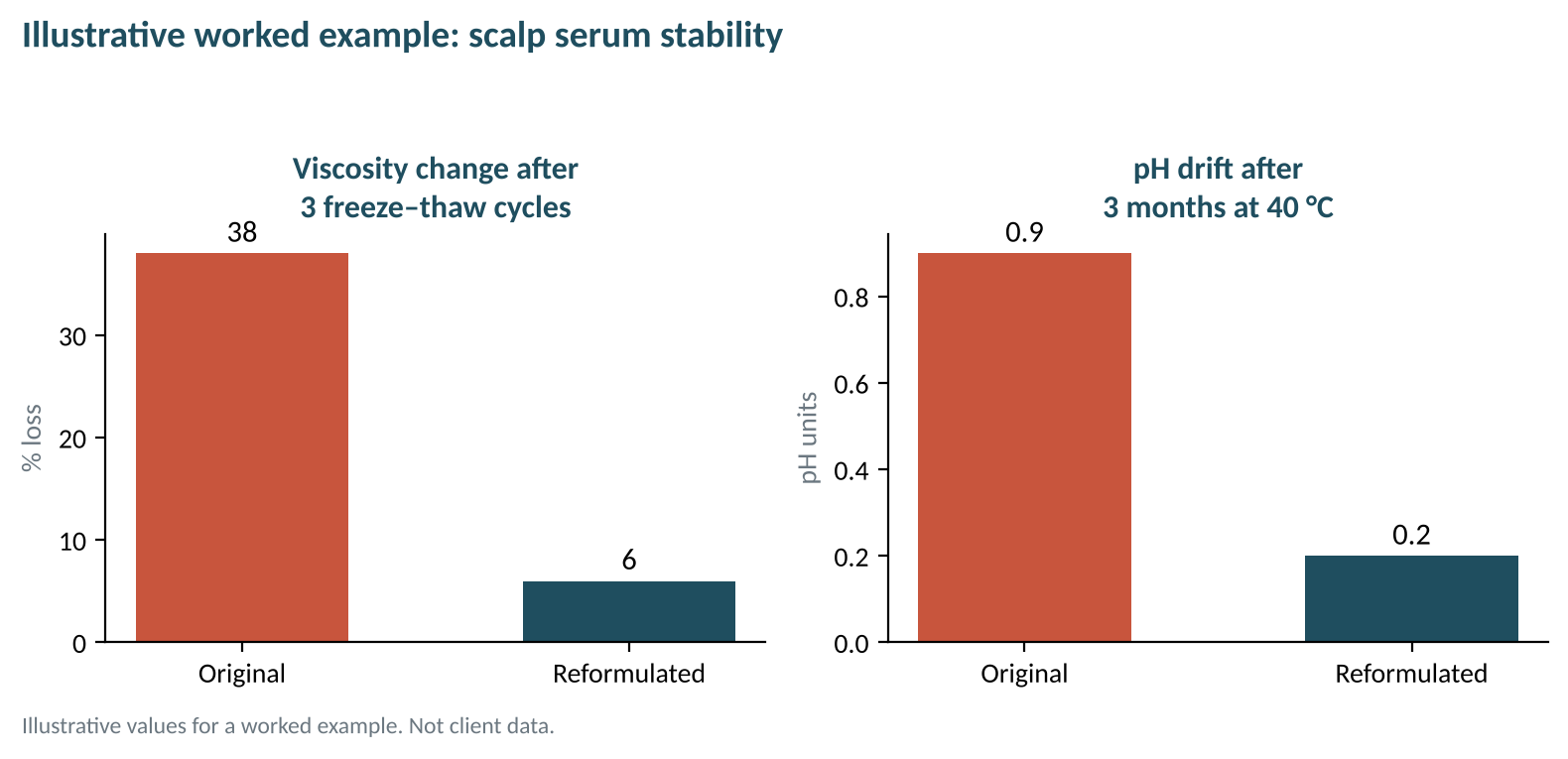
| Viscosity change after 3 freeze-thaw cycles | 38% loss | 6% loss |
| pH drift after 3 months at 40 °C | 0.9 units | 0.2 units |
| Dropper delivery | Uneven | Consistent |
All values are illustrative. The pattern is realistic: a lower active load and a better carrier would fix the physical faults without changing the concept.
05Illustrative timeline
| Stage | Illustrative timing | What would happen |
|---|---|---|
| Brief review | Week 1 | Claim reframed; actives and use levels confirmed |
| Prototype | Weeks 2–5 | Three carrier options made at bench scale |
| Pilot batch | Weeks 6–8 | Crystals and viscosity loss found after cold storage and freeze-thaw |
| Reformulation | Weeks 9–11 | Caffeine lowered; solubiliser and thickener changed |
| Final testing | Months 3–4 | Stability and ISO 11930 testing on the final formula, with stability in the dropper pack |
A four-month plan leaves no slack: three months at 40 °C cannot start until the formula is fixed.
06Choosing the claim
For launch, a consumer perception study plus instrumental measures of hair appearance could support wording such as "helps hair look fuller". EU guidance asks perception tests to use a representative panel, careful questions and claims that follow directly from the results [5].
Wording about growth would need a controlled study with trichogram or phototrichogram measures such as TrichoScan, which counts hairs and measures density in vivo [10]. See Hair-growth claims: trichogram and phototrichogram explained. A growth claim would also reopen the legal-category question.
The claim must not borrow from caffeine's research record, which rests mainly on human hair follicles in organ culture. In one study, caffeine at 0.0005% to 0.005% lengthened hair shafts and prolonged the growth phase in male and female follicles in vitro [7]. The claims guidance says in vitro results should not be presented as if they showed an effect in people [5]. Every claim must also meet the six common criteria in Regulation (EU) No 655/2013 [6].
The full planning path for a launch, from formulation to claims and testing, is in Launching a hair serum: formulation, claims and testing. For the base chemistry of cleansing products in this series, see the hub, What are sulfates in shampoo?
07Outcome and lessons
In this example, the reformulated serum would pass stability and preservation testing, and the launch could go ahead with appearance-based claims. Any later hair growth serum would need the controlled study described above.
Three lessons carry over:
- Rewrite the brief first.
Put the brief in cosmetic terms before formulation starts, because the claim shapes every later decision.
- Build in a solubility margin.
An active used near its solubility limit is likely to crystallise in cold storage.
- Test in the final pack early.
The dropper would reveal a dosing fault that bench samples hid (see packaging compatibility testing).
08What this example does not show
A lower caffeine level means a lower dose of the active. That trade-off is acceptable only because the claim rests on appearance and scalp care, not on a pharmacological effect. A different active, pack or market would need its own checks, and a real project should match the claim to the evidence its budget can pay for.
Planning a scalp serum or a reformulation?
CSL's product development team reviews the brief, the actives and the claim plan before formulation starts, for hair care brands and formulators.
09Questions readers ask
Can a scalp serum claim to regrow hair?
Not as a cosmetic in most cases. In the EU, "promoting hair growth" usually points to a medicinal product, and in the US a claim to restore hair growth can make a product a drug.
Why would caffeine crystallise in a serum?
Caffeine dissolves to only about 2.2% in water at 25 °C, and less when cold, so a serum near that level can crystallise in cold storage. A lower dose or a solubiliser builds in a margin.
Is in vitro caffeine research enough for a hair growth serum claim?
No. The follicle studies use organ culture, and EU guidance says in vitro results should not be presented as an effect in people. A growth claim needs a controlled human study.
Which stability tests suit a dropper serum?
Typically room-temperature, elevated-temperature (such as 40 °C) and cold storage, plus freeze-thaw cycles, all in the final dropper pack, checking crystals, viscosity, pH and dose.
10References
- Working Group on Cosmetic Products, Sub-Group on Borderline Products. Manual on the scope of application of the Cosmetics Regulation (EC) No 1223/2009 (Art. 2(1)(a)), version 5.5, section 3.3.4: products containing substances stimulating hair growth or reducing hair loss. Brussels: European Commission; June 2025. European Commission
- US Food and Drug Administration. Is it a cosmetic, a drug, or both? (Or is it soap?). Silver Spring (MD): FDA; [cited 2026 Nov 18]. FDA
- National Center for Biotechnology Information. PubChem compound summary for CID 2519, caffeine: solubility (citing O'Neil MJ, editor. The Merck Index. 15th ed. Cambridge: Royal Society of Chemistry; 2013. p. 289; and Yalkowsky SH, He Y, Jain P. Handbook of aqueous solubility data. 2nd ed. Boca Raton: CRC Press; 2010. p. 506). Bethesda (MD): National Library of Medicine; [cited 2026 Nov 18]. PubChem
- Colipa, CTFA. Guidelines on stability testing of cosmetic products. Brussels: Colipa (now Cosmetics Europe); 2004. Cosmetics Europe
- Sub-Working Group on Claims. Technical document on cosmetic claims, agreed by the Sub-Working Group on Claims (version of 3 July 2017), Annex I (evidential support) and Annex II (consumer perception tests). Brussels: European Commission; 2017. European Commission
- Commission Regulation (EU) No 655/2013 of 10 July 2013 laying down common criteria for the justification of claims used in relation to cosmetic products. Off J Eur Union. 2013;L190:31–4. EUR-Lex
- Fischer TW, Herczeg-Lisztes E, Funk W, Zillikens D, Bíró T, Paus R. Differential effects of caffeine on hair shaft elongation, matrix and outer root sheath keratinocyte proliferation, and transforming growth factor-β2/insulin-like growth factor-1-mediated regulation of the hair cycle in male and female human hair follicles in vitro. Br J Dermatol. 2014;171(5):1031–43. doi:10.1111/bjd.13114. DOI
- Regulation (EC) No 1223/2009 of the European Parliament and of the Council of 30 November 2009 on cosmetic products, Article 2(1)(a) (consolidated). Off J Eur Union. 2009;L342:59–209. EUR-Lex
- International Organization for Standardization. ISO 11930:2019. Cosmetics – Microbiology – Evaluation of the antimicrobial protection of a cosmetic product (and Amd 1:2022). Geneva: ISO; 2019. ISO
- Hoffmann R. TrichoScan: a novel tool for the analysis of hair growth in vivo. J Investig Dermatol Symp Proc. 2003;8(1):109–15. doi:10.1046/j.1523-1747.2003.12183.x. DOI
Update log
- Published by Cosmetic Science Lab
This article is general technical information, not legal, regulatory or medical advice. Confirm requirements for your product and market before launch.