What are sulfates in shampoo? SLS, SLES and sulfate-free systems
How SLS and SLES clean, why SLES is generally milder, and how sulfate-free surfactant systems compare on foam, mildness and formulation. The hub of our hair and scalp series.
By Dr. Premalatha, Ph.D., Life Science, Regulatory Consultant, Cosmetic Science Lab
At a glance
- What they are
- Anionic surfactants, mainly sodium lauryl sulfate (SLS) and sodium laureth sulfate (SLES) [1]
- SLS in use
- Judged safe for brief use followed by thorough rinsing; at most 1% in leave-on products [2]
- Cleaning threshold
- SLS forms micelles above about 0.24%, its critical micelle concentration [2]
- Sulfate-free bases
- Betaines with glucosides, isethionates, sarcosinates or amino-acid surfactants [3]
- Watch for
- 1,4-dioxane from ethoxylated surfactants; New York caps shampoo at 1 ppm [4]
Quick answer
- What are sulfates in shampoo? They are anionic surfactants, mostly SLS and SLES, that lift oil and dirt from hair and scalp and make foam [1].
- A sulfate free shampoo swaps SLS and SLES for other surfactants. It is not automatically milder, and in the EU a "sulfate-free" claim must not imply that legal ingredients are unsafe [7].
Take-home message for brand owners
- Treat "sulfate-free" as a positioning choice and check the claim for each market.
- Ask for 1,4-dioxane data if the formula contains SLES or other ethoxylated ingredients.
Take-home message for formulators
- Plan the thickener and co-surfactant before you drop the sulfate.
- Repeat stability and challenge tests on any new surfactant base.
What are sulfates in shampoo? They are anionic surfactants, mainly sodium lauryl sulfate (SLS) and sodium laureth sulfate (SLES), that lift oil and dirt from hair and make foam [1]. SLES is ethoxylated, which generally makes it milder than SLS [5]. A sulfate free shampoo swaps them for other surfactants and usually trades some foam, viscosity or cost for a gentler or different profile. This page is the hub of our hair and scalp series.
01SLS and SLES: what the molecules look like
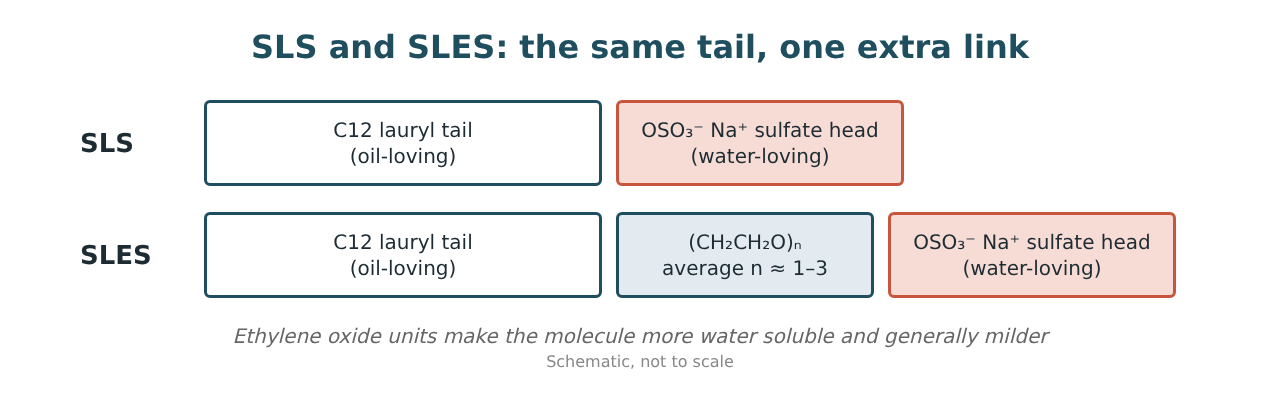
Every surfactant has a fatty tail that dissolves in oil and a polar head that dissolves in water. In SLS the tail is a C12 lauryl chain and the head is a sulfate group with a sodium counter-ion. SLES has the same tail, but ethylene oxide units are inserted between the tail and the sulfate head. Commercial grades usually carry an average of one to three units, shown in names such as sodium laureth-2 sulfate [6]. The ethylene oxide chain makes the molecule more water soluble and generally less harsh on skin [8][5].
02How sulfates clean: micelles, CMC and Krafft point
Above the critical micelle concentration (CMC) they gather into micelles that hold oil inside and carry it away in the rinse [8]. For SLS the CMC is about 0.24% [2]. Above the CMC, extra surfactant mainly forms more micelles rather than more free molecules [2].
The Krafft point matters too. Below this temperature an ionic surfactant cannot form micelles and may crystallise out of solution. Inserting ethylene oxide units between the tail and an anionic head lowers the Krafft point [8]. This helps SLES stay in solution at lower temperatures than SLS.
03Mildness, scalp irritation and colour fade
SLS is the standard irritant in experimental skin studies. In patch tests, solutions of 0.5 to 10% SLS cause slight to moderate irritation [2]. The US Cosmetic Ingredient Review (CIR) panel judged SLS safe in products designed for brief, discontinuous use followed by thorough rinsing, and set a 1% maximum in products meant for prolonged skin contact [2]. For SLES and related ether sulfates, the CIR conclusion is that they should be used only when they can be formulated to be non-irritating [6].
Laboratory screens help rank surfactants. The zein test measures how much corn protein a surfactant solution dissolves. SLS is the reference and typically scores in the strong-irritant band [9]. The test is a screening tool, not a full irritation assessment, and betaines cannot be scored with it because they make zein clump [9]. Mixing helps: in a human patch-test study, a mixture of 20% SLS and 20% of an amido betaine caused fewer irritation reactions than 20% of either surfactant alone [10]. See cocamidopropyl betaine and mild surfactants for more.
Sulfate-free shampoos are often sold for coloured or curly hair. A review of hair cosmetics found no published analysis of how well "sulfateless" shampoos perform [11].
04Sulfate-free systems compared
| System | Examples | Typical foam | Formulation note |
|---|---|---|---|
| Amphoteric co-surfactants | Cocamidopropyl betaine | Boosts foam and viscosity | The usual partner in sulfate-free bases; amido betaines can reduce anionic irritation [10] |
| Alkyl glucosides | Decyl glucoside, coco-glucoside | Moderate | Hard to thicken with salt; can leave hair feeling stripped as the main surfactant [3] |
| Isethionates | Sodium cocoyl isethionate | Creamy | Limited water solubility; common in bars and pastes [3] |
| Sarcosinates | Sodium lauroyl sarcosinate | Good | Anionic; check pH range and compatibility with cationic polymers [3] |
| Amino-acid surfactants | Sodium cocoyl glutamate | Good | Mild, but higher cost and often need a polymer thickener [3] |
Most sulfate-free shampoos pair a betaine with one or two of these surfactants. Note that "sulfate-free" is not the same as "anionic-free": sarcosinates, isethionates and glutamates are anionic too.
05Formulation variables and failure modes
- Viscosity: SLES and betaine blends thicken with salt. Glucoside and amino-acid systems usually need a polymeric thickener, which affects clarity and rinse feel [3].
- pH: shampoo pH varies widely. A survey of 123 shampoos found values from 3.5 to 9.0, and only about 38% were at or below 5.5, the approximate pH of the scalp [12]. See our pH glossary entry.
- Hard water: calcium and magnesium ions bind anionic surfactants and can cut foam [8]. Test foam in hard water.
- Conditioning polymers: a cationic polymer that was stable in an SLES base can cloud or separate in a new surfactant system.
- Preservation: ISO 11930 evaluates the finished product, so a new surfactant base needs its own challenge test [13].
- 1,4-dioxane: it can form as a by-product when ethoxylated ingredients are made. The FDA identifies these by "PEG" or "-eth-" in the name, which includes sodium laureth sulfate, and has recommended vacuum stripping to remove it since the 1980s [14]. New York has capped it at 1 ppm in personal care products, including shampoo, since 31 December 2023, and no waiver is effective after 30 December 2025 [4].
For strong foam at low cost, SLES with a betaine is the usual starting point. For a sensitive-scalp brief, start from a betaine with a glucoside or amino-acid surfactant.
06Can you say "sulfate-free" on pack?
In the EU every claim must meet the six common criteria of Regulation (EU) No 655/2013, including truthfulness and fairness [15]. Annex III of the Commission's Technical Document on claims, applicable since 1 July 2019, says a free-from claim should not denigrate legally used ingredients. It rejects "free from parabens" for that reason and applies the same rule to claims with a similar meaning [7]. The document does not name sulfates. SLS and SLES are legal, though, so the same reasoning can apply to a "sulfate-free" claim that implies they are unsafe. Free-from claims are acceptable when they help a specific group make an informed choice [7]. Before artwork is final, check how the authority in each target market reads the claim.
Truthfulness is the other trap. Sodium coco-sulfate is still an alkyl sulfate, so a formula that contains it cannot honestly be called sulfate-free. In the US, a cosmetic is misbranded if its labelling is false or misleading in any particular [16]. Our guide to paraben-free and preservative-free claims covers the free-from rules in detail.
Using SLES or other ethoxylated surfactants in products for the US? Read 1,4-dioxane in shampoo: New York's limits and how to test. For actives that sit in the base, see seborrheic dermatitis shampoo actives compared.
07The hair and scalp series
- Seborrheic dermatitis shampoo: actives compared
The anti-dandruff actives, their evidence and their legal status by market.
- Hair-loss products: cosmetic or drug?
Where the line between a cosmetic and a medicine sits in the EU, US and India.
- What are sulfates in shampoo? (this page)
SLS, SLES, sulfate-free systems and the claim rules.
- Hair-growth claims: trichogram and phototrichogram explained
Which clinical method supports which claim wording.
- Launching a hair serum
Formulation, claims and testing for a leave-on hair product.
- Developing a scalp serum: from brief to claim
An illustrative worked example that pulls the series together.
Building or reformulating a shampoo base?
CSL selects surfactant systems for hair care briefs and tests foam, viscosity, stability and preservation on the finished formula.
08Questions readers ask
Are sulfates in shampoo harmful?
They are permitted cosmetic ingredients. SLS can irritate skin, and the risk depends on concentration, contact time and the whole formula. Rinse-off use lowers exposure.
What is the difference between SLS and SLES?
SLES has a short ethylene oxide chain before its sulfate head. It is generally milder than SLS but can carry traces of 1,4-dioxane.
Does a sulfate free shampoo clean as well?
For everyday use it can, if the surfactant system is well built. Heavy oil or styling build-up may need a stronger cleanser.
Is sulfate-free better for coloured or curly hair?
There is little published evidence either way. Mildness, pH and conditioning matter more than the label, so test the finished product.
09References
- Robbins CR. Chemical and physical behavior of human hair. 5th ed. Berlin: Springer; 2012. doi:10.1007/978-3-642-25611-0. DOI
- European Medicines Agency. Background review for sodium laurilsulfate used as an excipient. EMA/CHMP/351898/2014. London: EMA; 2015. EMA
- Cornwell PA. A review of shampoo surfactant technology: consumer benefits, raw materials and recent developments. Int J Cosmet Sci. 2018;40(1):16–30. doi:10.1111/ics.12439. DOI
- New York State Department of Environmental Conservation. 1,4-Dioxane limits for household cleansing, personal care, and cosmetic products. Albany (NY): NYSDEC [cited 2026 Nov 18]. NYSDEC
- Effendy I, Maibach HI. Surfactants and experimental irritant contact dermatitis. Contact Dermatitis. 1995;33(4):217–25. doi:10.1111/j.1600-0536.1995.tb00470.x. DOI
- Robinson VC, Bergfeld WF, Belsito DV, Hill RA, Klaassen CD, Marks JG, et al. Final report of the amended safety assessment of sodium laureth sulfate and related salts of sulfated ethoxylated alcohols. Int J Toxicol. 2010;29(4 Suppl):151S–61S. doi:10.1177/1091581810373151. DOI
- Sub-Working Group on Claims. Technical document on cosmetic claims, agreed by the Sub-Working Group on Claims (version of 3 July 2017), Annex III: "free from" claims. Brussels: European Commission; 2017. European Commission
- Rosen MJ, Kunjappu JT. Surfactants and interfacial phenomena. 4th ed. Hoboken (NJ): John Wiley & Sons; 2012. doi:10.1002/9781118228920. DOI
- EURL ECVAM. DB-ALM Protocol no. 26: the zein test (skin irritation and corrosivity). Ispra: European Commission Joint Research Centre; 1991. JRC
- Hall-Manning TJ, Holland GH, Rennie G, Revell P, Hines J, Barratt MD, et al. Skin irritation potential of mixed surfactant systems. Food Chem Toxicol. 1998;36(3):233–8. doi:10.1016/S0278-6915(97)00144-0. DOI
- Gavazzoni Dias MFR. Hair cosmetics: an overview. Int J Trichology. 2015;7(1):2–15. doi:10.4103/0974-7753.153450. PMC
- Gavazzoni Dias MFR, de Almeida AM, Cecato PMR, Adriano AR, Pichler J. The shampoo pH can affect the hair: myth or reality? Int J Trichology. 2014;6(3):95–9. doi:10.4103/0974-7753.139078. PMC
- International Organization for Standardization. ISO 11930:2019. Cosmetics – Microbiology – Evaluation of the antimicrobial protection of a cosmetic product (and Amd 1:2022). Geneva: ISO; 2019. ISO
- US Food and Drug Administration. 1,4-Dioxane in cosmetics: a manufacturing byproduct. Silver Spring (MD): FDA [content current as of 2022 Mar 3; cited 2026 Nov 18]. FDA
- Commission Regulation (EU) No 655/2013 of 10 July 2013 laying down common criteria for the justification of claims used in relation to cosmetic products. Off J Eur Union. 2013;L190:31–4. EUR-Lex
- Misbranded cosmetics, 21 U.S.C. § 362. Federal Food, Drug, and Cosmetic Act, Chapter VI. LII
Update log
- Published by Cosmetic Science Lab
This article is general technical information, not legal, regulatory or medical advice. Confirm requirements for your product and market before launch.