Launching a hair serum: formulation, claims and testing
A scalp serum and a lengths serum need different formulas, claims and tests, and this guide plans a hair serum launch for the EU, Great Britain, the US and India. Part of our hair and scalp series.
By Dr. Premalatha, Ph.D., Life Science, Regulatory Consultant, Cosmetic Science Lab
At a glance
- Cyclic silicones
- EU limit of 0.1% each for D4, D5 and D6 in leave-on cosmetics after 6 June 2027 [4]
Quick answer
- What decides a hair serum launch plan? Where the serum goes: scalp serums are led by safety and careful wording, lengths serums by feel and instrumental claims.
- Both are leave-on, so the safety assessment must reflect longer exposure [1].
Take-home message for brand owners
- Decide early whether you are launching a scalp serum, a lengths serum or both.
- Agree every claim and every market before testing starts, because both set the budget.
Take-home message for formulators
- Ask silicone suppliers for residual D4, D5 and D6 levels, not only the INCI name.
- Run stability and preservation work in the final dropper or pump.
A hair serum launch is really two projects, depending on where the serum goes. A scalp serum is applied to skin, so safety and any hair-growth wording come first. A lengths serum coats the hair fibre, so slip, shine and frizz control come first. Both are leave-on products, and in the EU the safety assessment must account for the amount, duration and frequency of exposure [1].
01Scalp vs lengths: what changes
In hair care, the target shapes the plan. A serum for the scalp often carries humectants, peptides, caffeine or soothing agents. A serum for the lengths relies on silicones or their alternatives, oils and film formers.
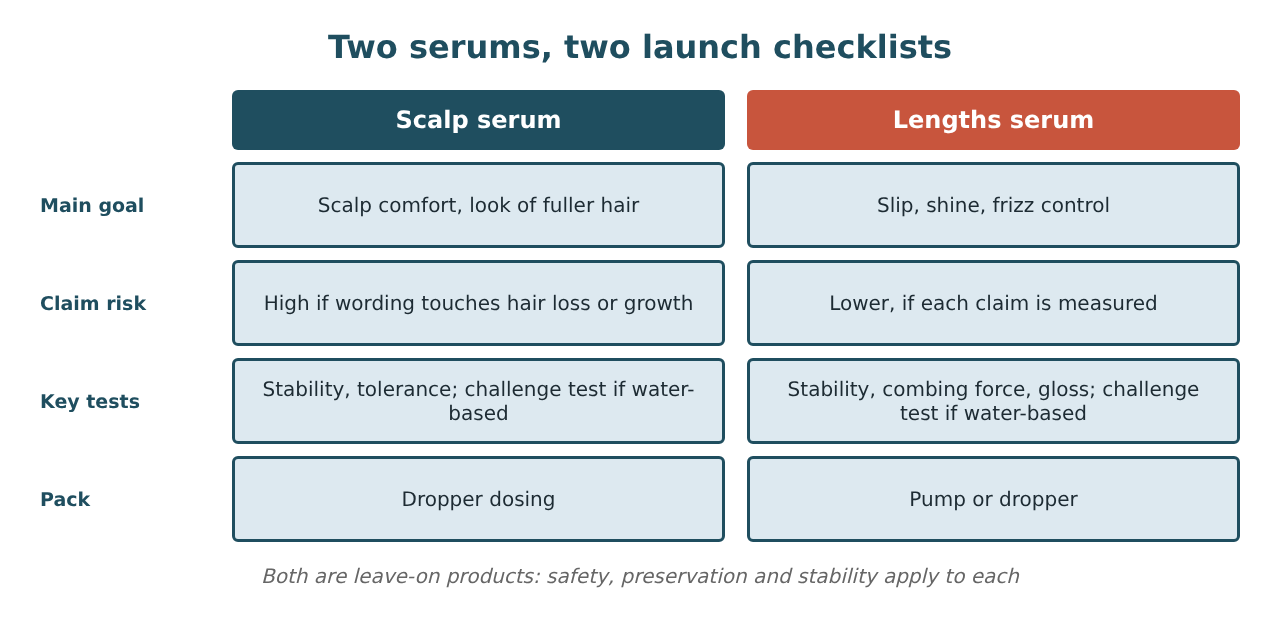
| Item | Scalp serum | Lengths serum |
|---|---|---|
| Main goal | Scalp comfort and the look of fuller hair | Slip, shine and frizz control |
| Typical ingredients | Humectants, peptides, caffeine, soothing agents | Silicones or alternatives, oils, film formers |
| Claim risk | High if wording touches hair loss or growth | Lower, if each claim is measured |
| Key tests | Stability, challenge test if water-based, tolerance; growth study if growth wording | Stability, challenge test if water-based, combing force, gloss, frizz |
| Pack | Dropper for dosing onto the scalp | Pump or dropper |
02Water-based or waterless
For a hair serum launch, the base decision is water-based or waterless. Water-based serums suit humectants, peptides and soothing actives, but they need a preservative system and an ISO 11930 challenge test on the finished formulation [2]. A waterless oil or silicone serum may instead be justified as microbiologically low risk under ISO 29621 [3]. It can feel heavy, though, and some oils and silicones build up on fine hair. Set a target feel before choosing ingredients, because feel is hard to change late.
03Silicones vs alternatives
Linear silicones such as dimethicone and amodimethicone give slip and shine and are not themselves restricted. The cyclic silicones D4, D5 and D6 are restricted under entry 70 of Annex XVII to REACH, as amended by Regulation (EU) 2024/1328 [4]. D5 appears on labels as cyclopentasiloxane. The rules depend on product type:
- Wash-off cosmetics: D4 and D5 at 0.1% by weight or more have been restricted since 31 January 2020 [4].
- All other cosmetics, including leave-on serums: products containing 0.1% by weight or more of D4, D5 or D6 may not be placed on the market after 6 June 2027 [4].
- Residues count: the limit applies to the mixture, and the derogations for residues from silicone polymers do not cover cosmetics [4].
A serum with no cyclic silicone on its INCI list can still exceed the limit through residues in a silicone raw material, so ask suppliers for residual D4, D5 and D6 data. Alternatives include esters, plant-derived alkanes and film-forming polymers. They usually need extra testing for feel, build-up and stability. The restriction is EU law, so check Great Britain separately under UK REACH.
04Packaging: dropper or pump
A dropper gives controlled dosing for scalp use, but it exposes the formula to air and to the teat, so test the formula against the elastomer parts. A pump gives faster dosing for lengths and, in an airless format, reduces air contact. Run stability tests in packaging made of the same materials as the marketed pack, since leakage, discolouration and dose drift show up only there [5]. See our packaging compatibility test guide.
05Testing and claim substantiation
The stability guidelines prescribe no standard test. They describe storage at 37°C, 40°C or 45°C for one to three months or more, and freeze-thaw cycles for some products [5]. A water-containing serum also needs a challenge test to ISO 11930 [2]. Every EU cosmetic needs a safety report before it is placed on the market [1]. Skin tolerance testing is not a legal requirement in itself, but it is common for scalp serums.
Claim substantiation depends on the wording. Combing force and gloss on lengths are measured instrumentally. Consumer testing covers perception. Growth-related wording needs a controlled study (see Hair-growth claims: trichogram and phototrichogram explained). In the EU, every claim must meet the six common criteria of Regulation (EU) No 655/2013 [6].
Wording also sets the legal category. In the EU, a cosmetic's purposes are limited to cleaning, perfuming, changing appearance, protecting, keeping in good condition or correcting body odours [1]. In the US, a product labelled or promoted as a hair grower or for hair loss prevention is regulated as a new drug [7].
Where a scalp serum sits on the cosmetic or drug line is covered in Hair-loss products: cosmetic or drug?. For the shampoo your serum is used with, see the series hub, What are sulfates in shampoo?
06Market-by-market checklist
The table lists the main steps per market, not every duty.
| Market | Main steps | Note |
|---|---|---|
| EU | A Responsible Person in the EU, a safety report, a product information file and notification on the CPNP before sale [1] | Claims judged against Regulation 655/2013 [6] |
| Great Britain | A UK-based Responsible Person and notification through the Submit cosmetic product notifications service before sale [8] | Northern Ireland has a separate process [8] |
| US | Under MoCRA: facility registration, product listing, safety substantiation records and serious adverse event reporting [9] | Hair grower and hair loss claims make it a drug [7] |
| India | Imports: registration certificate in Form COS-2 from the Central Licensing Authority. Local manufacture: licence in Form COS-8 from the State Licensing Authority [10] | A new ingredient needs prior permission; see our Cosmetics Rules 2020 guide [10] |
07Timeline ranges
These ranges are indicative only. Formulation and prototyping usually take several weeks to a few months. An ISO 11930 challenge test runs for 28 days after inoculation, plus preparation and reporting [2]. Accelerated stability storage often runs for up to three months [5]. Growth studies run for months because they follow the hair cycle. In India, the Central Licensing Authority has up to six months to decide on an import registration, and a State Licensing Authority 45 days for a manufacturing licence [10]. EU and GB notification must be made before sale, so it comes after the safety report [1][8]. With growth wording, the controlled study sets the schedule.
08Cost drivers and common mistakes
No prices are given here. Cost rises with the number of variants, sizes, packs and markets, the level of claim evidence (instrumental, consumer or clinical) and the number of reformulation rounds. Four mistakes drive most rework:
- Freezing the formula before testing the final pack.
Pack problems then force a late change.
- Writing claims before deciding the evidence.
The wording then needs an unbudgeted study.
- Treating a scalp serum and a lengths serum as one product.
The tests, claims and pack all differ.
- Missing silicone residues.
A raw material change can push residual D5 over the EU limit for leave-on products [4].
Each adds a reformulation round. See budgeting for a challenge test and stability study. Next in this series is an illustrative worked example: Developing a scalp serum: from brief to claim.
Planning a hair serum launch?
CSL plans hair care launches from brief to registration, including formulation, testing and claims.
09Questions readers ask
Do I need a challenge test for a hair serum?
Yes, if it contains water. A waterless serum may be justified as low risk under ISO 29621, but it still needs a safety assessment and stability data.
Can a scalp serum claim hair growth?
Only with evidence that matches the wording, and the wording can change the category. In the US, hair grower and hair loss prevention claims make it a drug.
Can I still use cyclopentasiloxane in a leave-on serum?
Not in the EU at 0.1% or more by weight after 6 June 2027. Plan the change now, and check residues from other silicones.
Does a lengths serum need tolerance testing?
EU law does not require one, but the serum still needs a safety assessment. Brands often add one if the serum may reach the scalp or face.
10References
- Regulation (EC) No 1223/2009 of the European Parliament and of the Council of 30 November 2009 on cosmetic products, Articles 2, 4, 10, 11 and 13 and Annex I (consolidated). Off J Eur Union. 2009;L342:59–209. EUR-Lex
- International Organization for Standardization. ISO 11930:2019. Cosmetics – Microbiology – Evaluation of the antimicrobial protection of a cosmetic product (and Amd 1:2022). Geneva: ISO; 2019. ISO
- International Organization for Standardization. ISO 29621:2017. Cosmetics – Microbiology – Guidelines for the risk assessment and identification of microbiologically low-risk products. Geneva: ISO; 2017. ISO
- Commission Regulation (EU) 2024/1328 of 16 May 2024 amending Annex XVII to Regulation (EC) No 1907/2006 of the European Parliament and of the Council as regards octamethylcyclotetrasiloxane ('D4'), decamethylcyclopentasiloxane ('D5') and dodecamethylcyclohexasiloxane ('D6'). Off J Eur Union. 2024 May 17;L series. EUR-Lex
- Cosmetics Europe (Colipa), Cosmetic, Toiletry and Fragrance Association (CTFA). Guidelines on stability testing of cosmetic products. Brussels: Colipa; 2004. Cosmetics Europe
- Commission Regulation (EU) No 655/2013 of 10 July 2013 laying down common criteria for the justification of claims used in relation to cosmetic products. Off J Eur Union. 2013;L190:31–4. EUR-Lex
- OTC drug products for external use as hair growers or for hair loss prevention, 21 C.F.R. § 310.527. eCFR
- Office for Product Safety and Standards. Submit a cosmetic product notification. London: GOV.UK; [cited 2026 Nov 18]. GOV.UK
- US Food and Drug Administration. Modernization of Cosmetics Regulation Act of 2022 (MoCRA). Silver Spring (MD): FDA; [cited 2026 Nov 18]. FDA
- Ministry of Health and Family Welfare, Government of India. Cosmetics Rules, 2020, Rules 12–14, 23, 25 and 30. G.S.R. 763(E). Gazette of India, Extraordinary; 2020 Dec 15. CDSCO
Update log
- Published by Cosmetic Science Lab
This article is general technical information, not legal, regulatory or medical advice. Confirm requirements for your product and market before launch.