Hair-loss products: cosmetic or drug? Where the line sits
A hair loss shampoo stays a cosmetic only while its claims are about cleansing, condition and appearance, and the EU, Great Britain, the US, India and Saudi Arabia each draw that line in a different place. Part of our hair and scalp series.
By Dr. Premalatha, Ph.D., Life Science, Regulatory Consultant, Cosmetic Science Lab
At a glance
- Cosmetic side
- Cleansing, condition and appearance claims [1]
Quick answer
Take-home message for brand owners
- Write one claim set per market. The same words can be cosmetic in the EU and a drug claim in the US.
- Keep regrowth and treatment wording off cosmetic packs and websites.
Take-home message for formulators
- An active also used in medicines is not decisive, but regulators treat it as a signal.
- Concentration, penetration and mode of action count, not only the claim.
A hair loss shampoo is a cosmetic when it cleans the hair and scalp and its claims are about condition and appearance, such as less breakage or fuller-looking hair. It becomes a drug when it claims to treat hair loss or to bring about hair regrowth. The ingredient alone does not decide this. Intended purpose, presentation and claim wording do, and each market draws the line differently [1][5][6]. Below are the rules in the EU, Great Britain, the US, India and Saudi Arabia, with example wording.
01Why hair-loss claims attract scrutiny
Androgenetic alopecia, or pattern hair loss, is the most common cause of hair loss. It is a medical condition, and it has two FDA-approved treatments: topical minoxidil and finasteride [7]. Buyers are often distressed, so regulators watch this category closely. A cosmetic can still serve them honestly through scalp cleansing, hair strength and the look of density.
Whether hair loss is a disease does not settle the question. In 1991 the EU Court of Justice, ruling on a minoxidil lotion sold in the Netherlands as a cosmetic, held that a product can be medicinal if it is used to restore, correct or modify physiological functions [8]. Stimulating hair growth can be such an effect.
02The rule in each market
EU. A cosmetic is defined by its main intended function: cleaning, perfuming, changing appearance, protecting, keeping in good condition or correcting body odours [1]. A medicinal product is presented as treating or preventing disease, or restores, corrects or modifies physiological functions by a pharmacological, immunological or metabolic action. In cases of doubt, medicines law applies [5]. The borderline manual says the decision is case by case. A substance also used in medicines is not decisive but can be an indicator, and concentration, absorption and penetration all count [2]. Minoxidil is prohibited in cosmetics (Annex II) [1].
Great Britain. Cosmetics must comply with Schedule 34 to the Product Safety and Metrology etc. (Amendment etc.) (EU Exit) Regulations 2019. For borderline products the MHRA applies the Human Medicines Regulations 2012, whose test has the same presentation and function limbs as the EU one [9].
US. The FD&C Act defines a drug by intended use, including articles intended to affect the structure or any function of the body; a cosmetic cleanses, beautifies, promotes attractiveness or alters appearance [10]. FDA names claims to restore hair growth as drug claims [6]. Under 21 CFR 310.527, no ingredient is generally recognised as safe and effective as an over-the-counter (OTC) hair grower or hair loss preventer, so any external product labelled or promoted for those uses is a new drug [3].
India. The Drugs and Cosmetics Act 1940 defines a cosmetic in section 3(aaa) and a drug in section 3(b), which includes substances for the treatment, mitigation or prevention of disease [11]. CDSCO states that a product with a drug claim is not a cosmetic, and Rule 36 of the Cosmetics Rules 2020 bars false or misleading claims [12]. See our Cosmetics Rules 2020 guide.
Saudi Arabia. The SFDA lists "anti-hair loss products" among cosmetics, but a cosmetic must not be presented as treating or preventing disease, and unclear cases can be referred for a classification decision [13]. Other GCC states have their own authorities.
| Market | Legal basis | Test applied | What it means for hair-loss claims |
|---|---|---|---|
| EU | Reg. 1223/2009 Art. 2(1)(a); Dir. 2001/83/EC Art. 1(2) [1][5] | Function and presentation, case by case | "Promoting hair growth" usually medicinal; "reducing hair loss" usually cosmetic [2] |
| Great Britain | Schedule 34 (2019); Human Medicines Regulations 2012 [9] | Same two-limb test (MHRA) | Case by case, as in the EU |
| US | FD&C Act 201(g)(1), 201(i); 21 CFR 310.527 [10][3] | Intended use, shown by claims and context | Hair grower or hair loss prevention claim: new drug |
| India | Drugs and Cosmetics Act 1940 s. 3; Cosmetics Rules 2020 [11][12] | Definitions and claims | A drug claim ends cosmetic status |
| Saudi Arabia | SFDA classification guidance [13] | Claims, presentation and ingredients | Cosmetic only without disease claims |
03Claim wording: where the line falls
The EU and the US differ most in the middle of the scale.
| Claim wording | EU | US |
|---|---|---|
| "Regrows hair" or "promotes hair growth" | Usually medicinal [2] | Drug [3] |
| "Treats hair loss" or "treats alopecia" | Medicinal: a disease claim [5] | Drug [10] |
| "Reduces hair loss" | Usually cosmetic, judged case by case [2] | Drug [3] |
| "Prevents hair fall" | May be cosmetic [2] | High risk if read as hair loss prevention [3] |
| "Reduces breakage when combing" | Cosmetic if supported | Cosmetic if supported |
| "Helps hair look thicker and fuller" | Cosmetic | Cosmetic |
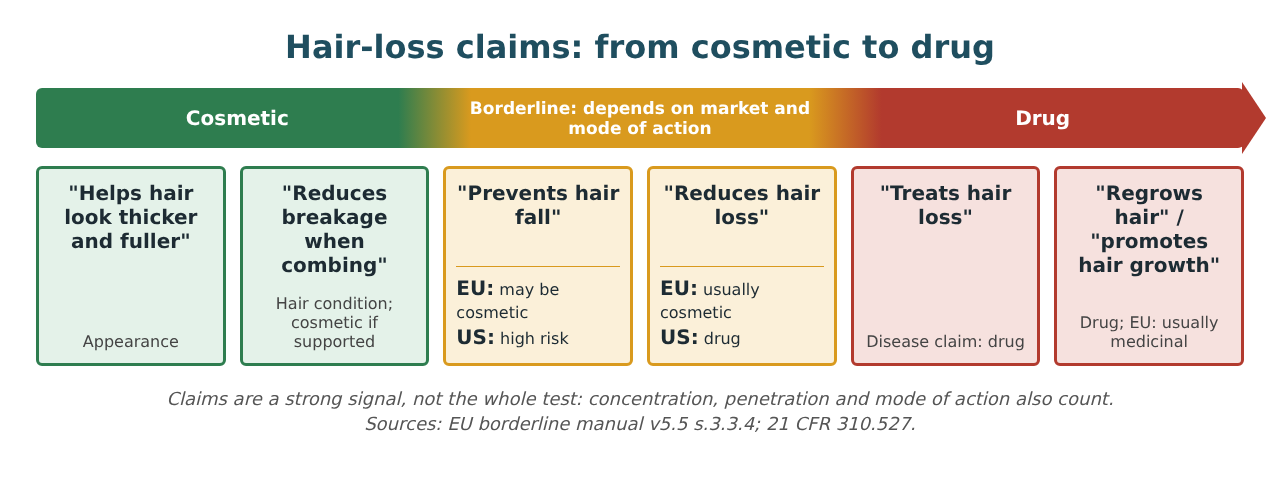
The manual is not legally binding, and it says claims do not replace a careful look at the mode of action [2]. A product that works by changing the hair cycle can be medicinal whatever its label says. Wording tied to breakage, combing or the look of the hair is safest everywhere.
04Minoxidil: the drug benchmark
Minoxidil is the topical active with the strongest randomised evidence. In a 48-week trial in 393 men, 5% minoxidil beat 2% minoxidil and placebo on hair counts [14]. In the US, topical minoxidil 2% was first approved in 1988 and switched from prescription to OTC sale in 1996, under its own new drug application [4]. There is no OTC monograph for hair growers [3]. In the EU minoxidil is prohibited in cosmetics, so a minoxidil product can only be sold as a medicine [1][2].
05Cosmetic actives and the evidence gap
Cosmetic shampoos for thinning hair often use caffeine, peptides, rosemary oil or hair growth complexes. Caffeine shampoo shows the gap between evidence and claim. In organ culture, caffeine enhanced hair shaft elongation in male and female human scalp follicles and offset the suppression caused by testosterone [15]. That is laboratory evidence, not a clinical result [15], and a growth effect is what the EU manual asks regulators to examine [2].
In a six-month trial, 100 people with androgenetic alopecia used rosemary oil or 2% minoxidil; hair counts rose in both groups with no significant difference [16]. One small trial does not make a hair regrowth claim safe for a cosmetic, and in the US the claim alone would make it a drug [3].
How hair counts are measured for hair growth claims is covered in Hair-growth claims: trichogram and phototrichogram explained. For the shampoo base the actives sit in, read What are sulfates in shampoo?
06What a brand must do
- Decide the purpose first.
Choose cosmetic or medicine before writing copy, then stay on that side of the line.
- Write claims per market.
"Reduces hair loss" can pass in the EU but is a drug claim in the US.
- Check every channel.
Intended use is read from labels, advertising and websites, not only the pack [6].
- Check ingredient status in each market.
The same active can be a cosmetic ingredient in one place and a drug in another, as with the actives in Seborrheic dermatitis shampoo: actives compared.
- Keep an evidence file.
Record each wording, its data, its status by market and the last review date, so a reviewer can see why a phrase such as "for thinning hair" is on the pack. Keep it with the EU product information file. Re-check whenever the claim, active or presentation changes.
Need hair-loss claims checked before print?
CSL reviews claim wording against the formula, the evidence and the rules in each target market.
07Questions readers ask
Is caffeine shampoo a drug?
Not because of the caffeine. With cleansing and appearance claims it can be a cosmetic; a regrowth or treatment claim moves it towards drug status.
Can I say "anti hair fall"?
In the EU it may be cosmetic, case by case. In the US it risks reading as hair loss prevention, a drug use. Breakage wording is safer in both.
Can a cosmetic shampoo contain minoxidil?
Not in the EU, where minoxidil is prohibited in cosmetics. In the US, a minoxidil hair product is regulated as a drug.
Does "for cosmetic use only" fix a regrowth claim?
No. Regulators judge the whole presentation, and a disclaimer does not cancel a drug claim made elsewhere.
08References
- Regulation (EC) No 1223/2009 of the European Parliament and of the Council of 30 November 2009 on cosmetic products, Article 2(1)(a) and Annex II, entry 372 (consolidated). Off J Eur Union. 2009;L342:59–209. EUR-Lex
- Working Group on Cosmetic Products, Sub-Group on Borderline Products. Manual on the scope of application of the Cosmetics Regulation (EC) No 1223/2009 (Art. 2(1)(a)), version 5.5, section 3.3.4: products containing substances stimulating hair growth or reducing hair loss. Brussels: European Commission; June 2025. European Commission
- Drug products containing active ingredients offered over-the-counter (OTC) for external use as hair growers or for hair loss prevention, 21 C.F.R. § 310.527. eCFR
- US Food and Drug Administration. Drugs@FDA: NDA 019501, Rogaine (minoxidil) topical solution 2%, approval history. Silver Spring (MD): FDA [cited 2026 Nov 18]. Drugs@FDA
- Directive 2001/83/EC of the European Parliament and of the Council of 6 November 2001 on the Community code relating to medicinal products for human use, Articles 1(2) and 2(2) (consolidated). Off J Eur Communities. 2001;L311:67–128. EUR-Lex
- US Food and Drug Administration. Is it a cosmetic, a drug, or both? (Or is it soap?). Silver Spring (MD): FDA; content current as of 2024 Sep 11 [cited 2026 Nov 18]. FDA
- Ho CH, Sood T, Zito PM. Androgenetic alopecia. In: StatPearls [Internet]. Treasure Island (FL): StatPearls Publishing; updated 2024 Jan 7 [cited 2026 Nov 18]. NCBI Bookshelf
- Court of Justice of the European Communities. Judgment of 16 April 1991, Upjohn Company and Upjohn NV v Farzoo Inc. and J. Kortmann, Case C-112/89. EUR-Lex
- Medicines and Healthcare products Regulatory Agency. MHRA Guidance Note 8: a guide to what is a medicinal product, sections 10 and 12. London: MHRA; 2025. GOV.UK
- Federal Food, Drug, and Cosmetic Act § 201(g)(1) and (i), 21 U.S.C. § 321(g)(1) and (i). Ithaca (NY): Legal Information Institute [cited 2026 Nov 18]. Cornell LII
- The Drugs and Cosmetics Act, 1940 (Act No. 23 of 1940), sections 3(aaa) and 3(b). New Delhi: Government of India. India Code
- Central Drugs Standard Control Organization. Frequently asked questions on registration and import of cosmetics into India, Q.1 and Q.54. New Delhi: CDSCO, Ministry of Health and Family Welfare [cited 2026 Nov 18]. CDSCO
- Saudi Food and Drug Authority. Products classification guidance, version 8.0. Riyadh: SFDA; 2024. SFDA
- Olsen EA, Dunlap FE, Funicella T, Koperski JA, Swinehart JM, Tschen EH, et al. A randomized clinical trial of 5% topical minoxidil versus 2% topical minoxidil and placebo in the treatment of androgenetic alopecia in men. J Am Acad Dermatol. 2002;47(3):377–85. Source
- Fischer TW, Herczeg-Lisztes E, Funk W, Zillikens D, Bíró T, Paus R. Differential effects of caffeine on hair shaft elongation, matrix and outer root sheath keratinocyte proliferation, and transforming growth factor-β2/insulin-like growth factor-1-mediated regulation of the hair cycle in male and female human hair follicles in vitro. Br J Dermatol. 2014;171(5):1031–43. Source
- Panahi Y, Taghizadeh M, Marzony ET, Sahebkar A. Rosemary oil vs minoxidil 2% for the treatment of androgenetic alopecia: a randomized comparative trial. Skinmed. 2015;13(1):15–21. PubMed
Update log
- Published by Cosmetic Science Lab
This article is general technical information, not legal, regulatory or medical advice. Confirm requirements for your product and market before launch.