Ferments in skin care: what the evidence shows for fermented ingredients
Galactomyces, bifida and lactobacillus ferments are popular in skin care. Controlled human evidence is patchy. Here is what exists and how CSL formulation scientists use ferments responsibly.
By CSL Formulation team · Evidence checked by CSL scientists
At a glance
- What it is
- Ingredients made by fermenting a base (rice, milk, plants) with yeast or bacteria, then filtering or lysing, e.g. Galactomyces ferment filtrate, Bifida ferment lysate, Lactobacillus ferment
- Main benefits
- Hydration and smoother-looking skin; calmer-looking reactive skin in one controlled trial; fewer visible blemishes in small acne studies
- Levels tested in trials
- 10% Bifidobacterium longum lysate; 5% Lactococcus ferment lysate; 3% Lactobacillus ferment lysate blend; galactomyces level not disclosed
- Time to results
- 4 weeks to 12 months, depending on the study
- Watch for
- Each ferment is a different material; much of the evidence is unpublished, uncontrolled or manufacturer-run
01What is it?
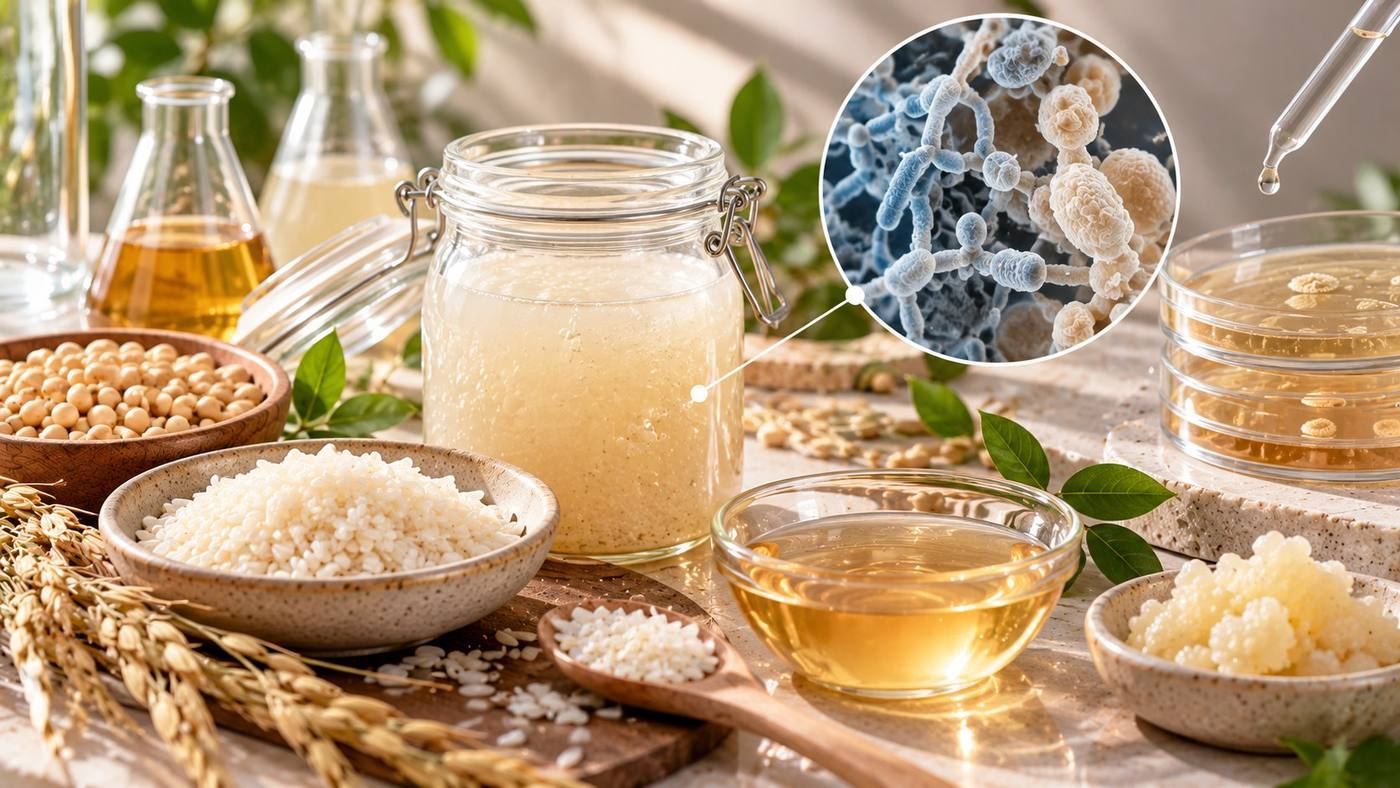
“Ferment” covers many different ingredients made by growing yeast or bacteria on a base such as rice, milk or plant extract. The result is filtered or broken open to give a mix of sugars, amino acids, organic acids and cell fragments. Galactomyces ferment filtrate, Bifida ferment lysate and Lactobacillus ferments are the most common in skin care.
02What it does
Ferments deliver small humectant and nutrient molecules, and some contain bacterial fragments that may calm skin reactivity. Human studies report better hydration, smoother-looking skin and, for some lysates, less sensitivity or fewer spots. Because each ferment is different, results from one do not transfer to another.
03The evidence
Studies below were checked against the publisher, DOI or journal record on 26 Sep 2026. We list design and size so you can judge the strength of each result.
| Study | Design | Who and how long | What it found |
|---|---|---|---|
| Warp et al. 2026, Dermatology and Therapy (Springer Nature) Source | Systematic review | 33 studies, 2,112 people with acne, including Lactobacillus-fermented extracts and ferment lysates | A split-face trial found a Lactobacillus-fermented plant extract beat tea tree oil for spots, but topical studies overall were small and short. |
| Anwar et al. 2025, Journal of Pakistan Association of Dermatologists Source | Double-blind, randomised, placebo-controlled trial | 70 people with acne, 8 weeks, 5% Lactococcus ferment lysate | Average spot count fell from 48.5 to 24.5 and oiliness fell more than with placebo; inflammation markers did not differ significantly. |
| Cui et al. 2023, Scientific Reports (Springer Nature) Source | Randomised study using each person as their own control, manufacturer-run | 52 adults, 30 days, lotion with 3% blend of four Lactobacillus ferment lysates | Water loss fell 26.8%, hydration rose 26.6% and redness fell 13.8% from baseline. |
| Miyamoto et al. 2023, Journal of Clinical Medicine (MDPI) Source | Long-term observational study, no control group, manufacturer-funded | 86 Japanese women, 12 months, three products containing Galactomyces ferment filtrate (level not disclosed) | Hydration rose within 2 months, and wrinkles, spots and roughness improved over 12 months. With no control group, product effects cannot be separated from other factors. |
| Guéniche et al. 2010, Experimental Dermatology (Wiley) Source | Randomised, double-blind, placebo-controlled trial | 66 women with reactive skin, 2 months, cream with 10% Bifidobacterium longum lysate (Bifida ferment lysate) | Skin sensitivity fell significantly versus placebo (P=0.0024), and the barrier resisted tape stripping better (P=0.0044). |
Some ferment lysates have small controlled trials for calmer skin and fewer blemishes, but most ferment claims rest on supplier data or uncontrolled studies. Treat each ferment as its own ingredient. Suitable claims are modest, such as “hydrates” or “helps skin look smoother”, supported by testing of the finished product.
04How CSL formulation scientists use it
- Choose ferments with a named organism, defined base and supplier specification. Ask for batch-to-batch consistency data and any human studies at the level you plan to use.
- Filtrates and lysates contain sugars and amino acids that can feed spoilage organisms, so preservative efficacy testing is essential. Watch for pH drift, odour and colour change in stability testing.
- Galactomyces ferment filtrate is often used at high levels in essences and toners; bacterial ferment lysates are usually used at a few per cent in serums and creams.
- Ferments combine easily with humectants, niacinamide and barrier lipids. Claims should match the exact ferment and level tested.
05Regulatory and claims
Ferments are regulated as ordinary cosmetic ingredients under their INCI names. The US Cosmetic Ingredient Review (CIR) issued a tentative report in January 2024 on yeast-derived ingredients, including Galactomyces ferment filtrate, which it reported in use at up to 90.7% in leave-on moisturisers. CSL regulatory specialists confirm the status in each target market. Keep claims cosmetic, for example “hydrates and smooths”, not “repairs” or “treats”.
06Questions brands ask
Are ferments the same as probiotics?
No. Most ferments are filtered or lysed, so they contain no live microbes. They are closer to postbiotics, but many also contain nutrients from the fermented base.
Is Galactomyces ferment filtrate proven?
It has a long history of use and lab data, but the main human study found had no control group and was run by the manufacturer. Strong claims are not yet supported.
Do ferments cause irritation?
The controlled trials found reported them as well tolerated. As with any ingredient, the finished product should pass skin compatibility testing.
07References
- Warp PV, Bilik SM, Ferrari LM, et al. Prebiotics, probiotics, and postbiotics for acne vulgaris: a systematic review. Dermatol Ther (Heidelb). 2026;16(3):1531–1550. Link
- Anwar AI, Zainuddin AA, Hutabarat EN, Savitri KAP. Effectiveness of topical microbiome containing Lactococcus ferment lysate 5% in acne vulgaris patients. J Pak Assoc Dermatol. 2025;35(2):93–98. Link
- Cui H, Feng C, Zhang T, et al. Effects of a lotion containing probiotic ferment lysate as the main functional ingredient on enhancing skin barrier: a randomized, self-control study. Sci Rep. 2023;13:16879. Link
- Miyamoto K, et al. Significant reversal of facial wrinkle, pigmented spot and roughness by daily application of galactomyces ferment filtrate-containing skin products for 12 months: an 11-year longitudinal skin aging rejuvenation study. J Clin Med. 2023;12(3):1168. Link
- Guéniche A, Bastien P, Ovigne JM, et al. Bifidobacterium longum lysate, a new ingredient for reactive skin. Exp Dermatol. 2010. Link
- Cosmetic Ingredient Review. Safety assessment of yeast-derived ingredients as used in cosmetics. Tentative report for public comment. 10 January 2024. Link
Used in: Microbiome-friendly
Update log
- Evidence reviewed and page published by CSL scientists
This page summarises published research for brands and formulators. It is general information, not medical advice, and results in studies depend on the full formula tested.