Worked example: patch testing and safety assessment for a baby and kids lotion
How a baby and kids lotion project would typically combine an adult sensitive-skin patch test with a safety assessment built for children: formula screening, ethics, exposure, microbiology and claims. This is an illustrative worked example, not a client project. Part of our testing and safety series.
By Dr. Premalatha, Ph.D., Life Science, Regulatory Consultant, Cosmetic Science Lab
Worked example. This page describes how a typical baby and kids lotion project would combine an adult patch test with a safety assessment. It is illustrative: it does not describe a specific client, and it contains no measured data.
At a glance
- Product
- A leave-on body lotion for babies and children (illustrative)
- Key point
- An adult sensitive-skin patch test is a screen; the safety assessment carries the conclusion for children
- Caveat
- A patch test supports a narrow claim, never "suitable for all babies"
Quick answer
- How is a baby lotion shown to be safe? A mild formula, an adult patch test as a screen, then a safety assessment that uses a conservative exposure estimate for children.
- Patch testing on babies is not done for routine cosmetic safety work; human studies only confirm safe use, they do not identify hazards [4].
- Young children have more skin area per kilogram of body weight, so the assessor scales exposure up [3].
- Microbial limits for products for children under three are stricter than for most other products [8].
Take-home message for brand owners
- Agree claims such as "gentle" or "dermatologically tested" before testing, not after.
- Give the assessor stability and microbiology data early.
Take-home message for formulators
- Keep the ingredient list short and fragrance out unless essential.
- Check every restricted ingredient for its under-three conditions.
01The brief
A lotion for babies and children carries a higher safety expectation than almost any other cosmetic. Parents read labels closely, retailers ask for evidence and regulators expect a documented assessment. A project like this would start with a short list of decisions: the age range, the use (daily body lotion or nappy-area care), the claims and the markets. Words such as "gentle", "hypoallergenic" and "dermatologically tested" attract close attention, so they would be agreed before testing begins.
02Screening the formula for children
Ingredient choice is the first safety tool. The list would be kept short, fragrance avoided or limited, and the preservative system chosen for mildness as well as effectiveness. Each ingredient is checked against the Regulation's annexes of prohibited, restricted and permitted substances; several restricted substances and preservatives carry specific conditions for products for children under three [1].
Infant skin is not simply small adult skin. Studies describe differences in its structure and function during the first years of life [2], and young children have a larger body surface area relative to body weight, which raises exposure per kilogram [3]. The assessor would therefore build a conservative exposure estimate rather than copy an adult one [4].
03The adult sensitive-skin patch test
Patch testing on babies is not done for routine cosmetic safety work, and the Annex I guidelines state that human studies should confirm safe use, not identify hazards [4]. Instead, a patch test would be run on adult volunteers who describe their skin as sensitive. Self-reported sensitive skin is often linked with stronger responses to irritants, which makes the panel a more demanding screen. It does not, on its own, prove that a product suits infants.
| Stage | What would happen | Purpose |
|---|---|---|
| Protocol and ethics | Written protocol, informed consent, ethics committee review [5][6] | Protect volunteers and make results usable |
| Volunteer selection | Inclusion and exclusion criteria; sensitive-skin panel | A relevant and safe test group |
| Patch application | Product applied under an occlusive patch, typically for 48 hours, alongside controls | Compare reactions against reference sites |
| Skin grading | A trained evaluator scores redness and other reactions after removal on a standard scale | Objective, repeatable scoring |
| Report | Results and any deviations summarised | Input for the safety assessor |
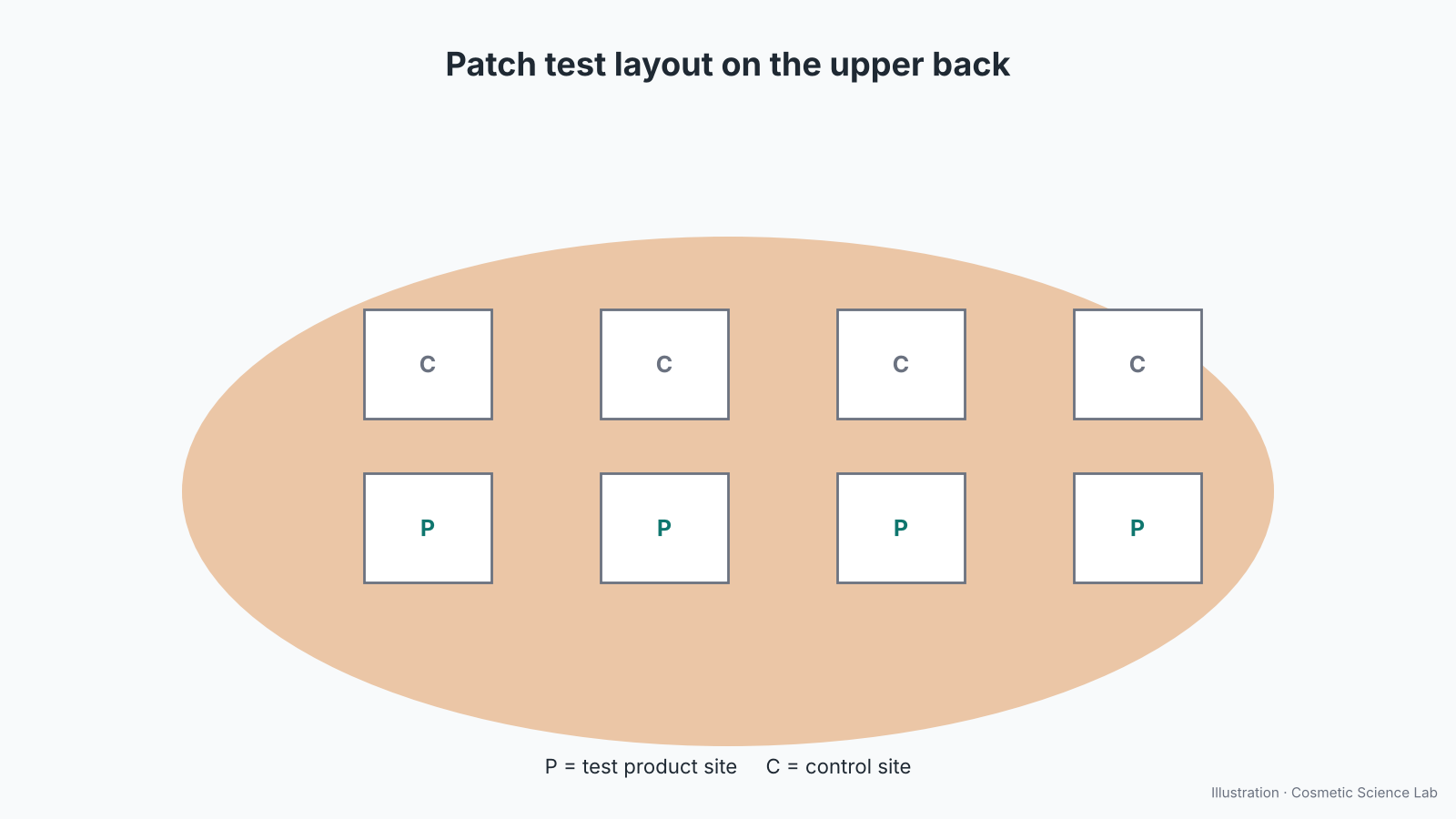
This is a single-application test. A repeat insult patch test (HRIPT) is a different design, with an induction phase, a rest period and a challenge, used to look for sensitisation.
04Consent and ethics in practice
The study would follow the Declaration of Helsinki and, in India, the ICMR national ethical guidelines for research involving human participants [5][6]. Volunteers would receive a written explanation of the test, the product, possible reactions and their right to withdraw at any time. Informed consent would be recorded before any patch is applied, and an independent ethics committee would review the protocol. Those records form part of the study report.
05The baby and kids lotion safety assessment
The safety assessor then brings every input together: the full formula, the toxicological profile of each ingredient, impurities, packaging, microbiological quality, stability and the patch test report. Exposure is estimated from the amount applied, how often and how much of the body is covered, and a margin of safety is calculated for the ingredients that matter; a margin of at least 100 is generally expected [3][4]. The assessment must also state any warnings required on the label [1]. Our EU CPSR guide explains the report itself.
The patch test is one data point among several. Stability data show that the lotion stays within its specification, in its final pack, over its intended shelf life. Microbiological data show that it meets the stricter limits expected for products for children under three, no more than 100 CFU/g total aerobic mesophilic microorganisms, and that its preservative system passes a challenge test [4][8]. If the assessor found a gap, the formula or the evidence would be revised before release.
06Claims after testing
A patch test supports a narrow statement, for example that the product was tested under dermatological control on a defined group of adults. It does not justify "suitable for all babies". Any claim must meet the EU common criteria, including truthfulness and evidential support [7]. See our claims and clinical testing page.
07What a brand would typically receive
- The patch test protocol and final report.
- The safety assessment report with the assessor's conclusion.
- A list of required label warnings, if any.
- Guidance on which claims the evidence supports.
- A product file that can be shown to retailers and authorities.
08Timeline and lessons
Patch testing and safety assessment run alongside stability and microbiology work, so the whole file can close at about the same time. If testing begins only after packaging is printed, a change of wording or formula can mean reprinting.
- Choose mild ingredients before you test.
Testing confirms a gentle formula; it cannot create one.
- Agree claims first.
Then design the evidence to match.
- Use the patch test as a screen.
It is not final proof for infants.
- Feed the assessor early.
Stability and microbiology data are the slowest inputs.
For the microbiology behind a gentle formula, read our evidence library on microbiological testing, and see how data reaches the final report in our EU safety assessment guide.
Developing a lotion for babies or children?
CSL plans patch testing, stability, microbiology and the safety assessment together, so the product file closes before launch.
09Questions readers ask
Are baby cosmetics patch tested on babies?
No. Routine patch tests use adult volunteers, often with sensitive skin, and the safety assessment covers children through exposure modelling.
What does "dermatologically tested" mean on a baby lotion?
That the product was tested under dermatological supervision on a defined group; it does not mean it suits every baby.
What microbial limit applies to products for children under three?
Under ISO 17516, no more than 100 CFU/g total aerobic mesophilic microorganisms, stricter than for most other products.
Can a baby lotion claim to be hypoallergenic?
Only with evidence that the product minimises allergy risk, and the claim still has to meet the EU common criteria.
10References
- Regulation (EC) No 1223/2009 of the European Parliament and of the Council of 30 November 2009 on cosmetic products. Off J Eur Union. 2009;L342:59–209. EUR-Lex
- Stamatas GN, Nikolovski J, Mack MC, Kollias N. Infant skin physiology and development during the first years of life: a review of recent findings based on in vivo studies. Int J Cosmet Sci. 2011;33(1):17–24. PubMed
- Scientific Committee on Consumer Safety. The SCCS Notes of Guidance for the testing of cosmetic ingredients and their safety evaluation, 12th revision. SCCS/1647/22, Corrigendum 2. Luxembourg: European Commission; 2023. European Commission
- Commission Implementing Decision 2013/674/EU of 25 November 2013 on Guidelines on Annex I to Regulation (EC) No 1223/2009 of the European Parliament and of the Council on cosmetic products. Off J Eur Union. 2013;L315:82. EUR-Lex
- World Medical Association. Declaration of Helsinki: ethical principles for medical research involving human participants. Ferney-Voltaire: WMA; 2024. WMA
- Indian Council of Medical Research. National ethical guidelines for biomedical and health research involving human participants. New Delhi: ICMR; 2017. ICMR
- Commission Regulation (EU) No 655/2013 of 10 July 2013 laying down common criteria for the justification of claims used in relation to cosmetic products. Off J Eur Union. 2013;L190:31–4. EUR-Lex
- International Organization for Standardization. ISO 17516:2014. Cosmetics – Microbiology – Microbiological limits. Geneva: ISO; 2014.
Update log
- Published by Cosmetic Science Lab
This article is general technical information, not legal, regulatory or medical advice. Confirm requirements for your product and market before launch.