EU Cosmetics Regulation: the safety assessment and the stability data you need before launch
Every cosmetic sold in the EU needs a safety report signed by a qualified assessor, and stability data sit at its centre. Here is what the Regulation requires, how the report is built and which stability data an assessor will ask for. Part of our testing and safety series.
By Dr. Premalatha, Ph.D., Life Science, Regulatory Consultant, Cosmetic Science Lab

The rules behind this article
- Law
- Regulation (EC) No 1223/2009, Articles 3, 10, 11 and 19 and Annex I [1]
- Guidance
- Commission guidelines on Annex I (2013/674/EU) [2]; SCCS Notes of Guidance, 12th revision [3]
- Scope
- What the EU safety report contains and the stability data it needs
- Key point
- Stability must be run on the marketed composition, in the intended pack
- Caveat
- UK rules are separate; an EU report cannot simply be reused there
Quick answer
- What does the EU require before launch? A safety assessment by a qualified assessor, written up as a Cosmetic Product Safety Report in the Product Information File [1].
- Stability tests should suit the product type and use, cover the composition actually sold and include the intended pack [2].
- The Product Information File is kept for ten years after the last batch is placed on the market [1].
Take-home message for brand owners
- Start the safety file during formulation, so stability runs in parallel.
- Freeze the formula before the assessment is signed.
Take-home message for formulators
- Run stability on the final formula in the final pack.
- Collect supplier safety and impurity data for every raw material.
01What the EU Cosmetics Regulation requires
No cosmetic can be sold in the European Union until a qualified person has assessed its safety in writing. Regulation (EC) No 1223/2009 says a product made available on the market must be safe for human health under normal or reasonably foreseeable conditions of use [1]. Before it is placed on the market, the Responsible Person must ensure it has undergone a safety assessment and that a Cosmetic Product Safety Report (CPSR) has been set up in line with Annex I [1]. The report sits in the Product Information File, which must be kept for ten years after the last batch is placed on the market [1]. Our guide to the Responsible Person and Product Information File covers that obligation.
The safety assessor must hold a university-level qualification in pharmacy, toxicology, medicine or a similar discipline, or one a Member State recognises as equivalent [1]. Holding a formulation role does not by itself qualify someone to sign the assessment.
02How the safety report is structured
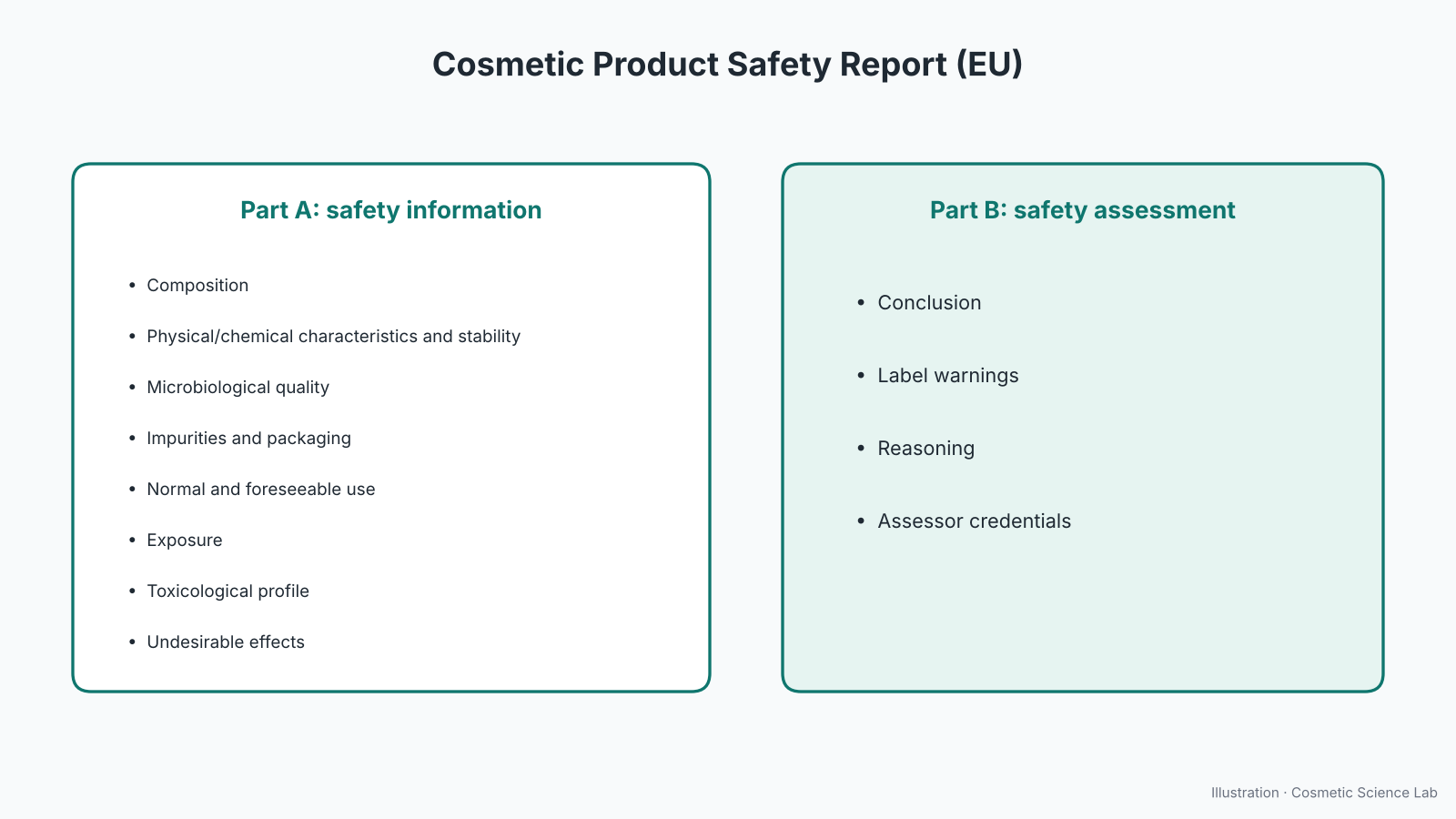
The CPSR has two parts, set out in Annex I [1].
| Part | What it contains | Why it matters |
|---|---|---|
| Part A: safety information | Composition; physical and chemical characteristics and stability; microbiological quality; impurities, traces and packaging; normal and foreseeable use; exposure to the product and its substances; toxicological profiles; undesirable effects; other product information | The evidence the assessor works from |
| Part B: safety assessment | The conclusion, required label warnings and instructions, the reasoning, and the assessor's credentials and approval | The professional judgement the Responsible Person relies on before placing the product on the market |
For margin-of-safety calculations and the full Annex I checklist, see our EU CPSR guide.
03Where stability data fits
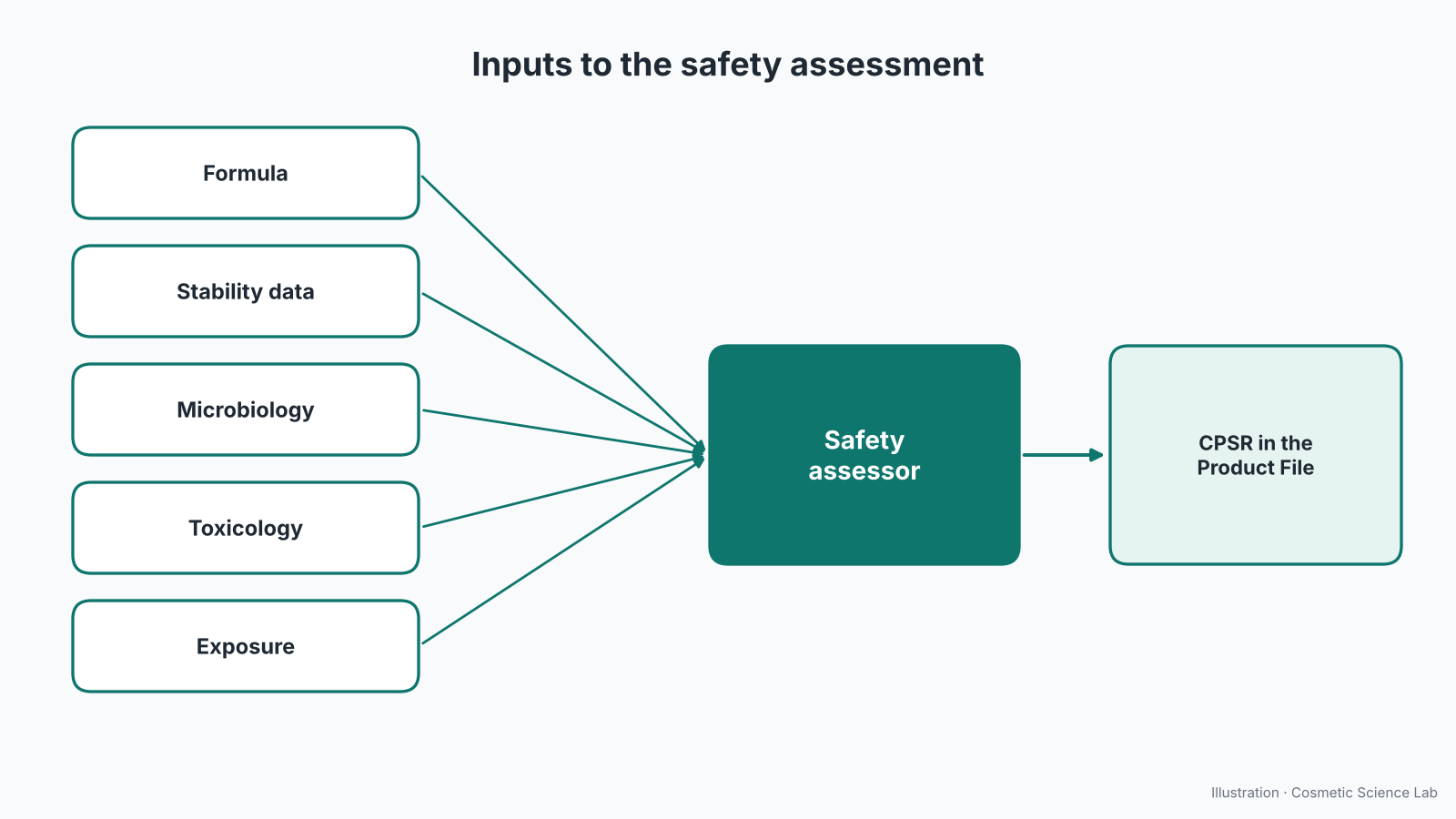
Stability is not an optional extra. Part A asks for the physical and chemical characteristics of the finished product and its stability under reasonably foreseeable storage conditions [1][2]. Without it, the assessor cannot tell whether the product assessed is the product the consumer will use months later.
Stability data also supports the durability information on the label. A product with a minimum durability of 30 months or less must carry a date; one that lasts longer does not, but it must show the period after opening instead, unless that concept is not relevant to the product [1]. Both statements rest on data.
04What EU stability data usually includes
The Regulation does not prescribe one fixed protocol. The Commission guidelines on Annex I ask for stability tests adapted to the product type and its intended use, run on the composition actually placed on the market and in the intended packaging, with the methodology and results described in the report [2]. In practice, assessors commonly look for:
- Storage at several temperatures, with a clear record of the time points.
- Physical checks: appearance, odour, colour, pH, viscosity and separation.
- Packaging compatibility, including migration or interaction with the pack.
- Microbiological quality, supported by a preservative efficacy test where applicable [2].
- Evidence for any period after opening shown on the label [2].
05Who does what
- The Responsible Person
Is legally accountable for the product and keeps the Product Information File [1].
- The safety assessor
Reviews the data and approves Part B of the report.
- The formulator
Supplies the formula, process and ingredient documents.
- The testing laboratory
Provides stability, microbiological and any human-use data.
The safety report is only as strong as the data behind it. Gaps in the file become gaps in the conclusion.
06Questions to ask before appointing an assessor
- Does the assessor hold a qualification that meets Article 10(2)?
- Will they review the finished formula and pack, or only the ingredient list?
- Which stability and microbiology data do they expect, and in what format?
- How are formula changes handled after the report is signed?
- Who keeps the report, and for how long?
07Common gaps that delay a launch
- Stability run on a bench sample rather than the final formula or pack.
- Missing preservative efficacy data.
- Ingredient information without supplier safety documents or impurity data.
- A formula changed after the assessment was signed.
- Exposure assumptions that do not match the product, such as one assessed as rinse-off but labelled or used as leave-on.
There is no fixed timetable, because the work depends on how complete the data are. The slowest items are usually stability readings and missing supplier documents. Starting the file at formulation lets stability run in parallel, so the report is written when the data are ready. See how we run sunscreen stability testing for what that data looks like.
08Other markets, and a route for Indian exporters
The United Kingdom has its own rules and its own Responsible Person, so an EU report must be reviewed and held by a UK Responsible Person under UK rules; see our UK market page. Other markets, including the Gulf and ASEAN, ask for related documents in different formats, and a complete technical file can usually be adapted.
Brands starting from the Indian rules, summarised in our Cosmetics Rules, 2020 guide, still need to meet EU requirements separately. The safer path is to plan the safety assessment while the formula is still in development, using the scientific guidance assessors rely on [3], so stability and microbiology studies are designed once and used for both markets.
Preparing to sell in the EU?
CSL brings stability, microbiology and ingredient data into one file, so your safety assessor can write and defend the CPSR.
09Questions readers ask
Who can sign an EU cosmetic safety assessment?
A person with a university-level qualification in pharmacy, toxicology, medicine or a similar discipline, or one recognised as equivalent by a Member State.
Is stability data required for an EU CPSR?
Yes. Annex I Part A requires the product's stability under reasonably foreseeable storage conditions.
How long must the Product Information File be kept?
Ten years after the last batch of the product is placed on the market.
Can an EU safety report be used in the UK?
Not as it stands. It must be reviewed and held by a UK Responsible Person under the UK rules.
10References
- Regulation (EC) No 1223/2009 of the European Parliament and of the Council of 30 November 2009 on cosmetic products. Off J Eur Union. 2009;L342:59–209. EUR-Lex
- Commission Implementing Decision 2013/674/EU of 25 November 2013 on Guidelines on Annex I to Regulation (EC) No 1223/2009 of the European Parliament and of the Council on cosmetic products. Off J Eur Union. 2013;L315:82. EUR-Lex
- Scientific Committee on Consumer Safety. The SCCS Notes of Guidance for the testing of cosmetic ingredients and their safety evaluation, 12th revision. SCCS/1647/22, Corrigendum 2. Luxembourg: European Commission; 2023. European Commission
Update log
- Published by Cosmetic Science Lab
This article is general technical information, not legal, regulatory or medical advice. Confirm requirements for your product and market before launch.