Inside our lab: how we run sunscreen stability testing in India
Sunscreens must keep their texture, their UV filters and their protection through heat, light and months on a shelf. Here is how a stability study is planned, stored, measured and reported, step by step. Part of our testing and safety series.
By Dr. Premalatha, Ph.D., Life Science, Regulatory Consultant, Cosmetic Science Lab

How this study is run
- Where
- CSL stability and QC lab, India
- Conditions
- Room, elevated and cold temperature, freeze–thaw, light, and warm-humid where the market calls for it
- Key point
- Pass or fail criteria are written before the first sample goes into storage
- Caveat
- Stability shows whether protection holds; it does not replace the SPF test
Quick answer
- How is sunscreen stability tested? Samples of the final formula, in its pack, are stored at several temperatures and under light, then checked at set intervals against criteria agreed in advance.
- Sunscreens need extra checks because UV filters can break down in light, and the loss depends on which filters are combined [1].
- Photostability compares an irradiated film with an unexposed control, early enough to change the formula.
- The report states the shelf life the data support and feeds the safety assessment.
Take-home message for brand owners
- Send a pilot-scale batch in the final pack, not a bench sample.
- Tell the lab your markets, so storage matches the climate.
Take-home message for formulators
- Run photostability early, while the filter system can still change.
- Restart the programme if the formula changes.
01Why sunscreens need their own stability programme
Sunscreen is one of the hardest cosmetics to keep stable. It carries sensitive UV filters, a heavy oil load and often mineral powders, and it is expected to survive heat, sweat and sunlight. A moisturiser can drift a little in viscosity and still work; a sunscreen cannot drift in protection. Organic UV filters can degrade in light, and the loss depends on which filters are combined and how they are stabilised [1]. Mineral filters such as zinc oxide and titanium dioxide can settle or clump if they are poorly dispersed, and emulsions loaded with filters and film formers are harder to hold together than a simple cream.
Climate adds pressure. A sunscreen in India or the Gulf may sit in a hot car or a beach bag for weeks, so stability work must reflect real use, not only laboratory comfort. This is how we run stability testing for sunscreens in our lab in India, from the first protocol discussion to the final report.
02Step 1: the protocol comes first
Every programme starts with a short technical discussion. We record the format (lotion, spray, stick or gel), the pack, the claims, the batch size and the markets. These decide the storage conditions, the test intervals and the pass or fail criteria, which are written down before the first sample goes into storage. Writing criteria in advance stops results from being read to suit the outcome.
03Step 2: storage conditions
Industry guidance recommends storage at room temperature, elevated temperature and cold, with freeze–thaw cycles and light exposure where relevant; accelerated storage is often run at 37, 40 or 45 °C for one to three months or more [2]. For sunscreens we usually add a warm, humid condition matched to the target climate.
| Condition | Typical purpose | What it can reveal |
|---|---|---|
| Room temperature | Real-time behaviour through shelf life | Slow drift in texture or colour |
| Elevated temperature | Accelerated ageing | Separation, thinning or odour change |
| Cold storage | Low-temperature behaviour | Crystallisation or thickening |
| Freeze–thaw cycles | Transport and storage extremes | Emulsion robustness |
| Warm and humid | Target-climate simulation | Pack interaction and microbial risk |
| Light exposure | Photostability | Colour change and filter loss |
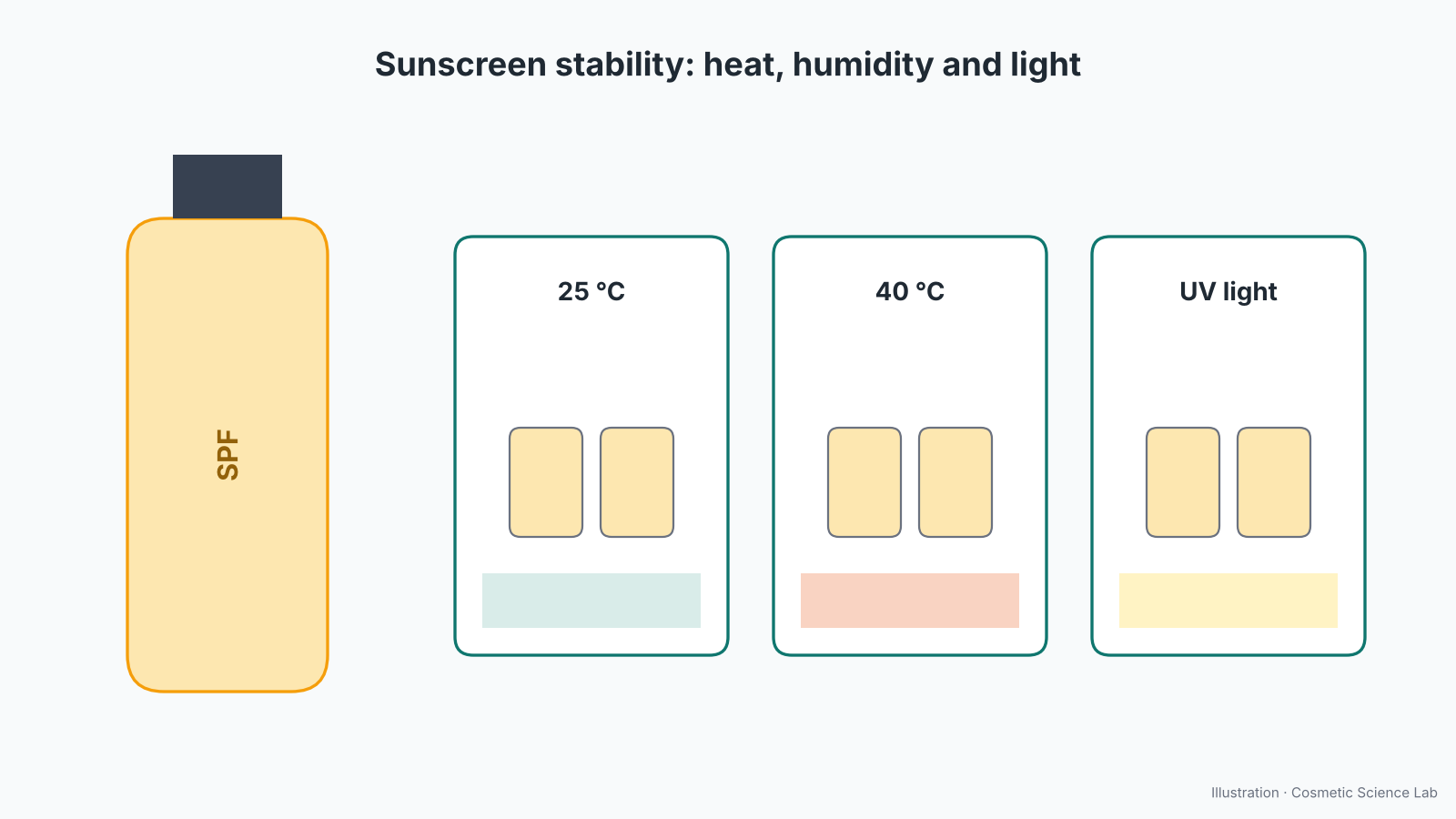
Conditions are agreed per product and market. The protocol, not the habit of the lab, decides what is tested.
04Step 3: what we measure at each time point
Samples are pulled at set intervals and compared with their starting values. A typical sunscreen readout covers:
- Appearance and odour: colour, gloss, grain and any change in smell.
- pH and viscosity: early signs that the emulsion or thickener is shifting.
- Phase behaviour: separation, bleeding or sedimentation, including after centrifugation.
- Microscopy: droplet size and the dispersion of mineral particles.
- Packaging interaction: leakage, staining, pump function and label adhesion; see our packaging compatibility guide.
- Filter content or protection indicators: where the claim and budget call for it.
05Photostability: the check unique to sun care
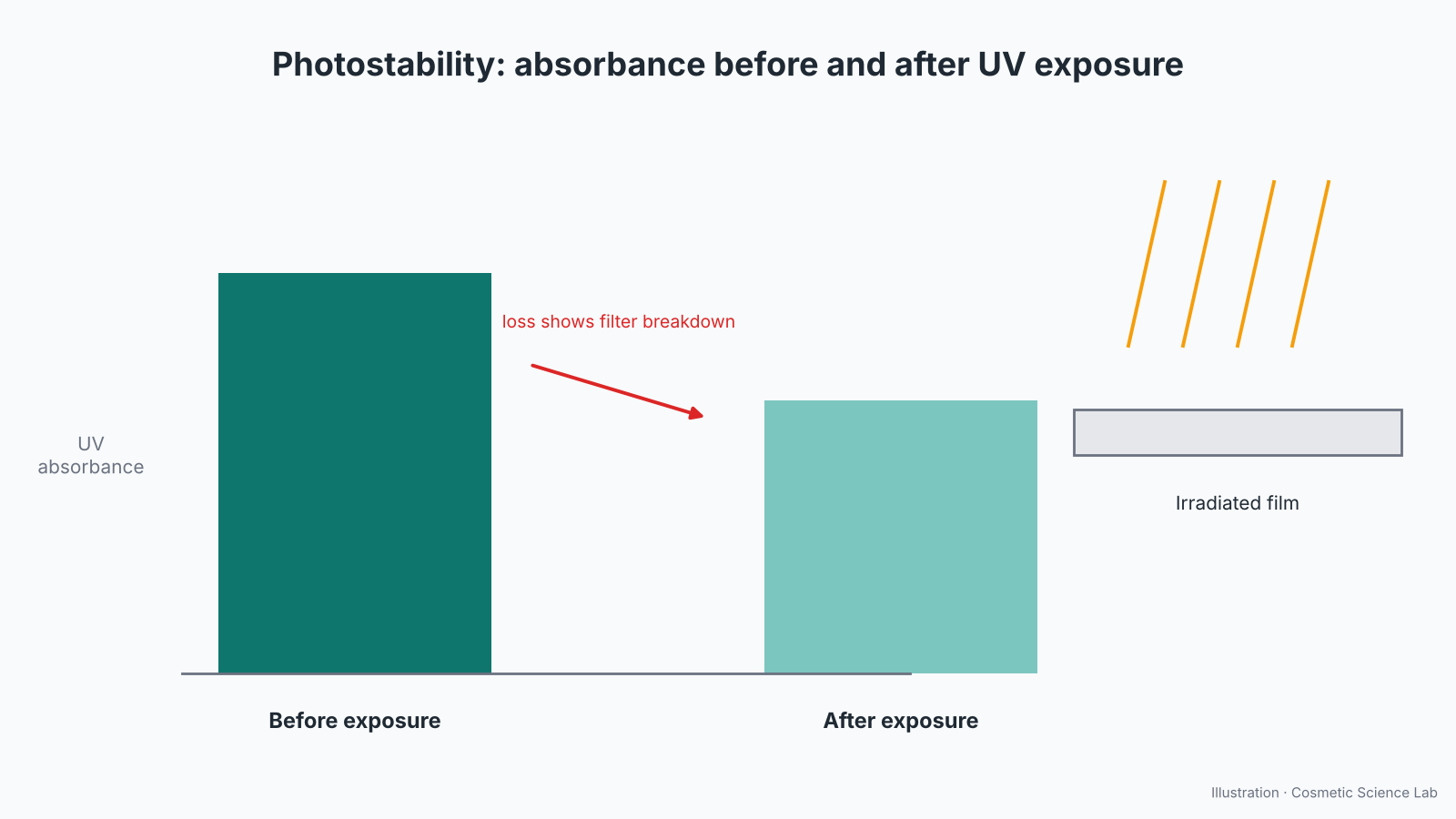
Photostability asks a simple question: after exposure to light, does the product still protect? A thin film of sunscreen is spread on a suitable substrate, irradiated, and its absorbance or filter content is compared with an unexposed control. A large fall shows that filters are breaking down or that the combination does not stabilise itself [1]. The test is most useful early, while the formula can still change; our guide to why sunscreen expires explains avobenzone breakdown.
It does not replace the SPF test. SPF is still most commonly measured on human volunteers under ISO 24444, although ISO 23675 and ISO 23698, both published in 2024, now offer alternatives; UVA protection is assessed in vitro under ISO 24443 [3][4]. See SPF, UVA-PF and PA explained. Stability work shows whether the protection measured at launch still holds at the end of shelf life.
06Step 4: reading results and writing the report
Results are trended against the pre-agreed criteria and the pack used. The report records the protocol, the batches, the conditions, every reading and a plain conclusion on the shelf life the data support. It also notes anything that changed, such as a pump that clogged or a colour that darkened, because those details matter to the brand and to the safety assessor who will rely on the data. If a batch is reformulated, the programme restarts on the final formula.
07Common sunscreen stability problems
| What is seen | Likely cause | Typical response |
|---|---|---|
| Oily layer or bleeding | Weak emulsion or too much oil phase | Rebalance emulsifiers and thickener |
| Gritty or streaky film | Poor dispersion of mineral filters | Improve dispersion and milling |
| Yellowing or odour | Oxidation or filter degradation | Add antioxidants; review filter pairing |
| Thinning over time | Polymer or pH drift | Change polymer; buffer the system |
| Pump or spray failure | Viscosity change or pack interaction | Adjust rheology; test other packs |
Format changes the risk. Sprays must stay thin enough to atomise after ageing, sticks must resist cracking and sweating in heat, and water-resistant lotions rely on film formers that can behave differently after storage, so the protocol is adjusted for each. A worked example of a sunscreen that failed its label SPF is in our SPF 15 reformulation example.
08How to prepare a sunscreen for testing
- Send a pilot-scale batch.
Made in the final process, not a bench sample.
- Use the intended pack.
Or one as close to it as possible.
- Share the formula and claims.
They decide what has to be measured.
- Name the markets.
So the climate and the rules can be matched.
- Keep retain samples.
Of every batch tested.
A good stability report does more than say pass or fail. It tells the brand what shelf life to print, which pack to choose and which batch conditions to watch, and it gives the safety assessor evidence rather than assumptions. How that evidence enters the EU safety report is covered in our EU safety assessment and stability data guide; the same principles apply to any cream, as in how an anti-aging cream is built to stay stable.
Planning a sunscreen launch?
Send your formula and pack details and CSL will plan a stability and photostability programme for your markets.
09Questions readers ask
How long does sunscreen stability testing take?
Accelerated storage commonly runs for one to three months or more, while real-time storage continues through the intended shelf life.
What is sunscreen photostability testing?
A film of sunscreen is irradiated and its absorbance or filter content compared with an unexposed control, to see whether filters break down in light.
Does stability testing measure SPF?
No. SPF has its own test, most commonly ISO 24444; stability shows whether protection holds over shelf life.
Why add a humid storage condition?
Hot, humid markets stress the pack and the preservative system, so a warm, humid condition matches real use there.
10References
- Gaspar LR, Maia Campos PMBG. Evaluation of the photostability of different UV filter combinations in a sunscreen. Int J Pharm. 2006;307(2):123–8. doi:10.1016/j.ijpharm.2005.08.029
- Colipa, CTFA. Guidelines on stability testing of cosmetic products. Brussels: Colipa/CTFA; 2004 Mar. Cosmetics Europe (PDF)
- International Organization for Standardization. ISO 24444:2019 Cosmetics — Sun protection test methods — In vivo determination of the sun protection factor (SPF). Geneva: ISO; 2019. ISO
- International Organization for Standardization. ISO 24443:2021 Cosmetics — Determination of sunscreen UVA photoprotection in vitro. Geneva: ISO; 2021. ISO
Update log
- Published by Cosmetic Science Lab
This article is general technical information, not legal, regulatory or medical advice. Confirm requirements for your product and market before launch.