Evidence library: microbiological testing, preservatives and the skin microbiome
How is the microbial quality of a cosmetic checked, and what do preservatives do to the microbes on skin? Here are the ISO 17516 limits, what published studies actually show and what a "microbiome-friendly" claim needs. Part of our testing and safety series.
By Dr. Premalatha, Ph.D., Life Science, Regulatory Consultant, Cosmetic Science Lab
At a glance
Quick answer
- Microbiological testing describes the product, not the skin. A clean batch result says nothing about skin flora.
- A microbiome claim needs evidence relevant to the finished product and the benefit claimed [5].
Take-home message for brand owners
- Keep quality control and claim substantiation as two separate jobs.
- Do not claim "microbiome-friendly" without a study on people.
Take-home message for formulators
- Effective preservation protects the user; it is not the enemy of skin health.
- Ask suppliers whether their microbiome data come from a dish or from people.
Brands often ask two questions. First, how is the microbial quality of a cosmetic checked? Second, if preservatives kill microbes in a bottle, what do they do to the microbes on skin? This evidence library entry covers both. It explains what cosmetic microbiological testing measures, then summarises what published studies say about preservatives and skin flora, including where the evidence is thin.
01What cosmetic microbiological testing covers
Microbiological testing checks that a product is free of harmful organisms and within agreed counts. Under ISO 17516:2014, products for children under three, the eye area or mucous membranes must have a total aerobic mesophilic count of no more than 1 × 10² CFU/g or mL; other products must have no more than 1 × 10³ CFU/g or mL [1]. Escherichia coli, Pseudomonas aeruginosa, Staphylococcus aureus and Candida albicans must be absent in 1 g or 1 mL [1]. A revised edition of ISO 17516 is being published; its main change is the renaming of the P. aeruginosa reference strain.
| Test | Question it answers | Reference |
|---|---|---|
| Total aerobic mesophilic count | How many bacteria, yeasts and moulds are present in the batch? | ISO 17516 [1] |
| Specified organisms | Are named pathogens absent in 1 g or 1 mL? | ISO 17516 [1] |
| Preservative challenge test | Does the preservative cope with added microbes? | ISO 11930 [2] |
| Hygiene audit of production | Is contamination prevented at source? | ISO 22716 [3] |
These tests are routine and valuable, but they describe the product, not the skin. Our microbiology page lists the methods behind them.
02Reading a microbiology report
A routine report lists the sample, the method, the count for each group of organisms and a clear statement for each specified organism: absent or detected. A count at or below the limit is a pass. A single detection of a named organism is a failure, whatever the total count. The report should also say how much product was tested, because the absence criteria apply to 1 g or 1 mL.
03What the skin microbiome is
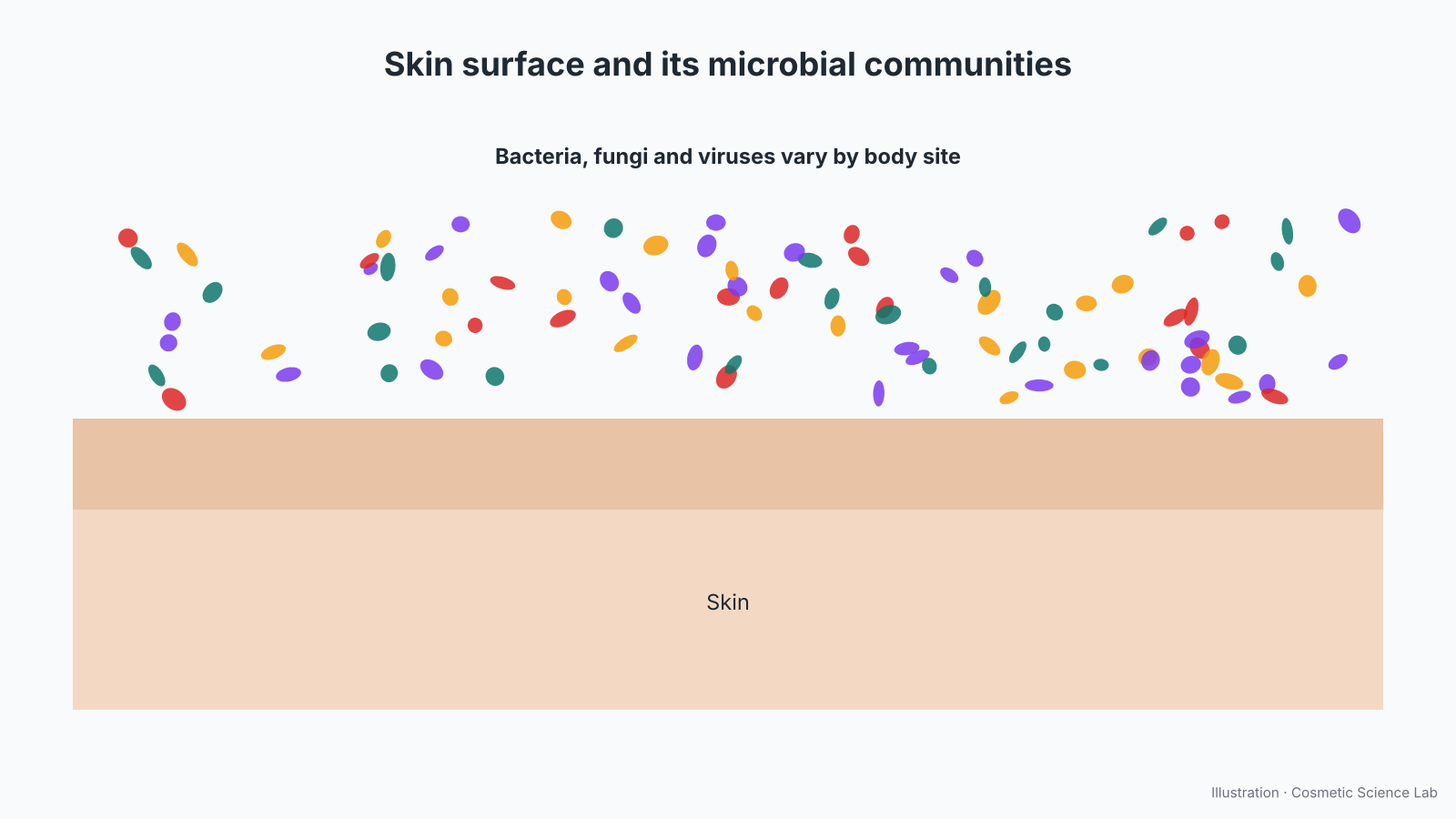
The skin carries communities of bacteria, fungi and viruses that vary by body site, whether oily, moist or dry. Reviews describe them as part of normal skin function, interacting with the immune system and the barrier [4]. Interest in microbiome-friendly products follows from this idea: if the community matters, products should avoid disturbing it.
04What published studies say about preservatives and skin flora
The honest summary is that the evidence is limited and uneven. Much of the work comes from laboratory studies in which microbes are grown in the presence of an ingredient. For example, one study grew nine resident bacteria taken from the faces of 14 healthy adults in culture. Methylisothiazolinone, iodopropynyl butylcarbamate, ethylhexylglycerin, methylparaben and phenoxyethanol all inhibited them at the maximum levels permitted in China [6]. Studies like this show that preservatives inhibit growth in a dish, which is their purpose. They do not show what happens on living skin, where contact is brief, products are often washed off and concentrations differ from those in a culture.
Human studies that sequence skin communities before and after product use are fewer and smaller. One followed 11 volunteers over 9 weeks as they stopped and restarted everyday products. Deodorant and foot powder changed bacterial diversity, lotions had little effect, and responses differed widely between people [7]. That study looked at whole products, not preservatives alone. Another paper reported in-vivo studies of finished products containing common preservative systems and found no measurable effect on the skin microbiome in normal use [8].
| Study | Design | Finding |
|---|---|---|
| J Cosmet Dermatol, 2019 [6] | In vitro; 9 resident isolates from 14 adults; 5 preservatives | All five inhibited growth at maximum permitted levels |
| Bouslimani et al., 2019 [7] | 11 volunteers, 9 weeks; everyday products | Deodorant and foot powder changed diversity; lotions had little effect |
| Murphy et al., 2021 [8] | In vivo; finished formulations with common preservative systems | No measurable microbiome effect in normal use |
These are small studies, not a settled consensus. At present there is no broad consensus that preservatives at permitted levels disrupt healthy skin flora, and equally no wide body of evidence proving that any particular product is harmless to it.
A product without effective preservation can grow microbes of its own and harm the user. Preservation and skin health are not opposites.
05Why the evidence is hard to generate
Skin communities differ between people and between body sites, and they change with season, hygiene, age and diet. Sampling methods and laboratory techniques differ between studies, so results are hard to compare. A small change in the proportion of one group of bacteria may be normal variation, not a sign of harm or benefit, which is why careful controls are essential.
06The claim problem: "microbiome-friendly"
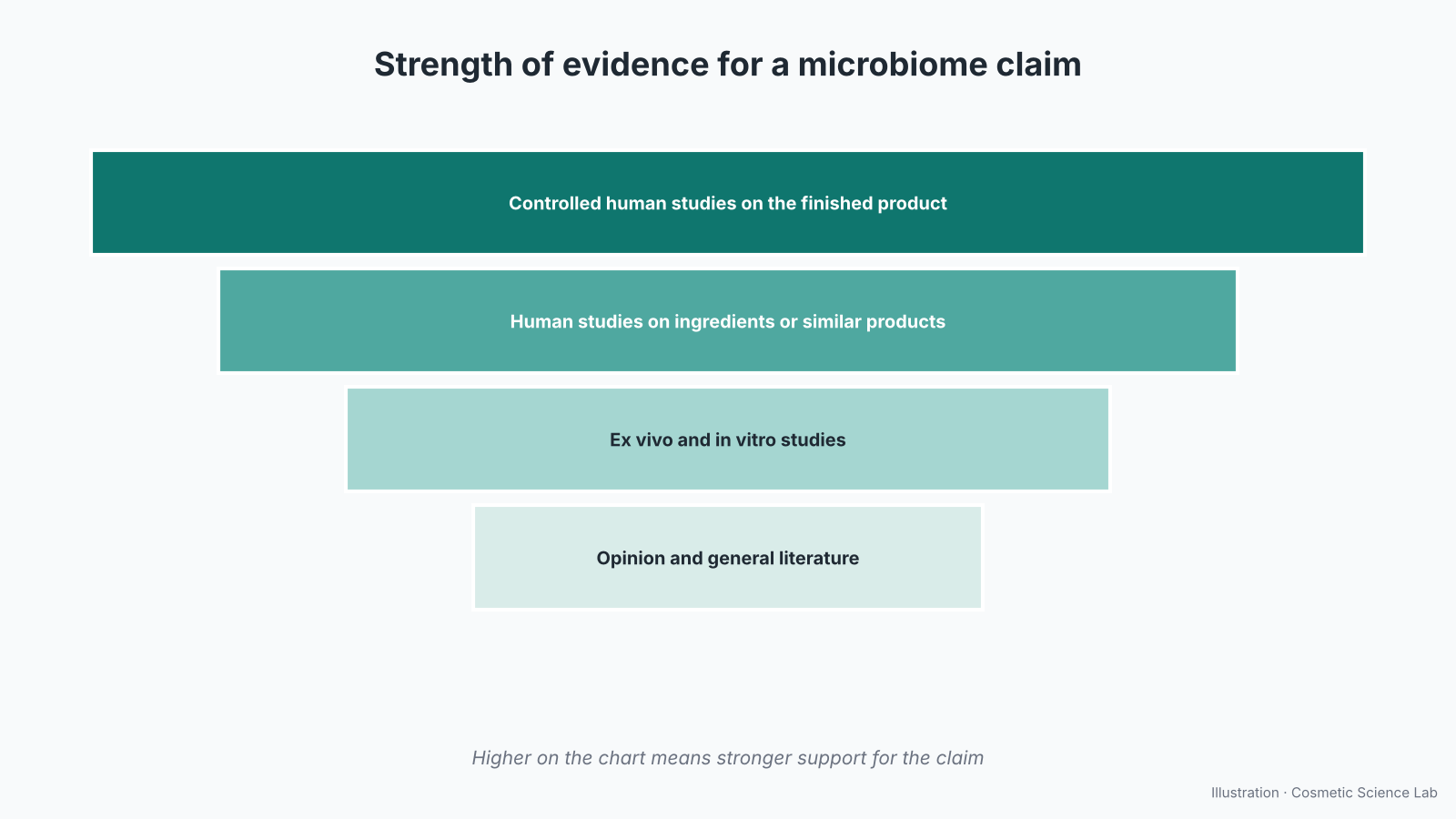
There is no legal definition of "microbiome-friendly" in EU cosmetics law. Any cosmetic claim must meet six common criteria: legal compliance, truthfulness, evidential support, honesty, fairness and informed decision-making [5]. A claim about the microbiome therefore needs adequate, verifiable evidence that is relevant to the finished product and the benefit claimed. Ingredient data alone are enough only if they are shown to carry over to the product [5]. The claim also should not imply a medical effect. Our guide to microbiome-friendly claims covers substantiation in more detail.
07What this means for a testing programme
A sensible programme separates two jobs. The first is quality control: confirm every batch meets microbial limits and that the preservative system passes a challenge test. The second is claim substantiation: if you want to say something about skin flora, plan a study that measures it directly, in people, with a suitable comparison. A clean microbial limit result says nothing about the microbiome, and a microbiome study says nothing about whether a batch is safe to ship.
- Test the basics first: microbial limits and a challenge test.
- Use measured language such as "formulated with the skin's balance in mind" only where you can support it.
- For a microbiome claim, plan a controlled human study with a clear endpoint.
- Keep the claim specific to the product tested, not every product in the range.
See how challenge studies work in our guide to preservative efficacy testing, and how safety evidence comes together for a sensitive product in our patch test worked example.
08How to read a microbiome study critically
- Where was it done?
In a dish, on excised skin or on people.
- How big and how long?
Note the number of volunteers and how long the product was used.
- Was there a comparison?
Look for a control group or a comparison product.
- Does the change matter?
Ask whether the measured change has a known effect on skin health.
- Is it the same product?
Check that the product tested is the one being marketed.
Unsure what evidence your microbiome claim needs?
CSL runs microbial limit and challenge testing and can help you judge what a claim about skin flora would need.
09Questions readers ask
What are the microbial limits for cosmetics?
Under ISO 17516:2014, no more than 1 × 10² CFU/g or mL for products for under-threes, the eye area or mucous membranes, and no more than 1 × 10³ for other products, with four specified organisms absent in 1 g or 1 mL.
Do preservatives damage the skin microbiome?
They inhibit skin bacteria in a dish, but small human studies of finished products have not shown a clear effect. The evidence is limited either way.
Is "microbiome-friendly" a regulated claim?
It has no legal definition in EU cosmetics law, but like any claim it must meet the six EU common criteria, including evidential support.
Does a microbial limit test prove a product is microbiome-friendly?
No. It checks the product's own contamination, not its effect on skin flora, which needs a study on people.
10References
- International Organization for Standardization. ISO 17516:2014. Cosmetics – Microbiology – Microbiological limits. Geneva: ISO; 2014.
- International Organization for Standardization. ISO 11930:2019. Cosmetics – Microbiology – Evaluation of the antimicrobial protection of a cosmetic product. Geneva: ISO; 2019. ISO
- International Organization for Standardization. ISO 22716:2007. Cosmetics – Good Manufacturing Practices (GMP) – Guidelines on Good Manufacturing Practices. Geneva: ISO; 2007. ISO
- Byrd AL, Belkaid Y, Segre JA. The human skin microbiome. Nat Rev Microbiol. 2018;16(3):143–55. doi:10.1038/nrmicro.2017.157. DOI
- Commission Regulation (EU) No 655/2013 of 10 July 2013 laying down common criteria for the justification of claims used in relation to cosmetic products. Off J Eur Union. 2013;L190:31–4. EUR-Lex
- Effect of cosmetic chemical preservatives on resident flora isolated from healthy facial skin. J Cosmet Dermatol. 2019. doi:10.1111/jocd.12822. PubMed
- Bouslimani A, da Silva R, Kosciolek T, Janssen S, Callewaert C, Amir A, et al. The impact of skin care products on skin chemistry and microbiome dynamics. BMC Biol. 2019;17:47. doi:10.1186/s12915-019-0660-6. DOI
- Murphy B, Hoptroff M, Arnold D, Eccles R, Campbell-Lee S. In-vivo impact of common cosmetic preservative systems in full formulation on the skin microbiome. PLoS One. 2021;16(7):e0254172. doi:10.1371/journal.pone.0254172. DOI
Update log
- Published by Cosmetic Science Lab
This article is general technical information, not legal, regulatory or medical advice. Confirm requirements for your product and market before launch.