Worked example: reformulating a sunscreen that tested at SPF 15 instead of SPF 50
A sunscreen labelled SPF 50 tested at SPF 15. This worked example shows how benchmarking against a product that meets its claim, then fixing the filter system and the film, could take the result to SPF 52. Every number is assumed for illustration and is not client data. Part of our sun care series.
By Dr. Premalatha, Ph.D., Life Science, Regulatory Consultant, Cosmetic Science Lab
Worked example. An illustrative project that shows the method CSL uses to fix a sunscreen that fails its SPF test. It is not a specific client, and every number on this page is assumed for illustration, not measured data.
Project snapshot (worked example)
- Brief
- Illustrative sunscreen lotion labelled SPF 50; not a real client
- Challenge
- SPF 15 in testing against an SPF 50 claim
- Approach
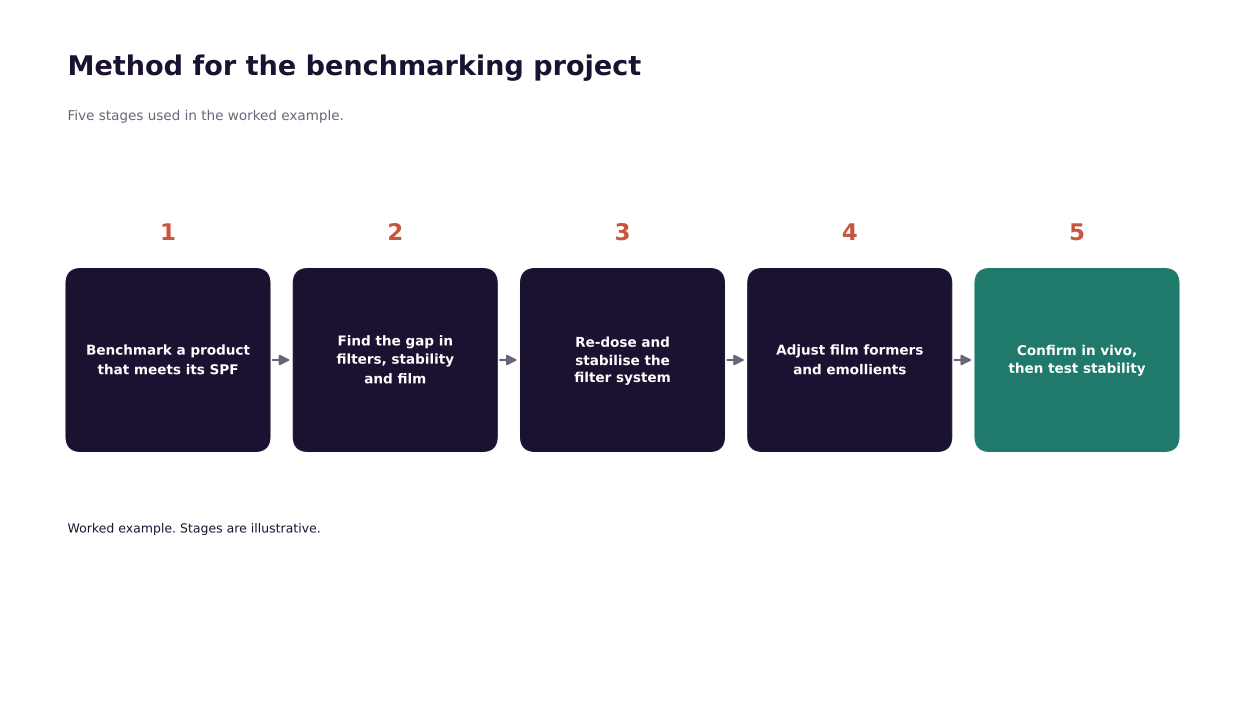
- Benchmark the gap, raise and stabilise the filters, improve the film, then confirm in vivo
- Result
- SPF 15 raised to SPF 52 (assumed numbers)
Quick answer
- When a sunscreen fails its SPF test, the cause is usually too little filter, filters that degrade, or an uneven film on skin.
- Benchmark first: compare the failing formula with a product that meets its claim to find the gap.
- Raise and stabilise the filters, then improve the film, and screen each step in vitro.
- Only an in vivo test gives the label value, and stability must be rechecked after the fix.
Take-home message for formulators
- Screen each change in vitro, but confirm the final formula in vivo.
- Recheck stability and UVA protection after every fix.
Take-home message for brand owners
- Ask which results are screening and which are final.
- Ask who owns the retest plan and what triggers a retest.
01The brief (illustrative)
A brand sells a lotion labelled SPF 50, and a test returns SPF 15. The brief is to bring the formula up to its label without changing the markets it serves, the filters it may use, or the feel customers like. The aim is a sunscreen reformulation that holds up on the next test, including any independent one. Independent failures are not rare: in 2025, 16 of 20 SPF 50 or 50+ sunscreens missed their claim in one consumer test, as our article on independent SPF failures explains.
02Benchmarking the gap
An SPF benchmark here means a product with the same claim that meets it. It shows what a working filter system, oil phase and film look like. In this example the benchmark carried a higher total filter level, a stabiliser alongside avobenzone, and a thicker, more even film. Our deformulation brief guide explains how to write a brief for this kind of benchmarking.
03Root causes to look for
A low SPF has a short list of likely causes, and a benchmark helps rank them:
- Too little UVB filter for the target SPF.
- Unstabilised avobenzone, so protection falls after light exposure.
- A thin or patchy film, often from low viscosity or poor spreading.
- Crystallisation of solid filters in the oil phase.
- A batch or lab problem, such as a weighing error, or a test that needs checking against a second lab.
04Step 1: raise and stabilise the filters
The first change raises the UVB filter level within the market limits and adds a stabiliser such as octocrylene alongside avobenzone. Photostability depends on the filter combination, so the system is checked after light exposure [3]. In vitro screening on plates shows the result moving, but screening only gives an indication [2]. Adding filter lifts SPF, though not in a straight line, and legal limits cap it, so the example stays under the lowest limit among its markets.
05Step 2: improve the film
SPF depends on the film the product leaves on skin. The second change adjusts film formers and emollients so the lotion spreads into a more even layer without feeling heavier, and the in vitro result moves again. Any change to the oil phase has to be tested for stability, because a film that is even on day one must stay even in storage. In this example pump delivery would also be checked, since a pump that under-dispenses changes the real dose.
06Step 3: confirm in vivo and recheck stability
The final formula would go to an accredited lab for an in vivo SPF test to ISO 24444 [1], and stability, UVA protection and water resistance would then be rechecked on the final version. The label SPF rests on the in vivo result, not on screening. Had the result missed the target, the work would return to Step 1 or 2 rather than relabelling the product. Our guide to in vivo vs in vitro SPF testing compares the methods.
07Trade-offs of each change
- More filter adds cost and can change the feel, and legal limits cap it.
- A stabiliser adds an ingredient and can make the film tacky.
- Film formers change feel and water resistance, so both need retesting.
- Every change needs stability and UVA protection rechecked, which takes time.
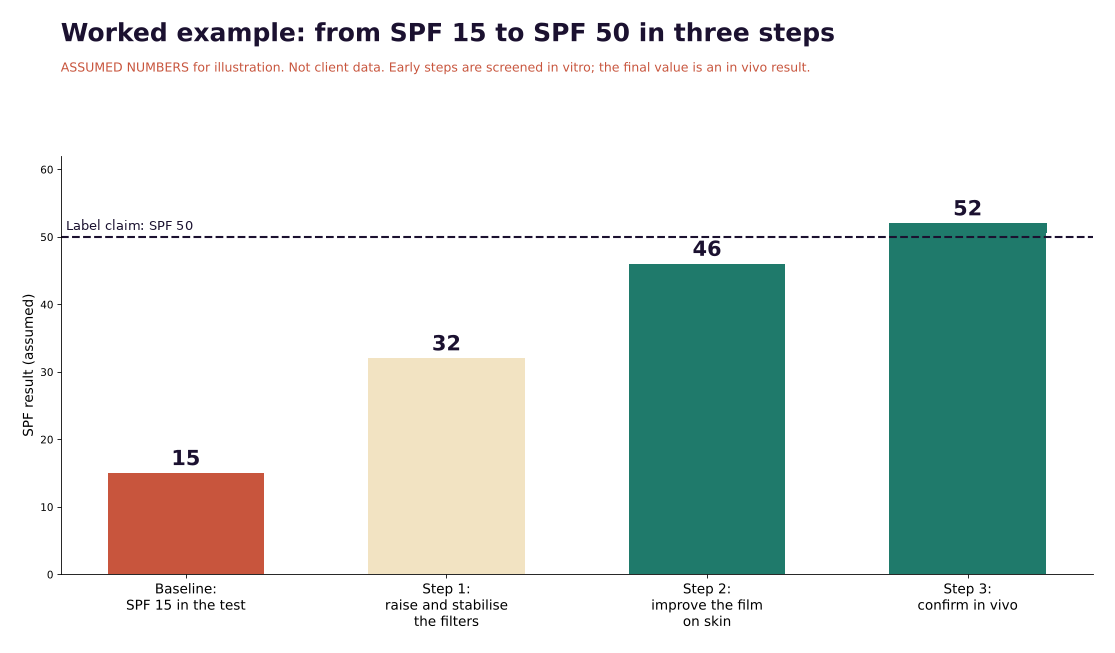
08Before and after (assumed numbers)
| Version | Change | SPF (assumed) |
|---|---|---|
| Baseline | Original formula, in the failing test | 15 |
| Version A | Raise and stabilise the filters, screened in vitro | 32 |
| Version B | Improve the film, screened in vitro | 46 |
| Version C | Final formula, in vivo result (assumed) | 52 |
09Cost and time drivers
The main drivers are the number of formula iterations, how many versions go to an in vivo panel, the stability time needed after each change, and lab availability. In vitro screening is quick and cheap compared with an in vivo panel, so it earns its place in the early steps. Stability testing takes weeks to months, so build it into the timeline from the start.
10Reading the numbers
The in vitro values in this example are screening results, and a real in vivo result can differ by a wide margin. Treat Versions A and B as direction, and Version C as the only label value. A benchmark tells you what is possible, not what your formula will score.
11What a brand would receive
- A root-cause note ranking the likely reasons for the low SPF.
- A benchmark comparison against a product that meets its claim.
- The reformulated formula with its specification.
- The in vivo SPF report and a stability summary.
- A retest rule sheet for future formula or pack changes.
12What this example does not prove
A worked example with assumed numbers cannot show how a real formula behaves. Real results depend on the filters, the vehicle, the film, the panel and the lab, and every fix has to be tested. Use this page as a method for fixing a failing SPF, not as a result.
Benchmark before you reformulate, fix the filter system and the film in that order, screen in vitro but label from in vivo, and recheck stability and UVA protection after every change.
This worked example closes the series. Start again with what the SPF number means, or go back to the hub on mineral vs chemical sunscreen.
Need to fix a failing SPF?
CSL formulation chemists build new formulas, reformulate products and match benchmarks, and you own the formula and its documentation.
13Questions to ask your lab
Which method and panel produced each SPF result?
Ask for the standard, the lab and the panel size for every number, so you can tell an in vivo result from a screening value.
Which results were screening and which were final?
In vitro plate results guide the work; only the in vivo result should go on the label.
How was stability checked after each change?
Ask for the storage conditions, the time points, and whether SPF or UVA was checked on aged samples.
What triggers a retest, and who pays for it?
Agree this before launch: a change to filters, film formers, process, pack or lab should trigger a retest.
14References
- International Organization for Standardization. ISO 24444:2019 Cosmetics. Sun protection test methods. In vivo determination of the sun protection factor (SPF). Geneva: ISO; 2019. ISO
- International Organization for Standardization. ISO 23675:2024 Cosmetics. Sun protection test methods. In vitro determination of sun protection factor (SPF). Geneva: ISO; 2024. ISO
- Gaspar LR, Maia Campos PMBG. Evaluation of the photostability of different UV filter combinations in a sunscreen. Int J Pharm. 2006;307(2):123–8. doi:10.1016/j.ijpharm.2005.08.029
Update log
- Published by Cosmetic Science Lab
This article is general technical information, not legal, regulatory or medical advice. Confirm requirements for your product and market before launch.