Does sunscreen expire? Avobenzone, photodegradation and the 3-year rule
Yes. Sunscreen can expire, because filters such as avobenzone break down in light and emulsions can separate with heat. Here is the US 3-year rule, the EU date rules, what actually degrades, how to store sunscreen and what brands should test. Part of our sun care series.
By Dr. Premalatha, Ph.D., Life Science, Regulatory Consultant, Cosmetic Science Lab
The data behind this article
- Source
- FDA sunscreen guidance and US expiry rules [1][2]; EU Cosmetics Regulation, Article 19 [3]; Mturi and Martincigh 2008 [4]; Gaspar and Maia Campos 2006 [5]
- Scope
- Shelf life, storage and photostability of sunscreen products
- Design
- Regulatory rules and laboratory photostability studies
- Key finding
- Avobenzone loses UVA protection in light unless stabilised, and photostability depends on the filter combination
- Caveat
- Storage matters as much as the printed date
Quick answer
- Does sunscreen expire? Yes. It has a shelf life, and light, heat and time all reduce protection.
- In the EU, a product that lasts 30 months or less needs a minimum durability date; longer-lasting products usually carry a period-after-opening symbol [3].
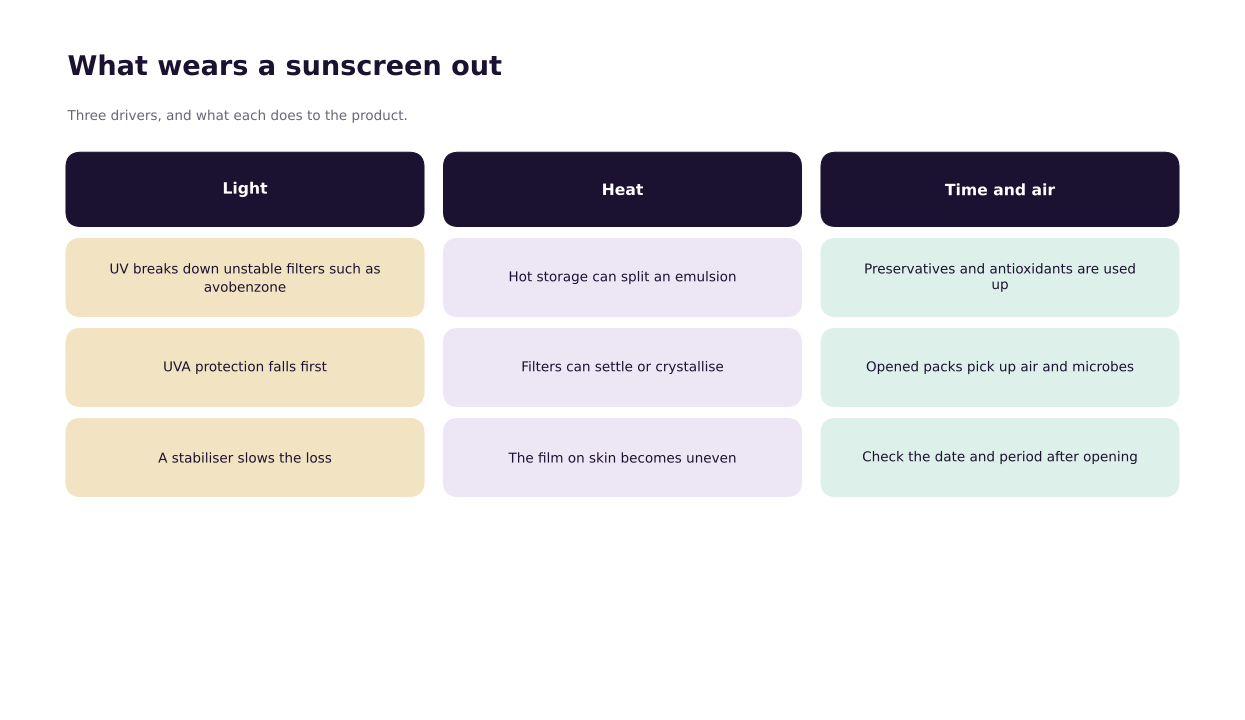
- Avobenzone, the most widely used UVA1 filter, breaks down in sunlight unless the formula stabilises it.
Take-home message for formulators
- Run stability and photostability on the final filter system.
- Test SPF on aged samples, not only on fresh ones.
Take-home message for brand owners
- Ask how long the formula was tested, and at what temperatures.
- Ask whether SPF was checked after ageing before you print a date.
01The rules on dates
Sunscreen shelf life depends on the rules and on how you store the product. In the US, sunscreens are over-the-counter drugs, and drugs need an expiry date set by stability testing. The exception is a product whose stability data show it stays stable for at least three years: it may be sold without a date [2]. For an undated sunscreen, the FDA advises treating it as expired three years after purchase [1].
In the EU, a cosmetic needs a date of minimum durability if it lasts 30 months or less. Products that last longer need a period-after-opening symbol instead, unless durability after opening is not relevant, as for many aerosols [3].
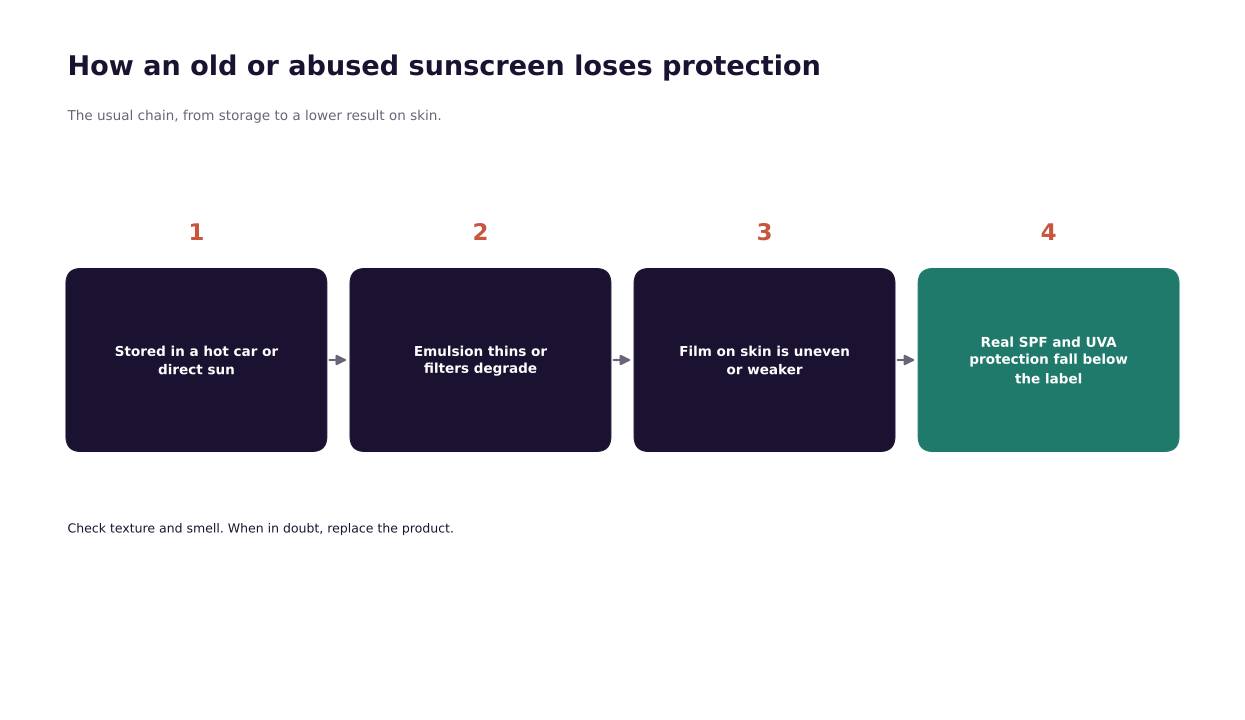
These rules set a minimum, not a promise. A bottle left in a hot car or in direct sun can lose protection long before its date. Expired sunscreen is not certain to fail, but its protection is no longer assured.
02What actually degrades
- Avobenzone.
The most widely used UVA1 filter, and until June 2026 the only organic UVA1 filter allowed in US sunscreens. It degrades under UV, and its absorbance falls unless it is stabilised [4].
- Filter combinations.
Photostability depends on which filters sit together, which is why formulas pair avobenzone with a stabiliser [5].
- The emulsion.
Heat in storage can thin or split an emulsion and leave filters unevenly spread, so the film on skin can protect less. Stability programmes test this with heat and temperature cycling [6].
- Preservatives and air.
Preservative efficacy can fall over time and after opening, and an opened pack is exposed to air and microbes.
- The pack.
The pack controls how much light and air reach the formula, so it has to be tested with the product.
03What the studies measured
Two studies show the pattern. Mturi and Martincigh dissolved avobenzone in solvents of different polarity, exposed it to light and measured how fast it degraded; the solvent changed the result [4]. Gaspar and Maia Campos compared filter combinations in a sunscreen and found that some combinations held up much better than others, and that octocrylene improved the photostability of avobenzone [5]. Lab studies use controlled light, so real results on a beach also depend on sun, sweat and rub-off.
04Why octocrylene matters
Octocrylene is a UVB filter that also slows avobenzone's breakdown, which is why the two often appear together [5]. Our octocrylene ingredient page covers its limits, allergy data and benzophenone. A stabiliser slows the loss; it does not stop it. Bemotrizinol can also photostabilise avobenzone [7], and it is permitted in the EU and, since June 2026, in the US at up to 6%; see why US sunscreens lag Europe. The choice depends on the markets you sell in.
05How to read dates and symbols
Look for an expiry date, an hourglass mark, or a period-after-opening symbol, which is an open jar with a number of months, such as 12M. A batch code lets you ask the brand when the product was made. If a US pack shows no date, the FDA advises treating it as expired three years after you bought it, and discarding it if you do not know how old it is [1].
06How to store sunscreen and when to discard it
- Keep it cool and out of direct sun. The FDA advises against exposing sunscreen containers to direct sun, and US labels say to protect the product from excessive heat and direct sun [1].
- Write the purchase date on the pack, and follow the date or period-after-opening symbol, whichever comes first.
- Discard it if it separates, changes colour or smell, or turns gritty.
- Do not stretch a product past its date to save money, because protection is no longer assured.
Weak protection matters because sun damage builds up, and skin cancer risk rises with years of sun exposure. Expiry matters for every skin type, and fair skin burns faster when protection is lower than the label.
07For brands and formulators
Plan a stability programme with accelerated and real-time storage, and check SPF and UVA protection on aged samples [6]. Test photostability of the filter system after light exposure, and test the pack, because a pump or tube can change how the product holds up; our packaging compatibility test guide explains how. Our pre-launch testing checklist lists the other tests to plan. Set the date from the data, not from habit, and print storage advice on the pack.
- Store samples at several temperatures, including an accelerated heat condition.
- Run freeze-thaw or temperature cycling, and a centrifuge test for emulsions.
- Expose samples to light and measure the UVA filters afterwards.
- Test the final pack with the formula.
- Check SPF on aged product, then set the date and the period after opening.
Filters degrade, so what does the number on the label actually promise? Read SPF, UVA-PF, PA++++ and broad spectrum explained.
Need a stable sunscreen formula?
CSL formulation chemists build new formulas, reformulate products and match benchmarks, and you own the formula and its documentation.
08Questions readers ask
Does unopened sunscreen expire?
Yes. It has a shelf life, and heat and light shorten it even when the pack is closed.
Can I use expired sunscreen?
Its protection is no longer assured, so replace it, especially before long sun exposure.
How long does an opened sunscreen last?
Follow the period-after-opening symbol or the date on the label, and replace it sooner if it changes.
Does sunscreen expire faster in a hot climate?
Heat speeds up degradation, so product kept in a hot climate or a car can lose protection sooner than the date suggests.
How long is sunscreen good for without a date?
In the US, the FDA advises treating an undated sunscreen as expired three years after purchase.
09References
- US Food and Drug Administration. Sunscreen: how to help protect your skin from the sun [Internet]. Content current as of 2026 Oct 16 [cited 2026 Nov 10]. FDA
- Code of Federal Regulations. Title 21, section 211.137: Expiration dating, paragraphs (a) and (h). eCFR
- Regulation (EC) No 1223/2009 of the European Parliament and of the Council of 30 November 2009 on cosmetic products, Article 19(1)(c). Off J Eur Union. 2009;L342:59–209. EUR-Lex
- Mturi GJ, Martincigh BS. Photostability of the sunscreening agent 4-tert-butyl-4′-methoxydibenzoylmethane (avobenzone) in solvents of different polarity and proticity. J Photochem Photobiol A Chem. 2008;200(2–3):410–20. doi:10.1016/j.jphotochem.2008.09.007
- Gaspar LR, Maia Campos PMBG. Evaluation of the photostability of different UV filter combinations in a sunscreen. Int J Pharm. 2006;307(2):123–8. doi:10.1016/j.ijpharm.2005.08.029
- International Organization for Standardization. ISO/TR 18811:2018 Cosmetics. Guidelines on the stability testing of cosmetic products. Geneva: ISO; 2018. ISO
- Chatelain E, Gabard B. Photostabilization of butyl methoxydibenzoylmethane (avobenzone) and ethylhexyl methoxycinnamate by bis-ethylhexyloxyphenol methoxyphenyl triazine (Tinosorb S), a new UV broadband filter. Photochem Photobiol. 2001;74(3):401–6. doi:10.1562/0031-8655(2001)074<0401:POBMAA>2.0.CO;2
Update log
- Published by Cosmetic Science Lab
This article is general technical information, not legal, regulatory or medical advice. Confirm requirements for your product and market before launch.