SPF, UVA-PF, PA++++ and broad spectrum explained
SPF measures protection from UVB, the rays that cause sunburn, while UVA-PF, PA ratings and broad spectrum describe UVA protection. Here is what each number means, how it is measured, and how to read a sunscreen label in each market. Part of our sun care series.
By Dr. Premalatha, Ph.D., Life Science, Regulatory Consultant, Cosmetic Science Lab
Reading the label at a glance
Quick answer
- SPF meaning: the sunburn dose with sunscreen divided by the dose without it, measured at 2 mg per square centimetre.
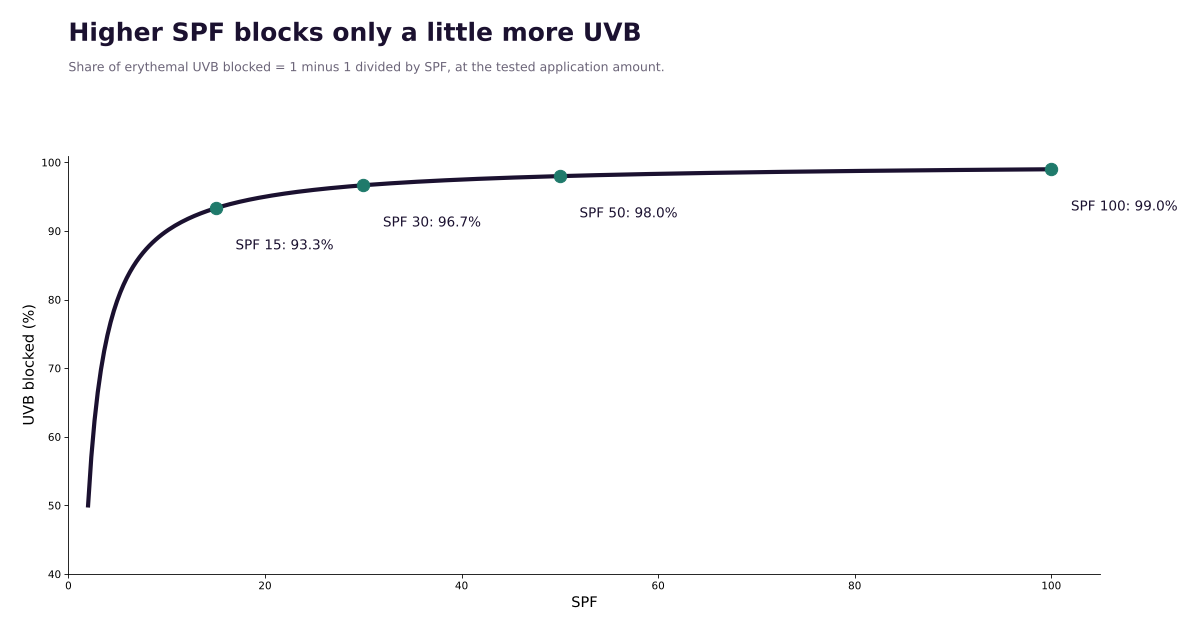
- SPF 30 blocks about 97% of sunburn-causing UVB and SPF 50 about 98%, so the extra gain is small.
- UVA protection is shown by UVA-PF, a PA rating from PA+ to PA++++, or a broad spectrum claim, depending on the market.
- Real protection falls roughly in proportion to the amount applied, so half the amount gives about half the label SPF.
Take-home message for formulators
- Know which test produces each label claim in each market.
- Plan SPF, UVA and water resistance tests for every market you sell in.
Take-home message for brand owners
- Ask which number your claim rests on and which method produced it.
- Check that the claim covers UVA as well as sunburn.
01What does SPF mean?
SPF stands for sun protection factor, and it is a ratio. It compares the smallest UV dose that reddens skin protected by the product, the minimal erythemal dose (MED), with the dose that reddens unprotected skin. The test applies 2 mg of product per square centimetre on volunteers. Most markets follow ISO 24444 [1][2]; the US uses its own method in its sunscreen monograph, and two newer ISO standards from 2024 add in vitro and hybrid routes.
SPF = MED (protected skin) ÷ MED (unprotected skin)
UVB blocked (%) = (1 − 1 ÷ SPF) × 100
| SPF | UVB blocked |
|---|---|
| 15 | About 93% |
| 30 | About 97% |
| 50 | About 98% |
| 100 | About 99% |
02What UVA numbers measure
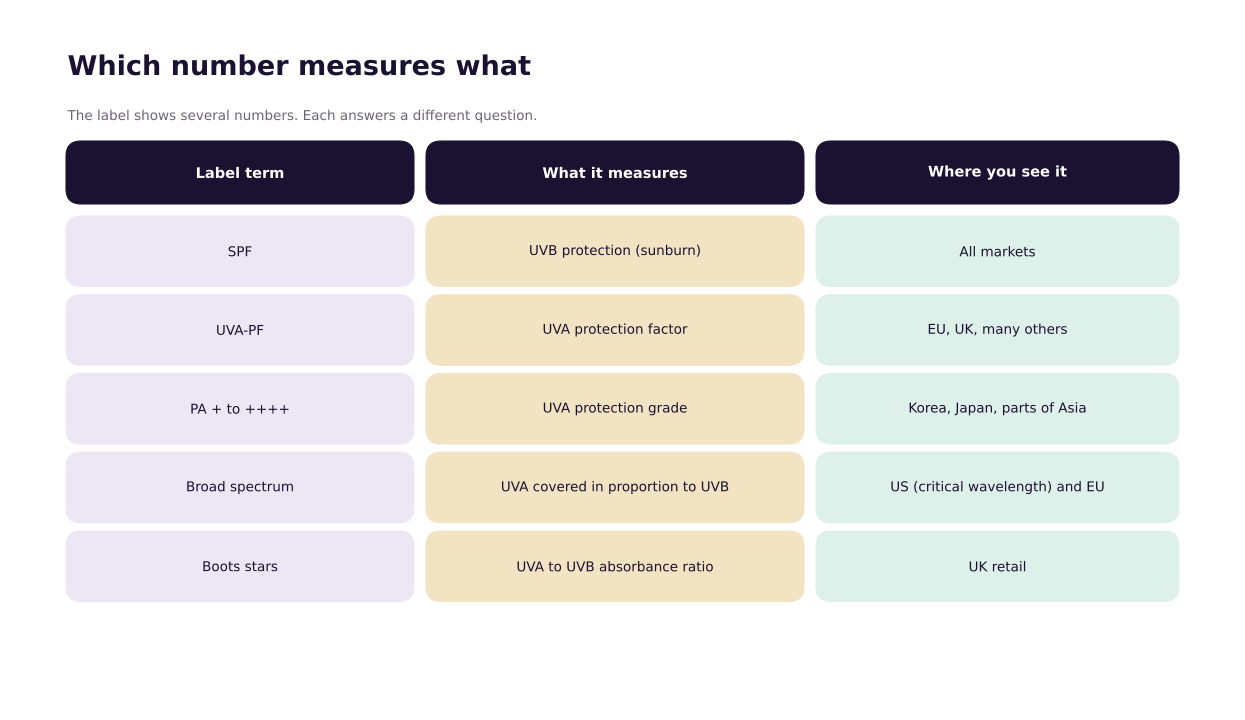
UVA protection is measured separately. On skin, the UVA protection factor (UVA-PF) compares the dose that causes persistent pigment darkening with and without product, under ISO 24442 [3]. In vitro, ISO 24443 measures how much UV passes through a film of product after a set dose of light, and scales the result to the product's SPF [4]. The PA rating is a grade built on UVA-PF, and PA++++ has been used in Japan since 2013 [5]. In the UK, the retailer Boots also uses a star rating based on the ratio of UVA to UVB absorbance.
| PA rating | UVA-PF |
|---|---|
| PA+ | 2 to under 4 |
| PA++ | 4 to under 8 |
| PA+++ | 8 to under 16 |
| PA++++ | 16 or more |
UVA reaches deeper into skin than UVB, passes through window glass, and contributes to photoageing and skin cancer. It is split into UVA2 (320 to 340 nm) and UVA1 (340 to 400 nm), and different filters cover different bands, so a UVA number tells you about coverage, not only strength. Our article on sunscreen filters explains which filters cover which band.
03Broad spectrum by market
Broad spectrum means UVA is covered in proportion to UVB. The US requires a mean critical wavelength of 370 nm or more [7]. A US product that is broad spectrum and SPF 15 or higher may say it decreases the risk of skin cancer and early skin ageing when used with other sun protection measures; other products must carry a warning that they only help prevent sunburn. The EU asks for a UVA-PF of at least one third of the labelled SPF and a critical wavelength of 370 nm, and groups labels into low (6 and 10), medium (15, 20 and 25), high (30 and 50) and very high (50+, for a measured SPF of 60 or more) [6].
The US has no SPF cap in force today. The FDA has proposed one, at 60+, but has not finalised it [9]. The numbers cannot be compared across markets without checking the method.
04How to read a sunscreen label in four steps
- Find the SPF.
It tells you about sunburn protection, not UVA.
- Find the UVA mark.
Look for a broad spectrum claim, a UVA circle, a PA rating or a star rating.
- Check water resistance.
A claim of 40 or 80 minutes tells you how long protection was tested in water.
- Check the amount.
The label assumes 2 mg per square centimetre. For the body, the American Academy of Dermatology suggests about one ounce, roughly a shot glass [8].
05The test behind each claim
| Claim | Test |
|---|---|
| SPF | In vivo on volunteers to ISO 24444 [1], or the FDA method in the US; in vitro (ISO 23675) and hybrid (ISO 23698) methods published in 2024 |
| UVA-PF | In vivo to ISO 24442 [3] or in vitro to ISO 24443 [4] |
| Critical wavelength | Spectrophotometer: the wavelength below which 90% of the area under the 290 to 400 nm absorbance curve falls |
| Water resistance | SPF measured again after 40 or 80 minutes of water immersion |
Our guide to in vivo vs in vitro SPF testing compares the methods in detail.
06Water resistance and reapplication
In the US, the SPF on a water resistant label is the value measured after 40 or 80 minutes in water [7]. In the EU, a product is “water resistant” if it keeps at least half its SPF after two 20-minute immersions, and “very water resistant” after four [10]. No sunscreen is waterproof. Reapply at least every two hours, and straight after swimming, sweating or towelling [8].
07Skin type, location and exposure
SPF is the same number for every skin type. What changes is how fast you burn, which depends on your skin type, location, season and time of day. UV is stronger near the equator and at midday, and SPF cannot adjust for that. Sun exposure also builds up over years, so protection matters even when you rarely burn.
08Worked example: applying less than the test
A sunscreen labelled SPF 50 was tested at 2 mg per square centimetre, and most people apply less. Faurschou and Wulf found that SPF falls roughly in proportion to the amount applied [11]. On that basis, applying half the amount, 1 mg per square centimetre, would give roughly SPF 25 instead of SPF 50 (an estimate, not a measured result). A higher SPF helps, but only if enough product is used.
09Common mistakes
- Comparing SPF across markets without checking the method.
- Assuming SPF covers UVA, when it measures UVB.
- Trusting a high SPF to extend time in the sun.
- Skipping reapplication after swimming or sweating.
- Using an old product past its date; see does sunscreen expire.
Now that you know what the number means, what happens when a product tests far below its label? Read when SPF 50+ tests at SPF 4.
Need SPF and UVA claims tested?
Talk to CSL about planning SPF, UVA and water resistance tests for the markets you sell in.
10Questions readers ask
Does SPF 100 give twice the protection of SPF 50?
No. At the tested amount, SPF 100 blocks about 99% of UVB and SPF 50 about 98%.
What does PA++++ mean?
A UVA protection factor of 16 or more on the Japanese PA scale.
What is a good SPF?
The American Academy of Dermatology advises a broad spectrum, water resistant sunscreen of SPF 30 or higher.
Does SPF 15 do anything?
At the tested amount, SPF 15 blocks about 93% of UVB. Health bodies advise SPF 30 or higher because people apply less than the test amount.
Is broad spectrum the same as UVA-PF?
No. Broad spectrum is a pass-or-fail claim, and UVA-PF is a measured number.
11References
- International Organization for Standardization. ISO 24444:2019 Cosmetics. Sun protection test methods. In vivo determination of the sun protection factor (SPF). Geneva: ISO; 2019. ISO
- Osterwalder U, Herzog B. Sun protection factors: world wide confusion. Br J Dermatol. 2009;161(Suppl 3):13–24. doi:10.1111/j.1365-2133.2009.09506.x
- International Organization for Standardization. ISO 24442:2022 Cosmetics. Sun protection test methods. In vivo determination of sunscreen UVA protection. Geneva: ISO; 2022. ISO
- International Organization for Standardization. ISO 24443:2021 Cosmetics. Determination of sunscreen UVA photoprotection in vitro. Geneva: ISO; 2021. ISO
- Japan Cosmetic Industry Association. Press release on the revised UVA protection measurement standard and the PA++++ classification [in Japanese]. Tokyo: JCIA; 2012 Nov 14.
- Commission Recommendation 2006/647/EC of 22 September 2006 on the efficacy of sunscreen products and the claims made relating thereto. Off J Eur Union. 2006;L265:39–43. EUR-Lex
- US Food and Drug Administration. Labeling and effectiveness testing; sunscreen drug products for over-the-counter human use. Final rule. Fed Regist. 2011 Jun 17;76(117):35620–65. Requirements now in OTC Monograph M020. GovInfo
- American Academy of Dermatology. How to apply sunscreen [Internet]. [cited 2026 Nov 10]. AAD
- US Food and Drug Administration. Questions and answers: FDA's regulatory actions on over-the-counter sunscreen [Internet]. Content current as of 2026 Sep 10 [cited 2026 Nov 10]. FDA
- Cosmetics Europe. Recommendation No. 16: water resistance labelling. Rev. 2023 Jun 16. Cosmetics Europe
- Faurschou A, Wulf HC. The relation between sun protection factor and amount of suncreen applied in vivo. Br J Dermatol. 2007;156(4):716–9. doi:10.1111/j.1365-2133.2006.07684.x
Update log
- Published by Cosmetic Science Lab
This article is general technical information, not legal, regulatory or medical advice. Confirm requirements for your product and market before launch.