When SPF 50+ tests at SPF 4: what the 2025 sunscreen test failures tell brands
A 2025 CHOICE sunscreen test found 16 of 20 SPF 50 or 50+ products below their label, one at SPF 4, and the regulator then raised concerns about a testing lab. Here is what was reported, why results differ, and how brands can prevent and fix a failure. Part of our sun care series.
By Dr. Premalatha, Ph.D., Life Science, Regulatory Consultant, Cosmetic Science Lab
The data behind this article
- Source
- CHOICE Australia test, June 2025 [1][2]; TGA findings reported October 2025 [3]; ISO SPF methods [5][6][7]; Wang et al. 2017 [9]
- Scope
- Independent SPF results and the recalls that followed, 2025 to 2026, with the 2021 benzene recalls for comparison
- Design
- Review of published results against the test methods behind them
- Key finding
- 16 of 20 SPF 50 or 50+ sunscreens missed their claim in one test; the regulator then raised concerns about a testing lab
- Caveat
- Several brands dispute the CHOICE results, and the TGA reforms are still proposals
- Status checked
- 10 Nov 2026
Quick answer
- In June 2025, CHOICE reported that 16 of 20 sunscreens labelled SPF 50 or 50+ missed their claim, and one labelled SPF 50+ tested at SPF 4 [1].
- The Australian regulator, the TGA, later said the shared base formula behind that product was unlikely to exceed SPF 21, and raised concerns about the lab that had tested it [3].
- A low result can come from the product, from how it is applied, or from the lab and method.
- Prevention means testing the final formula at a lab you have checked, retesting after changes, keeping batch retains and planning for an independent result.
Take-home message for formulators
- Test the final formula, retest after any change, and keep retains of every batch.
- Treat an independent low result as a reason to investigate, not to argue.
Take-home message for brand owners
- Ask which lab, method and panel produced your label SPF, and how you checked that lab.
- Decide now who acts if an independent test disagrees with your label.
01What was reported
In June 2025, the Australian consumer group CHOICE published a CHOICE sunscreen test of 20 sunscreens labelled SPF 50 or 50+. Sixteen measured below their label. Ultra Violette Lean Screen SPF 50+ Mattifying Zinc Skinscreen tested at SPF 4, and a retest of another batch at a second lab gave SPF 5 [1][2]. Most of the other failures tested between SPF 24 and SPF 43. Several brands disputed the results, and the brand first disputed them too.
The story then moved from one product to a lab. Ultra Violette withdrew Lean Screen in August 2025. In October 2025 the TGA said that the base formula shared by Lean Screen and other products was “unlikely to have an SPF greater than 21”, and that it had “significant concerns” about the testing lab many of them had used [3]. About 20 products made on that base formula were recalled, and the dispute between the brands and the formula supplier has since reached court [4].
| Date | Market | What happened | Source |
|---|---|---|---|
| Jul 2021 | US | Johnson & Johnson recalled five aerosol sunscreens after its internal testing found low levels of benzene | FDA recall notice [10] |
| Jun 2025 | Australia | CHOICE reported 16 of 20 SPF 50 or 50+ sunscreens below their claim, one at SPF 4 | CHOICE [1][2] |
| Aug 2025 | Australia | Ultra Violette withdrew Lean Screen SPF 50+ | ABC News [4] |
| Oct 2025 | Australia | TGA said the shared base formula was unlikely to exceed SPF 21 and raised concerns about the testing lab; products using the base were withdrawn | SBS News [3] |
| Sep 2026 | Australia | Brands sued the base formula supplier in the Federal Court over about 20 recalled products | ABC News [4] |
02Why results differ
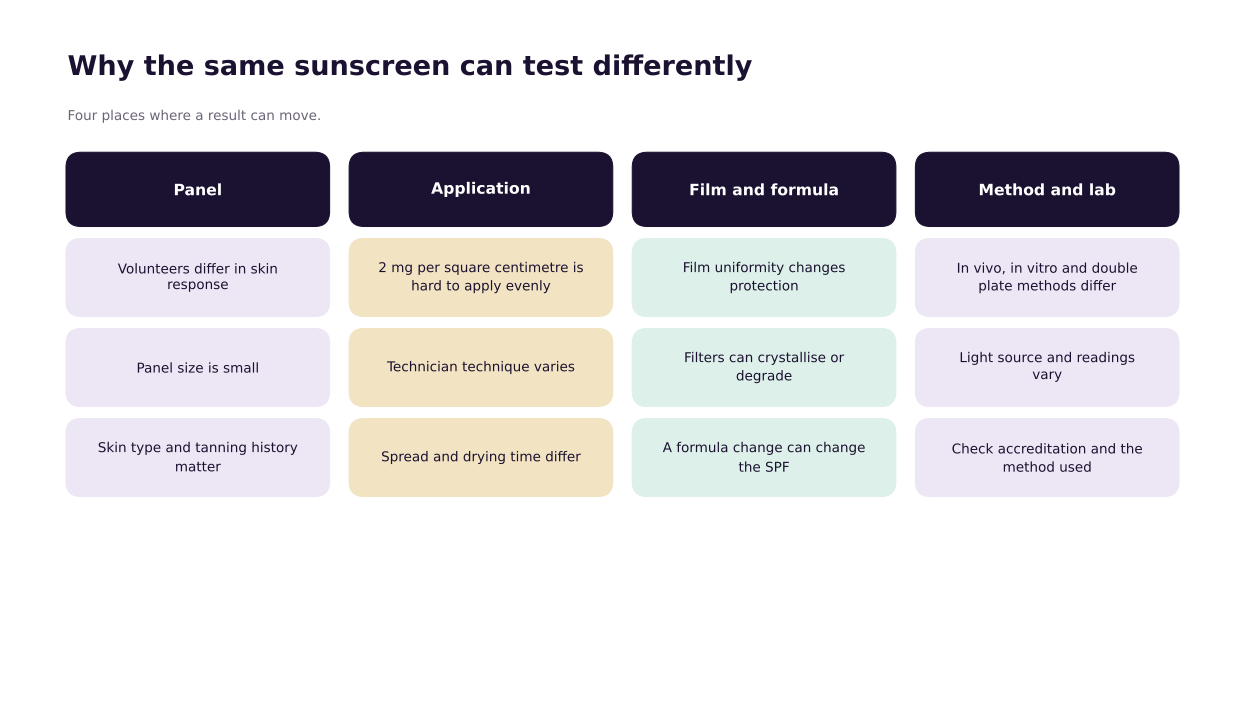
An in vivo SPF result depends on more than the formula. The volunteers on the panel, how evenly the product is applied, the film it leaves and the lab's own practice all move the number. Osterwalder and Herzog described how much confusion surrounds SPF and the limits of the methods [8]. The main standard, ISO 24444, sets the panel, the 2 mg per square centimetre dose and the acceptance rules [5]. Two newer standards from December 2024 add other routes: an in vitro double-plate method, ISO 23675 [6], and a hybrid diffuse reflectance method measured on skin, ISO 23698 [7].
UVA protection shows the same problem across markets. A 2017 study tested 20 US sunscreens and found that only 11 met the EU rule that UVA protection must be at least one third of the SPF [9]. A product can pass in one market and fail the same claim in another, which is why you need to know which method produced your number.
03Who is affected
Consumers come first: someone who trusts an SPF 50+ label and gets far less protection is more likely to burn. Brands face recalls, regulator action and lost trust, even when the fault sits with a supplier or a lab. Labs face scrutiny of their method and panel. In the Australian case all three were affected at once, and the TGA has since proposed reforms that include lab accreditation and more reliable testing; as of November 2026 these are proposals, not final rules.
04SPF shortfall versus safety recall
An SPF shortfall is an efficacy failure: the product protects less than its label says. A contaminant such as benzene is a safety failure. Either can lead to a sunscreen recall, but regulators treat them differently. Australia regulates most sunscreens as therapeutic goods, so the TGA acted on the shortfall. In the EU, serious risks from consumer products are shared through the Safety Gate alert system [11]. Confirm how your market treats an efficacy shortfall before you decide on action.
05What the label promises
An SPF 50 label promises a tested result at 2 mg of product per square centimetre, not the same protection at any amount. Our guide to SPF, UVA-PF, PA++++ and broad spectrum explains the number, how it is measured and why real use gives less. A gap between label and result matters most when people already apply less than the test amount.
06Lessons from the benzene recalls
The 2021 benzene recalls followed a different path. On 14 July 2021 Johnson & Johnson recalled five Neutrogena and Aveeno aerosol sunscreens after its own internal testing found low levels of benzene [10]. The control path is the same for SPF: know your supply, test finished batches, keep retains, and have a decision path ready before a third party tests your product. Our article on whether sunscreen causes cancer covers benzene in more detail.
07How brands prevent it
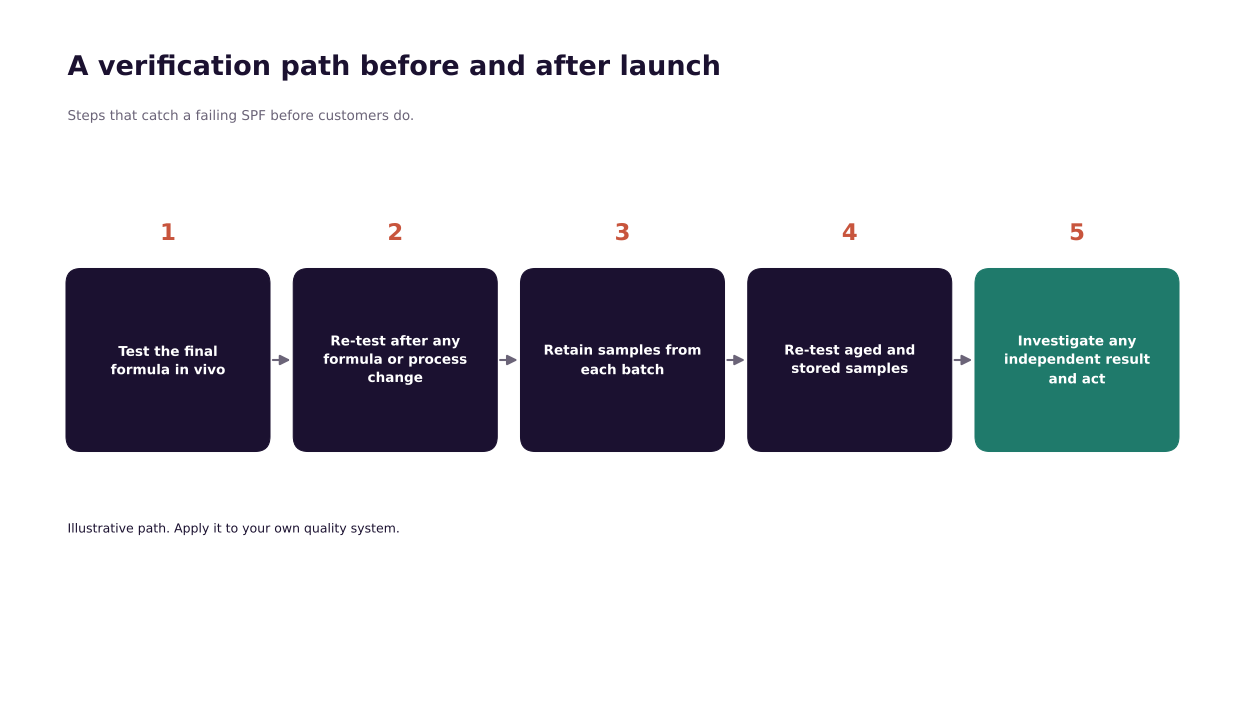
- Test the final formula in vivo, not a prototype, and not only in vitro.
- Check the lab, including its accreditation, its panel and how it handles disputed results.
- Do not rely on a supplier's base formula test alone; test your own finished product.
- Retest after any change to filters, film formers, emollients, process or pack, and check aged samples.
- Keep retains of every batch and name an owner for any independent result.
08The testing and formulation fix
If a formula tests low, look at three things. First, the filter dose: is there enough UVB filter for the target SPF? Second, photostability: do filters such as avobenzone degrade, and is a stabiliser such as octocrylene in place? Third, the film: does the product spread into an even layer? Our pre-launch testing checklist covers the tests to plan, and why cosmetics get recalled shows how quality failures lead to withdrawals.
What does a brand do after a failed SPF test? Our worked example on reformulating a sunscreen that tested at SPF 15 shows how one could be fixed, step by step.
09If an independent test fails you
- Hold and review.
Pull the batch records and your own test reports.
- Retest retained samples.
Use an accredited lab, and ask for the method and panel.
- Compare methods.
A different method or panel can explain a gap, but do not assume it does.
- Decide on action.
Work with your regulatory team, including whether to pause sales or recall.
- Fix the cause.
Document the change, then retest before you relaunch.
Want to avoid a failed SPF test?
Talk to CSL about planning SPF, UVA and water resistance tests before you lock the formula.
10Questions readers ask
Which sunscreen tested at SPF 4?
In CHOICE's June 2025 test, Ultra Violette Lean Screen SPF 50+ tested at SPF 4, and a retest at a second lab gave SPF 5. The brand first disputed the result and later withdrew the product.
Why did so many sunscreens fail the CHOICE test?
The causes are still disputed. The TGA found that one shared base formula was unlikely to exceed SPF 21 and raised concerns about the lab that had tested many products.
Is a failed SPF test the same as a recall?
No. A failed independent test is a result; a recall is an action the brand or regulator takes after reviewing it.
How can a brand check its SPF lab?
Ask for its accreditation, its method and panel size, and how it handles a disputed result, and retest the finished product rather than relying on a base formula report.
11References
- CHOICE. 16 of 20 sunscreens didn't meet SPF claims in CHOICE test [media release]. Sydney: CHOICE; 2025 Jun [cited 2026 Nov 10]. CHOICE
- CHOICE. We tested the SPF claims of 20 sunscreens. 16 failed [Internet]. Sydney: CHOICE; 2025 [cited 2026 Nov 10]. CHOICE
- SBS News. SPF slip-ups: more sunscreens withdrawn as TGA finds claims don't stack up [Internet]. 2025 Oct 1 [cited 2026 Nov 10]. SBS News
- ABC News. Wild Child Laboratories sued for 'deceptive' conduct over recalled sunscreens [Internet]. 2026 Sep 10 [cited 2026 Nov 10]. ABC News
- International Organization for Standardization. ISO 24444:2019 Cosmetics. Sun protection test methods. In vivo determination of the sun protection factor (SPF). Geneva: ISO; 2019. ISO
- International Organization for Standardization. ISO 23675:2024 Cosmetics. Sun protection test methods. In vitro determination of sun protection factor (SPF). Geneva: ISO; 2024. ISO
- International Organization for Standardization. ISO 23698:2024 Cosmetics. Measurement of the sunscreen efficacy by diffuse reflectance spectroscopy. Geneva: ISO; 2024. ISO
- Osterwalder U, Herzog B. Sun protection factors: world wide confusion. Br J Dermatol. 2009;161(Suppl 3):13–24. doi:10.1111/j.1365-2133.2009.09506.x
- Wang SQ, Xu H, Stanfield JW, Osterwalder U, Herzog B. Comparison of ultraviolet A light protection standards in the United States and European Union through in vitro measurements of commercially available sunscreens. J Am Acad Dermatol. 2017;77(1):42–7. doi:10.1016/j.jaad.2017.01.017
- US Food and Drug Administration. Johnson & Johnson Consumer Inc. issues voluntary recall of specific Neutrogena and Aveeno aerosol sunscreen products due to the presence of benzene [Internet]. 2021 Jul 14. FDA
- European Commission. Safety Gate: the EU rapid alert system for dangerous non-food products [Internet]. European Commission
Update log
- Published by Cosmetic Science Lab
This article is general technical information, not legal, regulatory or medical advice. Confirm requirements for your product and market before launch.