Octocrylene: use levels, limits, safety and formulation tips
Octocrylene is an oil-soluble UVB filter that also stabilises avobenzone, and it appears in a large share of sunscreens. Here is what it does, how each market limits it, and what the data show on allergy, benzophenone and the environment, including the proposed EU restriction. Part of our sun care series.
By Dr. Premalatha, Ph.D., Life Science, Regulatory Consultant, Cosmetic Science Lab
At a glance
- What it is
- Oil-soluble organic UV filter; INCI Octocrylene; CAS 6197-30-4; 2-ethylhexyl 2-cyano-3,3-diphenylacrylate
- Main benefits
- UVB filter with some short UVA cover; photostabiliser for avobenzone [3]; solvent for crystalline filters
- Levels used
- Up to 10% where permitted; the sunscreens in the FDA absorption trial contained 2.35 to 10% [8]
- Watch for
- Photocontact allergy, benzophenone in aged product, and a proposed EU environmental restriction [11]
01What is it?
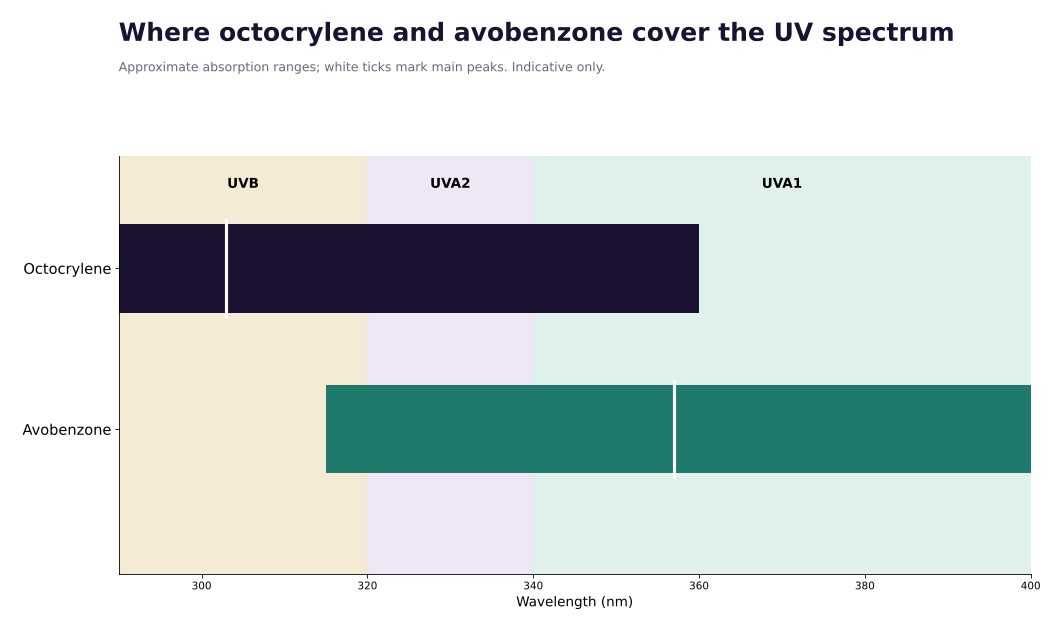
Octocrylene is a viscous, oil-soluble liquid ester and one of the most widely used organic UV filters. It absorbs mainly in the UVB range and adds some short UVA cover. Like other organic filters it absorbs UV and releases the energy as heat; see mineral vs chemical sunscreen for how organic and mineral filters compare.
02What it does
Octocrylene has three jobs in a formula. It adds UVB protection. It stabilises avobenzone: it quenches the excited state that avobenzone enters after absorbing UV, which slows avobenzone's breakdown in sunlight [3][4]. And it helps dissolve solid filters in the oil phase. That combination is why it turns up in so many sunscreens, and why removing it usually means rebuilding the filter system.
03The evidence
Studies below were checked against the publisher, DOI or regulator record on 10 Nov 2026.
| Study | Design | What it found |
|---|---|---|
| SCCS 2021 [10] | EU expert safety opinion | Safe as a UV filter up to 10%; at most 9% in propellant sprays |
| Avenel-Audran et al. 2010 [5] | Case series, French photopatch network | Octocrylene is an emerging photoallergen; 38 of 42 adults with reactions had a history of ketoprofen photoallergy |
| Downs et al. 2021 [6] | Lab analysis of 16 commercial sunscreens | Benzophenone averaged 39 mg/kg and rose to 75 mg/kg after six weeks of accelerated ageing |
| Matta et al. 2019 [8] | Randomised absorption trial, 24 volunteers | Octocrylene reached blood levels above 0.5 ng/mL under maximal use |
| Stien et al. 2019 [9] | Lab study in coral | Octocrylene accumulated in coral tissue as fatty acid conjugates and affected coral cell mitochondria |
Benzophenone, the breakdown product, is classed by IARC as possibly carcinogenic to humans (Group 2B) [7], and EU law requires benzophenone from octocrylene to be kept at trace level [1]. The absorption result is a trigger for more safety data, not a finding of harm; our article on whether sunscreen causes cancer explains the difference.
Octocrylene is permitted and effective today. The real decisions for a brand are how to control benzophenone as the product ages, how to handle photoallergy, and whether to plan an octocrylene-free version for the EU before a restriction arrives.
04How CSL formulation scientists use it
- Pair it with avobenzone and check UVA protection after light exposure, not only before.
- Balance the oil phase with lighter emollients, because octocrylene is a heavy, tacky ester and adds to the oil load the emulsifier must carry.
- Age samples during stability testing and measure benzophenone, especially for the EU.
- Ask each supplier for assay, colour, acid value and impurity limits, including benzophenone, and keep the CoA for every lot (see raw material specs and CoA).
- For an octocrylene-free formula, consider bemotrizinol or bisoctrizole where allowed; bemotrizinol also helps stabilise avobenzone. Any swap needs new photostability, SPF and UVA testing (see Korean sunscreen filters).
05Regulatory and claims
| Market | Status | Limit |
|---|---|---|
| EU | Annex VI UV filter; REACH restriction proposed | 10%; 9% in propellant sprays; benzophenone at trace level [1] |
| US | OTC Monograph M020 filter; one of 12 filters for which the FDA still wants more data | Up to 10% [2] |
| Hawaii | Not covered by the state law; Maui County allows only mineral sunscreens without a prescription | Not sold in Maui County [12] |
| India, GCC | Regulated through national cosmetics standards | Confirm the current limit before launch |
The EU position is changing. France has proposed a REACH restriction that would effectively end the use of octocrylene in cosmetics on environmental grounds, and ECHA's risk assessment committee supported it in June 2026 [11]. A Commission decision is still pending, so octocrylene remains permitted in the EU today. In the US, the bemotrizinol final order of June 2026 gives US brands their first new alternative in decades; see why US sunscreens lag Europe. “Reef safe” is not a regulated term, so avoid it unless you can support it in each market.
Used in: Sun careSun protectionDaily SPF skin care
06Questions brands ask
Is octocrylene safe?
The EU's scientific committee considers it safe up to 10%, or 9% in propellant sprays. The risks to manage are photocontact allergy and benzophenone as products age [10].
Is octocrylene banned?
Not in the EU or US. Hawaii's state law covers oxybenzone and octinoxate, but Maui County allows only mineral sunscreens, and an EU restriction has been proposed [11][12].
Does octocrylene cause contact dermatitis?
Rarely. Most adult cases are photocontact reactions in people already sensitised to the painkiller ketoprofen [5].
Is octocrylene the same as octinoxate?
No. Octinoxate (ethylhexyl methoxycinnamate) is a different UVB filter, and it is one of the two filters Hawaii's law covers.
Next in this series: octocrylene slows avobenzone's breakdown, so what happens as a sunscreen ages? Read does sunscreen expire. Back to does sunscreen cause cancer.
07References
- Commission Regulation (EU) 2022/1176 of 7 July 2022 amending Regulation (EC) No 1223/2009 as regards the use of certain UV filters in cosmetic products. EUR-Lex
- US Food and Drug Administration. OTC Monograph M020: sunscreen drug products for over-the-counter human use, M020.10(j). FDA
- Lhiaubet-Vallet V, Marin M, Jimenez O, Gorchs O, Trullas C, Miranda MA. Filter-filter interactions. Photostabilization, triplet quenching and reactivity with singlet oxygen. Photochem Photobiol Sci. 2010;9(4):552–8. doi:10.1039/B9PP00158A
- Gaspar LR, Maia Campos PMBG. Evaluation of the photostability of different UV filter combinations in a sunscreen. Int J Pharm. 2006;307(2):123–8. doi:10.1016/j.ijpharm.2005.08.029
- Avenel-Audran M, Dutartre H, Goossens A, Jeanmougin M, Comte C, Bernier C, et al. Octocrylene, an emerging photoallergen. Arch Dermatol. 2010;146(7):753–7. doi:10.1001/archdermatol.2010.132
- Downs CA, DiNardo JC, Stien D, Rodrigues AMS, Lebaron P. Benzophenone accumulates over time from the degradation of octocrylene in commercial sunscreen products. Chem Res Toxicol. 2021;34(4):1046–54. doi:10.1021/acs.chemrestox.0c00461
- International Agency for Research on Cancer. Benzophenone. IARC Monogr Eval Carcinog Risks Hum. 2013;101. IARC
- Matta MK, Zusterzeel R, Pilli NR, Patel V, Volpe DA, Florian J, et al. Effect of sunscreen application under maximal use conditions on plasma concentration of sunscreen active ingredients: a randomized clinical trial. JAMA. 2019;321(21):2082–91. doi:10.1001/jama.2019.5586
- Stien D, Clergeaud F, Rodrigues AMS, Lebaron K, Pillot R, Romans P, et al. Metabolomics reveal that octocrylene accumulates in Pocillopora damicornis tissues as fatty acid conjugates and triggers coral cell mitochondrial dysfunction. Anal Chem. 2019;91(1):990–5. doi:10.1021/acs.analchem.8b04187
- Scientific Committee on Consumer Safety. Opinion on octocrylene (SCCS/1627/21). Luxembourg: European Commission; 2021. European Commission
- ANSES. Restreindre l'utilisation de l'octocrylène dans les produits cosmétiques pour protéger l'environnement [Internet]. 2025 Oct 1 [cited 2026 Nov 10]. ANSES
- County of Maui. Mineral-only sunscreen (Ordinance 5306) [Internet]. County of Maui
Update log
- Evidence reviewed and page published by CSL scientists