Does sunscreen cause cancer? What the benzene, oxybenzone and absorption studies show
No study shows that wearing sunscreen causes skin cancer, but absorption data and benzene contamination have raised real questions. Here is what each study found, at what dose, and what it means for formulators. Part of our sun care series.
By Dr. Premalatha, Ph.D., Life Science, Regulatory Consultant, Cosmetic Science Lab
The data behind this article
- Source
- FDA-led absorption trials, JAMA 2019 and 2020 [1][2]; Valisure benzene petition, 2021 [3]; Nambour melanoma trial follow-up, 2011 [4]
- Population
- Healthy adult volunteers (absorption trials); sunscreen batches (benzene testing); 1,621 adults in Nambour, Australia (melanoma trial)
- Design
- Clinical pharmacokinetic trials; laboratory batch testing; randomised trial with long follow-up
- Key finding
- Several filters reached the blood above 0.5 ng/mL; benzene was found in some batches; regular use was linked to fewer melanomas
- Caveat
- Absorption is not evidence of harm, and benzene is a contaminant, not an ingredient
Quick answer
- Does sunscreen cause cancer? No study shows that it does, and the best trial evidence links regular use to fewer melanomas.
- Absorption trials show that several filters reach the blood after maximal use, but their authors say people should not stop using sunscreen.
- Benzene is not a sunscreen ingredient. Testing found it as a contaminant in some batches, which led to aerosol recalls in 2021 and 2022.
- For brands, the lessons are batch testing for contaminants and keeping safety and absorption data for every filter.
Take-home message for formulators
- Test finished batches for benzene and other contaminants.
- Keep the filter dossier and absorption data current for each filter.
Take-home message for brand owners
- Ask suppliers for contaminant testing on every lot.
- Do not call sunscreen risk-free or harmful; say what the studies show.
01What the studies looked at
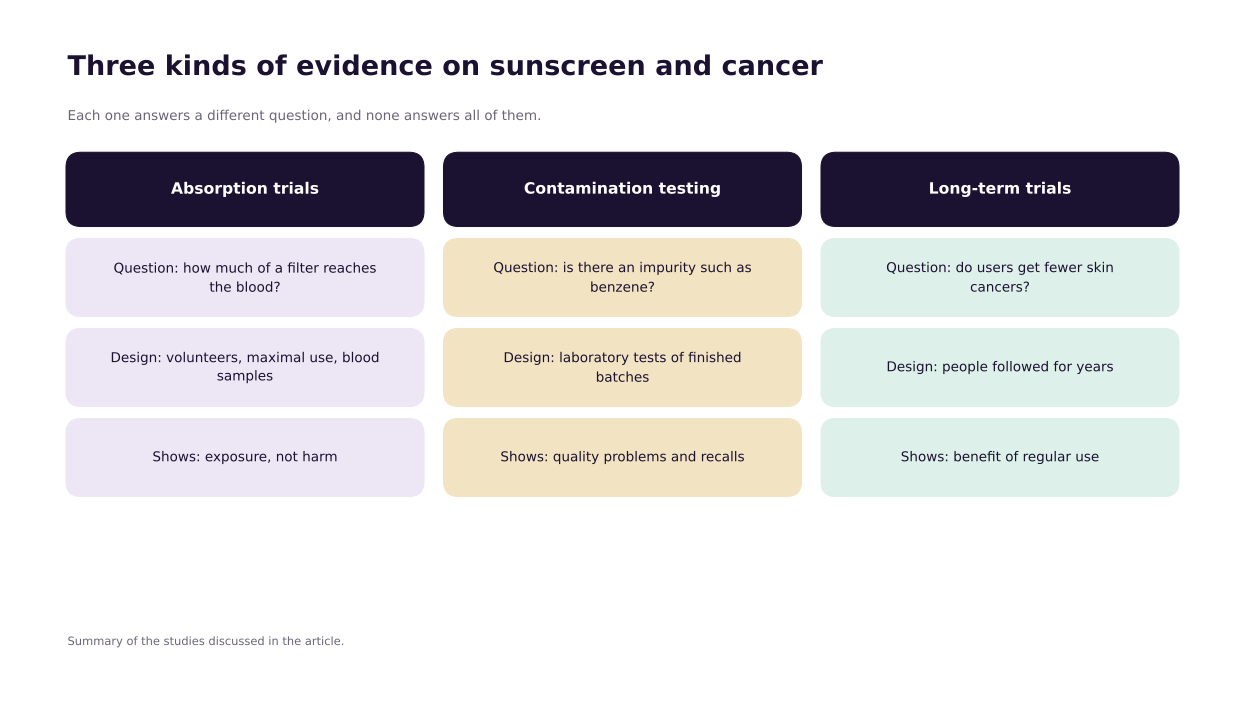
Three kinds of evidence drive this question. Absorption trials measure how much of a filter reaches the blood. Contamination testing looks for impurities, such as benzene, in finished products. Long-term trials follow people who use sunscreen and count skin cancers. Each answers a different question, and none answers all of them.
| Evidence | Question | What it shows | Limit |
|---|---|---|---|
| Absorption trials | How much filter reaches the blood? | Exposure after maximal use | Short, small, not a harm outcome |
| Contamination testing | Is an impurity such as benzene present? | Quality failures in batches | Says nothing about the filters |
| Long-term trials | Do users get fewer skin cancers? | A benefit of regular use | Few trials, long timescales |
02What the absorption studies found
In 2019 an FDA-led trial in 24 volunteers applied four sunscreens at 2 mg per square centimetre to 75% of the body, four times a day for four days. Avobenzone, oxybenzone, octocrylene and ecamsule all reached blood levels above 0.5 ng/mL, the level at which the FDA may ask for further safety studies [1]. A 2020 follow-up in 48 volunteers tested six filters, adding homosalate, octisalate and octinoxate, and found all six above 0.5 ng/mL after a single application [2].
Systemic absorption means a filter passes through the skin into the bloodstream. The 0.5 ng/mL figure is a trigger for more study, not a safety limit, and both papers state that the findings do not mean people should stop using sunscreen [1][2]. The trials used maximal-use conditions, meaning repeated, generous application over most of the body, to find the upper bound of absorption. Real-world exposure is usually lower.
03Oxybenzone and hormones
Oxybenzone gets most of the attention. Cell and animal studies show weak hormone-like, or endocrine, activity for some filters, but human evidence is limited [5]. The EU has tightened its limits: since 2022 oxybenzone (benzophenone-3) is allowed at up to 6% in face, hand and lip products, 2.2% in body products including sprays, and 0.5% in other products [10]. Hawaii banned sales of sunscreens containing oxybenzone and octinoxate from 1 January 2021, mainly over coral reef concerns rather than human health [9].
04Why exposure alone is not risk
Risk needs two things: how much of a substance reaches the body, and what it does there. Absorption trials measure the first. Toxicology studies address the second. Absorption data is one half of a safety assessment, which is why the FDA asks for both kinds of data and why the EU reviews them together in each filter's safety opinion. A filter in the blood is a reason to look, not a finding of harm.
05Benzene: a contaminant, not an ingredient
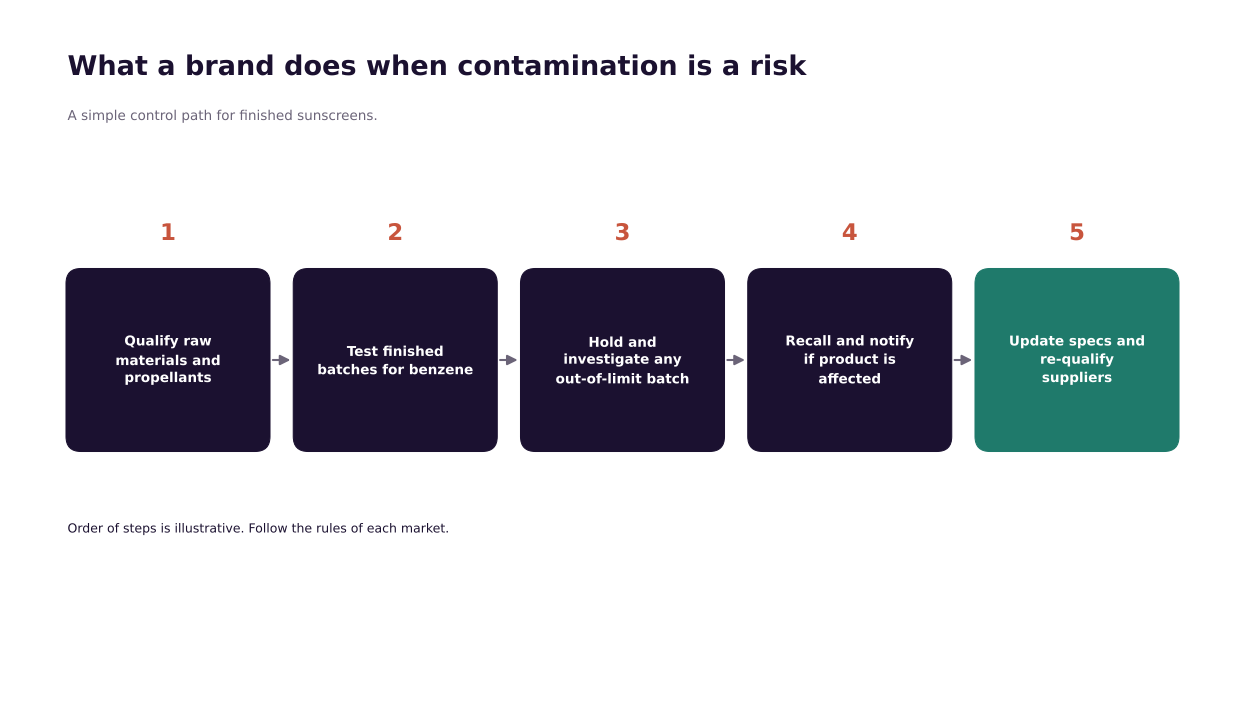
Benzene in sunscreen is a quality failure, not a formulation choice. Benzene is a known human carcinogen and has no place in a sunscreen. In May 2021 the independent lab Valisure petitioned the FDA after finding benzene in 78 of 294 batches from 69 companies, 14 of them above 2 ppm, across sprays, gels and lotions, and in both chemical and mineral products [3]. Recalls of aerosol sunscreens followed: Johnson & Johnson recalled all lots of five aerosol product lines in July 2021 after its own testing [6], Coppertone recalled aerosol lots in September 2021, and Banana Boat recalled a hair and scalp spray in 2022.
The FDA has since told drug manufacturers to test for benzene where it can arise, and named sources including some propellants and carbomers [7]. The lesson for brands is control: benzene should be prevented by supplier qualification and batch testing, not found by a third party after launch.
06What the best trial evidence shows
The strongest evidence on benefit comes from a randomised trial of 1,621 adults in Nambour, Australia. With long follow-up, people assigned to daily sunscreen use had 11 melanomas against 22 in the group who used it at their own discretion. That overall result was borderline (hazard ratio 0.50, P = 0.051), while the drop in invasive melanoma, 3 against 11, was statistically significant [4]. A 2020 review concluded that high-quality evidence shows sunscreen reduces the risk of both melanoma and other skin cancers, and that the clinical importance of absorption is not yet known [8].
Observational studies can mislead here. People with fair skin or a family history use more sunscreen and may spend longer in the sun, so sunscreen can appear linked to more melanoma. Randomised trials avoid that bias. Broad spectrum sunscreen works best alongside shade and clothing.
07What it means for formulators and brand owners
Treat benzene as a quality risk. Our pre-launch testing checklist covers the tests to plan, raw material specs and supplier qualification explains how to set limits with suppliers, and why cosmetics get recalled shows how quality failures turn into withdrawals.
- Supplier controls. Set a benzene limit in raw material and propellant specifications, and require a CoA for each lot.
- Batch testing. Test finished aerosol and non-aerosol batches for benzene on a risk-based schedule.
- Retains. Keep samples from every batch so any result can be rechecked.
- Absorption data. Hold exposure and toxicology data for each filter in the safety file.
- Claims. Describe what studies show, and avoid words such as safe or toxic without evidence.
Safety comes down to individual filters. Next in this series, our octocrylene ingredient page covers one filter in depth: its limits, allergy data and environmental questions. For how the filter groups compare, see mineral vs chemical sunscreen.
Need contaminant and safety testing planned for your sunscreen?
Talk to CSL about the tests your sunscreen needs before launch, from batch contaminant checks to the safety evidence behind each filter.
08Questions readers ask
Can sunscreen cause skin cancer?
No study shows that it does. The best randomised trial found fewer melanomas in people who used sunscreen daily.
Is it safe that sunscreen filters get into the blood?
Absorption shows exposure, not harm. Regulators asked for more safety data, and the trial authors said people should keep using sunscreen.
Is benzene an ingredient in sunscreen?
No. It is a contaminant that can come from raw materials such as propellants, and brands control it by testing.
Is oxybenzone banned?
Not in the EU or US, though the EU has lowered its limits. Hawaii banned the sale of sunscreens containing oxybenzone and octinoxate from 2021.
09References
- Matta MK, Zusterzeel R, Pilli NR, Patel V, Volpe DA, Florian J, et al. Effect of sunscreen application under maximal use conditions on plasma concentration of sunscreen active ingredients: a randomized clinical trial. JAMA. 2019;321(21):2082–91. doi:10.1001/jama.2019.5586
- Matta MK, Florian J, Zusterzeel R, Pilli NR, Patel V, Volpe DA, Yang Y, et al. Effect of sunscreen application on plasma concentration of sunscreen active ingredients: a randomized clinical trial. JAMA. 2020;323(3):256–67. doi:10.1001/jama.2019.20747
- Valisure. Valisure detects benzene in sunscreen [citizen petition FDA-2021-P-0497]. 2021 May 25. Valisure
- Green AC, Williams GM, Logan V, Strutton GM. Reduced melanoma after regular sunscreen use: randomized trial follow-up. J Clin Oncol. 2011;29(3):257–63. doi:10.1200/JCO.2010.28.7078
- Krause M, Klit A, Blomberg Jensen M, Søeborg T, Frederiksen H, Schlumpf M, et al. Sunscreens: are they beneficial for health? An overview of endocrine disrupting properties of UV-filters. Int J Androl. 2012;35(3):424–36. doi:10.1111/j.1365-2605.2012.01280.x
- US Food and Drug Administration. Johnson & Johnson Consumer Inc. issues voluntary recall of specific Neutrogena and Aveeno aerosol sunscreen products due to the presence of benzene [Internet]. 2021 Jul 14. FDA
- US Food and Drug Administration. FDA alerts drug manufacturers to the risk of benzene contamination in certain drugs [Internet]. [cited 2026 Nov 10]. FDA
- Sander M, Sander M, Burbidge T, Beecker J. The efficacy and safety of sunscreen use for the prevention of skin cancer. CMAJ. 2020;192(50):E1802–8. doi:10.1503/cmaj.201085
- Hawaii State Legislature. SB2571 (2018): ban on the sale of sunscreens containing oxybenzone or octinoxate, effective 1 January 2021. Hawaii State Legislature
- Commission Regulation (EU) 2022/1176 of 7 July 2022 amending Regulation (EC) No 1223/2009 as regards the use of certain UV filters in cosmetic products. EUR-Lex
Update log
- Published by Cosmetic Science Lab
This article is general technical information, not legal, regulatory or medical advice. Confirm requirements for your product and market before launch.