Allantoin in skin care: what the evidence shows for soothing skin
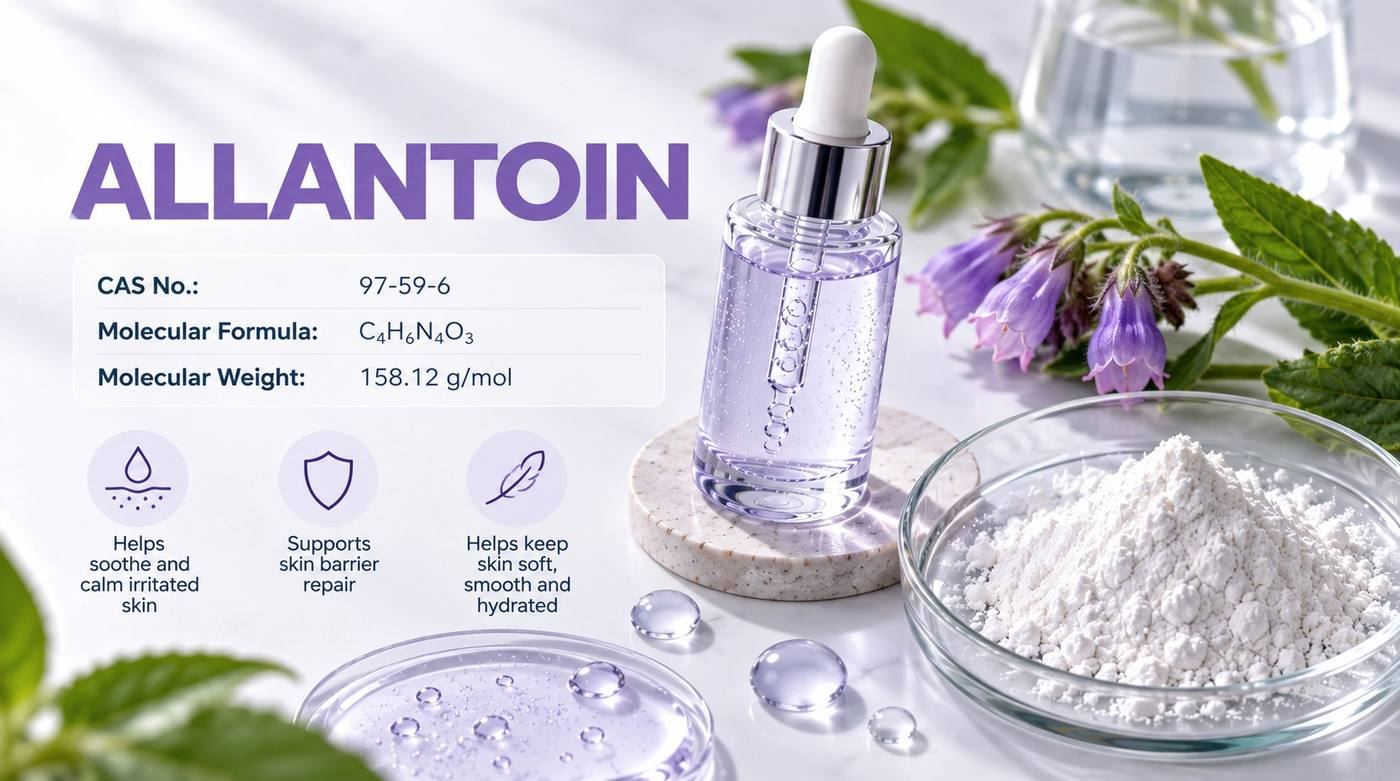
Allantoin is a long-used soothing and softening ingredient and, in the US, an approved skin protectant. Here is what the trials actually show, and how CSL formulation scientists use it in gentle products.
By CSL Formulation team · Evidence checked by CSL scientists
At a glance
- What it is
- A small nitrogen compound (a urea derivative) found in comfrey and made synthetically; used as a soothing, skin-conditioning agent
- Main benefits
- Soothing and comfort for dry or irritated skin; softer skin; helps loosen dry flakes
- Levels tested in trials
- 6% in a drug-development cream; cosmetic use up to 2%; US OTC skin protectant range 0.5% to 2%
- Time to results
- 2 weeks to 3 months in the few controlled studies
- Watch for
- Very little controlled evidence for allantoin alone; claims that tip into drug territory
01What is it?
Allantoin occurs naturally in plants such as comfrey and is made synthetically for cosmetics. It dissolves in water, has almost no odour or colour and is very well tolerated, which is why it appears in many creams for sensitive, dry and post-shave skin.
02What it does
Allantoin is thought to soften the outer skin layer and help shed dry flakes (a mild keratolytic effect) and to calm irritation. Much of this comes from long use and lab or animal work rather than controlled human trials. Visible benefits claimed are softer, more comfortable skin.
03The evidence
Studies below were checked against the publisher, DOI or journal record on 26 Sep 2026. We list design and size so you can judge the strength of each result.
| Study | Design | Who and how long | What it found |
|---|---|---|---|
| Prakoeswa et al. 2024, Dermatology Research and Practice (Wiley) Source | Randomised, double-blind controlled trial | 32 adults with mild-to-moderate atopic dermatitis, 14 days, moisturiser with allantoin, bisabolol and other soothing agents vs the same moisturiser without them | Hydration rose from 36.0 to 66.1 units vs 40.7 to 56.1 with the base, and eczema scores fell 24.5% vs 16.7%. The effect of allantoin alone cannot be separated. |
| Paller et al. 2020, Orphanet Journal of Rare Diseases (Springer Nature) Source | Phase 3, randomised, double-blind, vehicle-controlled trial (ESSENCE) | 169 patients with epidermolysis bullosa, 3 months, 6% allantoin cream (SD-101) vs vehicle cream | Wound closure did not differ (49.4% vs 53.6%); skin infections were less frequent with allantoin (18% vs 33.3%). Well tolerated. |
| Becker et al. 2010, International Journal of Toxicology (SAGE) – CIR safety assessment Source | Safety review of allantoin and its complexes | Allantoin reported in 1,376 cosmetic products at up to 2% | Safety data judged sufficient to support allantoin in the product types and at the concentrations reviewed. |
Allantoin is gentle and has a long safety record, but controlled evidence that it improves skin by itself is thin, and the largest trial missed its main endpoint. Use it as a supporting soothing ingredient and keep claims modest, such as “helps soothe and soften dry skin”, backed by testing of the finished product.
04How CSL formulation scientists use it
- Allantoin dissolves in water only to about 0.5% at room temperature, so CSL formulation scientists usually keep it at 0.1% to 0.5%, or dissolve it hot and check for recrystallisation at higher levels.
- It is stable across a mild pH range and suits gels, creams, after-sun, post-shave, baby-care and sensitive-skin products.
- It combines well with panthenol, bisabolol, glycerin and ceramides in soothing formulas and does not add colour or odour.
- If a US product is to carry skin protectant drug claims, allantoin must be 0.5% to 2% and the product must follow the OTC monograph, including labelling and manufacturing rules.
05Regulatory and claims
In the US, allantoin 0.5% to 2% is a permitted active ingredient in over-the-counter skin protectant drug products (21 CFR 347.10); a product making those protectant claims is regulated as an OTC drug, not a cosmetic. As a cosmetic ingredient, the Cosmetic Ingredient Review Expert Panel found the safety data sufficient at concentrations reviewed (up to 2%). In the EU it is used as a skin-conditioning ingredient; CSL regulatory specialists confirm the status in each target market and keep claims cosmetic, such as “soothes the feeling of dryness”.
06Questions brands ask
Is allantoin a drug or a cosmetic ingredient?
Both, depending on the claim. In the US it is an approved OTC skin protectant at 0.5% to 2%; used for skin conditioning with cosmetic claims, it is a cosmetic ingredient.
Does allantoin exfoliate?
It is described as mildly keratolytic, meaning it can help loosen dry flakes, but this is much gentler than acids and has little controlled human evidence behind it.
Is allantoin suitable for sensitive and baby skin?
It has a long safety record and is widely used in sensitive-skin and baby products. As with any ingredient, the finished formula should be safety-tested.
07References
- Prakoeswa CRS, et al. The role of moisturizer containing anti-inflammatory on skin hydration in mild-moderate atopic dermatitis patients. Dermatol Res Pract. 2024;2024:3586393. Link
- Paller AS, Browning J, Nikolic M, et al. Efficacy and tolerability of the investigational topical cream SD-101 (6% allantoin) in patients with epidermolysis bullosa: a phase 3, randomized, double-blind, vehicle-controlled trial (ESSENCE study). Orphanet J Rare Dis. 2020;15:158. Link
- Becker LC, Bergfeld WF, Belsito DV, et al. Final report of the safety assessment of allantoin and its related complexes. Int J Toxicol. 2010;29(3 suppl):84S–97S. Link
- US Food and Drug Administration. 21 CFR 347.10 – Skin protectant active ingredients. Electronic Code of Federal Regulations. Link
Used in: Sensitive skin
Update log
- Evidence reviewed and page published by CSL scientists
This page summarises published research for brands and formulators. It is general information, not medical advice, and results in studies depend on the full formula tested.