Cream vs lotion vs gel: what the formula difference means for skin
Cream vs lotion is mostly a question of oil content, emulsifier and thickener. A 550-child trial in England found no type of moisturiser worked better than another, which shifts the choice to feel, skin type and how consistently people use it.
By Dr. Premalatha, Ph.D., Life Science, Regulatory Consultant, Cosmetic Science Lab
Quick answer
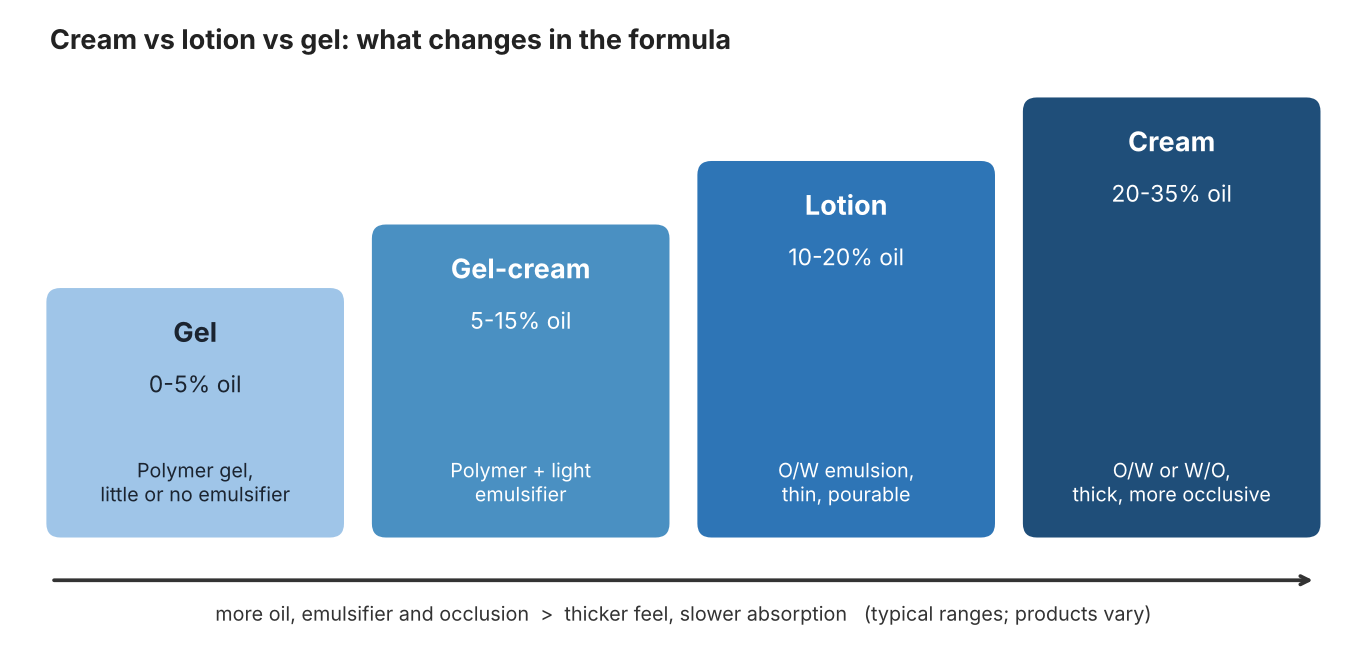
- Cream vs lotion: in our formulation practice a cream carries more oil (often 20–35%) and feels thicker; a lotion is a thinner oil-in-water emulsion (about 10–20% oil); a gel has little or no oil. In a 550-child trial in England, none was more effective than another [1].
Table 1. The study behind this article. Paper Ridd MJ et al. Effectiveness and safety of lotion, cream, gel, and ointment emollients for childhood eczema. Lancet Child & Adolescent Health, 2022 [1] Design Pragmatic, randomised, phase 4 superiority trial in 77 general practices in England; parents and clinicians unmasked [1] Sample 550 children aged 6 months to 12 years with eczema, randomised to lotion, cream, gel or ointment [1] Outcome Parent-reported eczema severity (POEM) weekly over 16 weeks [1] Funding National Institute for Health and Care Research (NIHR) [1] - Format sets feel, spread and occlusion; ingredients such as humectants drive barrier results [3].
- Oily skin usually prefers a gel or gel-cream, though direct trials are scarce.
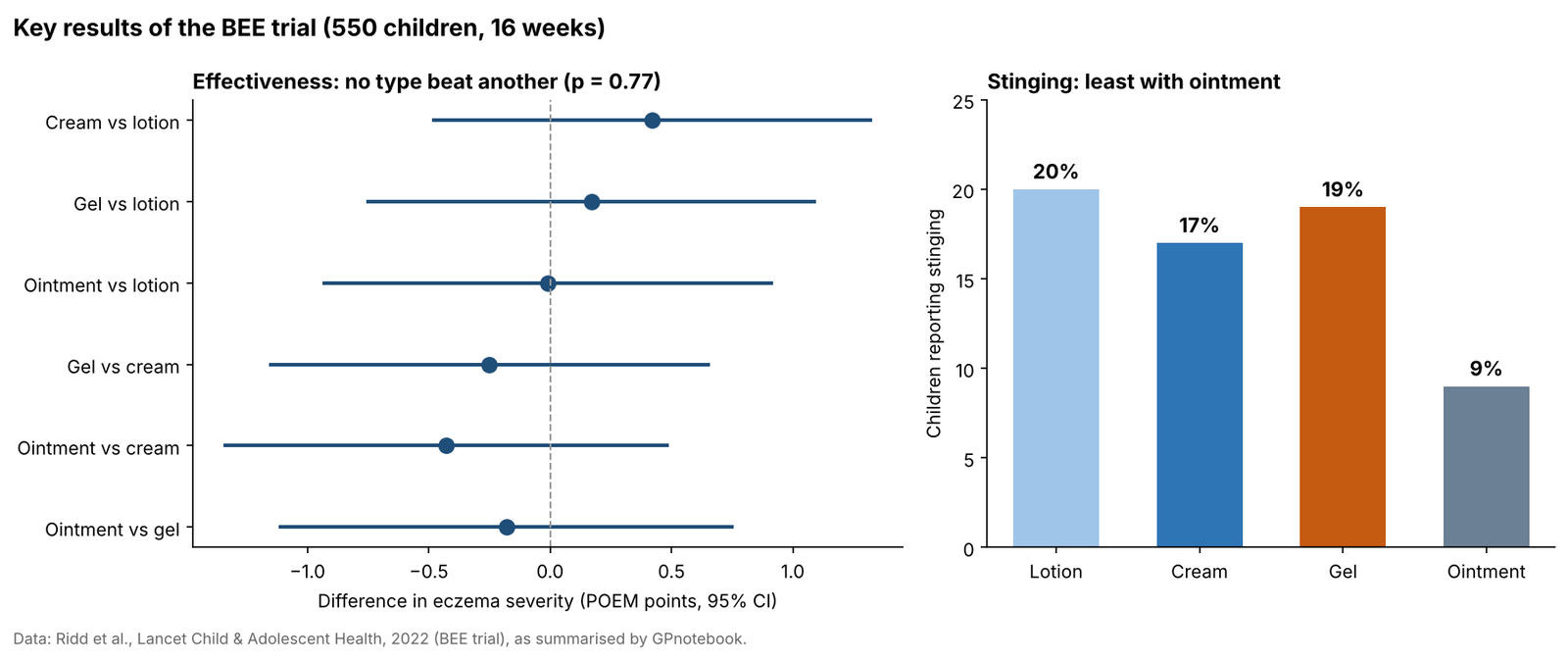
- Stinging was lowest with ointments (9%) and similar across lotion, cream and gel (17–20%) [1].
Take-home message for formulators
- Pick the format for feel and stability; put the efficacy in the ingredients.
- Test stinging and sensory on the target skin type, not just efficacy.
Take-home message for brand owners
- Do not claim one format "works better" without your own data.
- Offer the format your customer will actually use every day.
01Why this study matters now
Brands sell creams, lotions and gels as if each does something different. The BEE trial was the first large trial to compare all four emollient types head to head: 550 children used one type for 16 weeks, and the trial measured eczema severity, side effects and satisfaction [1]. It is a medical setting, but it answers the question every brief asks: does the format itself change the result?
02How cream, lotion and gel differ in the formula
The lotion vs cream difference comes down to three levers: oil content, emulsifier and thickener. The emulsion type (oil-in-water or water-in-oil) then sets the feel. For the basics, see What is an emulsion? and emulsifiers explained.
| Format | Oil phase | Emulsifier | Thickener | Feel and emulsion type |
|---|---|---|---|---|
| Gel | 0–5% | Little or none | Carbomer or other polymer | Clear or translucent, water-based; carries humectants such as hyaluronic acid |
| Gel-cream | 5–15% | Light or polymeric | Polymer network | Light, fast-absorbing, slightly opaque |
| Lotion | 10–20% | 2–5% O/W emulsifier plus fatty alcohol | Low levels of gum | Thin, pourable oil-in-water |
| Cream | 20–35% | Higher emulsifier and fatty alcohol | Fatty alcohols, waxes | Thick oil-in-water or water-in-oil; most occlusive |
Viscosity rises with the oil phase and fatty alcohols: a lotion pours, a cream holds its shape in the jar, and a gel gets its body from the polymer rather than from oil.
03Key results
- No difference in effectiveness: eczema severity did not differ between lotion, cream, gel and ointment over 16 weeks (p = 0.77). Every pairwise difference was under half a POEM point, well below the 3-point minimum clinically important difference [1].
- Similar side effects overall: adverse events ranged from 35% (ointment) to 40% (gel) [1].
- Stinging differed: 9% with ointments versus 17% (cream), 19% (gel) and 20% (lotion) [1].
Talk to our formulation team or request a product development plan.
04What the evidence supports, by skin type
Where the format matters, it is through occlusion and feel. Where results differ, ingredients usually explain it: in a 49-adult trial, a cream with urea and glycerin strengthened the barrier significantly more than a plain paraffin cream with no humectant [3].
| Skin type | Best-fit format | Evidence | Strength |
|---|---|---|---|
| Dry skin, weak moisture barrier | Richer cream (or ointment) | Petrolatum alone cuts water loss by about 98% [4], but in BEE no type was more effective [1]; humectants add measurable barrier benefit [3]. See Hydration & barrier repair | Moderate |
| Oily, acne-prone skin | Gel or gel-cream | Less oil means a lighter feel; no head-to-head trial found. See Acne & oil control | Low (preference-led) |
| Sensitive skin | Fewer ingredients; consider richer bases | Stinging was lowest with ointments in BEE [1]. See Sensitive skin & redness | Moderate (children with eczema) |
| Eczema-prone, child | Whichever is used consistently | No type more effective in 550 children [1]; shea butter cream rated very good or good by 74% of 34 children and teenagers [5] | High (BEE); low (shea study) |
| Face vs body | Face lotion or face cream by skin type; body lotion for large areas, body cream for very dry areas | Some parents liked how lotions soaked in [2]; lighter products are practical for large areas (CSL practice) | Low |
| Uneven skin tone | Any format | Results depend on actives, not the base. See Hyperpigmentation & even tone | – |
05What the evidence can't tell you
- No large trial compares a cosmetic cream and lotion with the same ingredients on healthy skin.
- Effectiveness was parent-reported; instrument measures such as hydration or water loss were not the primary outcome [1].
06Limits and funding of the studies
| Study | n | Main limits | Funding |
|---|---|---|---|
| Ridd et al. 2022 (BEE) [1] | 550 | Unmasked; parent-reported outcome; children only | NIHR (public) [2] |
| Danby et al. 2022 [3] | 49 | Single centre; four-week forearm test sites | Perrigo Nordic (manufacturer) [3] |
| Hon et al. 2015 [5] | 34 | Open-label case series; historical comparator; no fall in clinical severity | Products donated by the maker, which had no role in design or analysis [5] |
07What it means for formulators
- Choose the format for the user, not the claim. If efficacy is equal, adherence decides results; design the feel for the skin type and the area (face cream vs body lotion).
- Test stinging and sensory early, using texture claims and sensory panels.
- Match claims to the format you tested. A hydration claim proven on the cream does not transfer to a lotion with the same actives.
- Budget for stability: thinner lotions are more prone to separation; see why a lotion separates at 40 °C.
New to development? Start with New brand? Start here and How we work.
Choosing a format for your next launch?
Our Prototyping & product development team prototypes the same actives as a gel, lotion and cream, then tests feel, stability and tolerance before you commit.
08Questions readers ask
Cream vs lotion: which is better for dry skin?
A richer cream usually suits dry skin better because it carries more oil and occlusive ingredients that slow water loss [4]. In the BEE trial, though, no type was more effective for eczema, so the one used consistently wins [1].
Lotion vs cream: what is the actual difference?
Mainly oil content and viscosity. A lotion is a thinner oil-in-water emulsion, typically 10–20% oil in our formulation practice; a cream is thicker, often 20–35% oil, and may be water-in-oil.
Gel vs cream moisturizer: which is better for oily skin?
A gel or gel-cream carries little or no oil, so it feels lighter on oily skin. Direct trials are scarce; the choice rests mostly on feel and tolerance.
Is a gel-cream a gel or a cream?
Both. It is a polymer-thickened gel carrying a small oil phase, usually 5–15%, held by a light emulsifier.
09References
- Ridd MJ, Santer M, MacNeill SJ, et al. Effectiveness and safety of lotion, cream, gel, and ointment emollients for childhood eczema: a pragmatic, randomised, phase 4, superiority trial. Lancet Child Adolesc Health. 2022. Summary:. gpnotebook.com
- News-Medical. Study compares different types of moisturizers for children with eczema (University of Bristol press release). 26 May 2022. news-medical.net
- Danby SG, Andrew PV, Taylor RN, Kay LJ, Chittock J, Pinnock A, et al. Different types of emollient cream exhibit diverse physiological effects on the skin barrier in adults with atopic dermatitis. Clin Exp Dermatol. 2022;47(6):1154–64. eprints.whiterose.ac.uk
- Sethi A, Kaur T, Malhotra SK, Gambhir ML. Moisturizers: the slippery road. Indian J Dermatol. 2016;61(3):279–87. doi:10.4103/0019-5154.182427. DOI
- Hon KL, Tsang YC, Pong NH, Lee VWY, Luk NM, Chow CM, Leung TF. Patient acceptability, efficacy, and skin biophysiology of a cream and cleanser containing lipid complex with shea butter extract versus a ceramide product for eczema. Hong Kong Med J. 2015;21(5):417–25. hkmj.org
Update log
- Published by Cosmetic Science Lab
This article is general technical information, not legal, regulatory or medical advice. Confirm requirements for your product and market before launch.